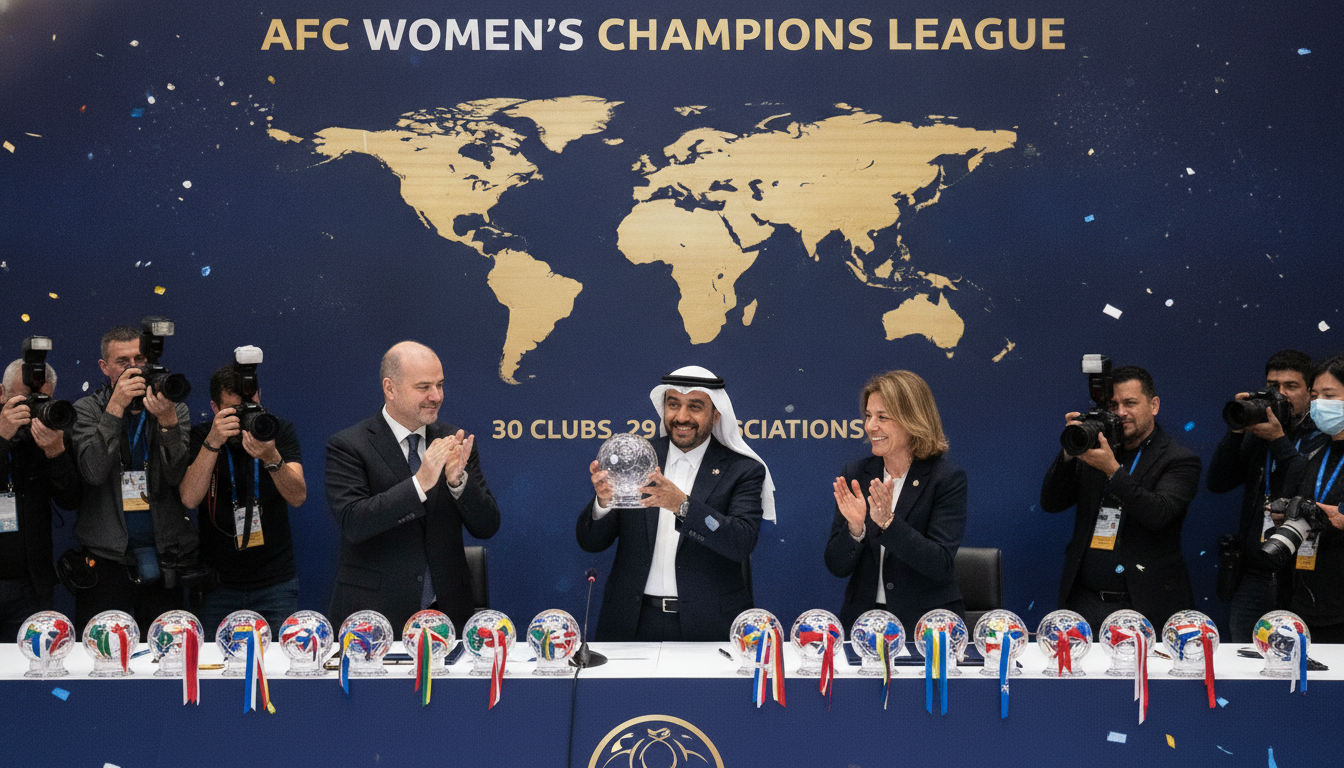
AFC Women’s Champions League expands to record 30 clubs as Preliminary Stage draw ushers in 2026/27 season
AFC Women’s Champions League expands to a record 30 clubs from 29 associations for 2026/27; the Preliminary Stage draw on June 30, 2026 signals growth.


The AFC Women’s Champions League opened its third season with a landmark Preliminary Stage draw in Bangkok on June 30, 2026, as a record 30 clubs from 29 member associations registered for the 2026/27 campaign. The increase of five clubs over the previous edition underscores the tournament’s rapid expansion and growing importance as a continental platform for female players and clubs. Organizers said the enlarged entry list reflects stronger domestic leagues, greater investment in women’s programmes and wider ambition among Asian federations.
Preliminary Stage draw sets new participation benchmark
The Preliminary Stage draw conducted in Bangkok formalized the opening phase of the 2026/27 AFC Women’s Champions League and confirmed the competition’s widest field since inception. Thirty clubs will contest the early rounds, a significant rise that broadens the competitive base across the continent. By expanding the number of participants, the AFC has signalled an intent to deepen access to elite club competition for nations that are still developing domestic women’s leagues.
The draw itself established which sides will meet in the preliminary matchups that determine progression to the competition proper. Those successful in the preliminary round will advance toward the group stage, where qualification for the knockout rounds will be decided. The draw’s outcome will shape early-season fixtures and travel plans for clubs and their federations.
Entry list highlights geographic reach across Asia
The 30-club entry sheet spans 29 different AFC member associations, drawing teams from East Asia, Southeast Asia, South Asia, Central Asia and West Asia. That geographic spread demonstrates the tournament’s role as a continent-wide competition rather than one dominated by a narrow set of countries. Associations that previously fielded single representatives are now joined by newcomers and repeat entrants, widening exposure for players and coaches.
While powerhouse leagues remain influential, the expanded field gives clubs from emerging markets the chance to test themselves against higher-ranked opponents. This balance may produce surprising results and accelerate the development curve for several national leagues. The presence of nearly three dozen associations reflects both grassroots growth and the AFC’s ongoing efforts to foster club development across the region.
What the expansion means for domestic development
The increased number of entrants into the AFC Women’s Champions League carries tangible implications for domestic competition structures. Clubs aiming to qualify must now contend with heightened domestic standards, improved youth pathways and more robust coaching and medical support to remain competitive at continental level. Federations are likely to use the expanded AWCL as leverage to secure sponsorship, broadcast deals and public funding for women’s competitions.
For players, more continental fixtures mean additional high-level match experience and visibility to scouts and national team selectors. That exposure can translate into improved competitive standards at both club and international levels. The ripple effects are expected to boost investment in facilities, academy programmes and professional contracts for female players across participating associations.
Competition format and the path to the final
The 2026/27 tournament will begin with the Preliminary Stage, where registered clubs will compete for a place in the subsequent group phase and eventually the knockout rounds. The exact configuration of groups and knockout pairings will be determined by the AFC’s competition regulations and the results of the Preliminary Stage draw. As with previous seasons, the format is intended to balance competitive integrity with logistical considerations for travel and scheduling.
Clubs advancing from preliminary ties will face a mix of established continental contenders and other qualifiers in the group stage, where performance determines the teams that progress to quarter-finals and beyond. Each stage presents escalating stakes, with home-and-away ties and neutral-venue options employed as necessary. The tournament’s structure aims to deliver a clear pathway from domestic success to continental recognition.
Regional balance and clubs to watch
Although the official entry list contains newcomers alongside familiar names, analysts expect traditional powerhouses from strong domestic competitions to remain influential in the title race. Leagues with professional or semi-professional setups typically supply teams equipped to navigate the demands of continental play. Emerging entrants from Central and South Asia will nevertheless be monitored closely for upsets and rapid improvement.
The broader field also offers a testing ground for coaching strategies, squad rotation and player development philosophies. Clubs that combine domestic dominance with strategic recruitment and youth integration are likely to prosper. Observers will track how smaller-market clubs manage resources and travel, and whether increased continental exposure narrows the performance gap over time.
Commercial and broadcast implications for the AWCL
The AFC Women’s Champions League’s expansion arrives at a time of rising commercial interest in the women’s game globally, and Asia is positioning itself to benefit from that trend. An enlarged competition offers more inventory for broadcasters, sponsors and partners, which can translate into higher visibility and revenue for participating clubs and associations. Commercial growth will be closely tied to audience engagement, match scheduling and the strength of domestic broadcast arrangements.
For sponsors, the AWCL presents a continental stage to reach diverse markets and amplify brand association with women’s sport. Federations and clubs that package the competition effectively can leverage social media, local partnerships and targeted marketing to attract new fans. The AFC’s ability to coordinate broadcast rights and streaming services will be a key determinant of the tournament’s commercial trajectory in the coming seasons.
The Preliminary Stage draw on June 30, 2026 also provides a focal point for media coverage and pre-season narratives that will build momentum toward kick-off. Momentum generated now can carry through to higher attendance figures and broader regional interest as the campaign progresses.
Competitive stakes and long-term impact on Asian football
Beyond immediate commercial gain, the expanded AFC Women’s Champions League is a strategic instrument for long-term competitive improvement across Asia. Regular continental competition raises coaching standards, compels clubs to professionalize operations and creates incentives for players to pursue football as a viable career. These structural shifts are likely to influence national team performance as players gain more intense, high-quality match experience.
Moreover, the tournament serves as a benchmark for federations to evaluate the effectiveness of domestic policies aimed at growing the women’s game. Where clubs succeed on the continental stage, national associations can use those outcomes to justify increased support and investment. Over successive seasons, the AWCL could contribute materially to narrowing gaps between traditional powerhouses and developing football nations.
The opening phases of the 2026/27 season will therefore be watched not only for results but for indicators of systemic change—academy outputs, matchday operations and commercial deals that reflect the sport’s maturation.
The AFC Women’s Champions League’s third season has begun with a record entry list that signals both ambition and a widening competitive field across Asia. The Preliminary Stage draw on June 30, 2026 marks the formal start of a campaign that will test clubs’ readiness for continental football and shape the trajectory of women’s club soccer on the continent in the years ahead.