Leverkusen Champions League hopes hinge on fitness ahead of must-win at Hamburg
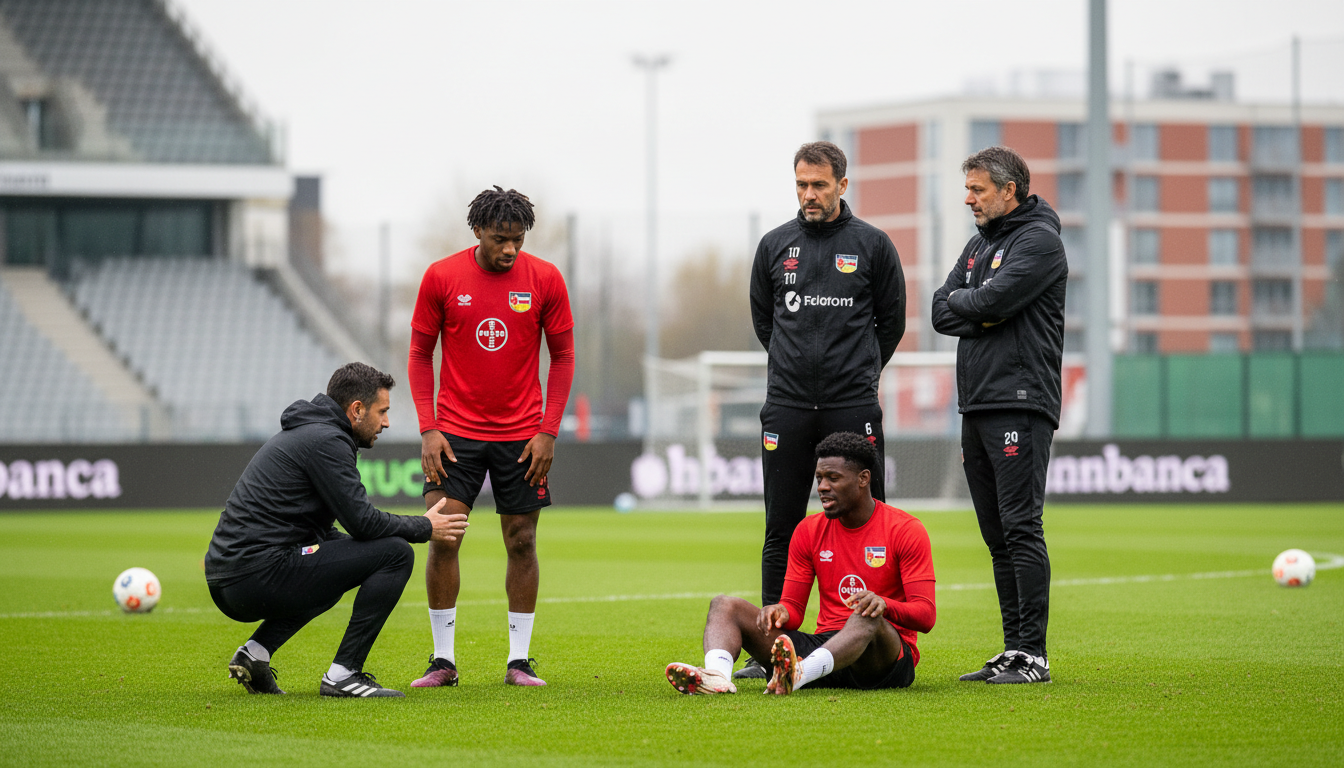
Bayer Leverkusen must beat Hamburg and hope VfB Stuttgart and Hoffenheim both lose to secure a spot in next season’s UEFA Champions League, with Leverkusen Champions League hopes now clouded by a trio of injury concerns. Kicker reports that Martin Terrier is sidelined with a thigh problem, Nathan Tella is doubtful with a muscular issue and Christian Kofane is racing to be fit after suffering a shoulder injury in the 3-1 loss to Stuttgart on Matchday 33. The timing of these setbacks leaves manager Kasper Hjulmand facing a constrained selection dilemma with high stakes for Saturday’s fixture.


Injury blow threatens Leverkusen frontline
Kicker’s account places Christian Kofane’s condition under particular scrutiny after the Cameroon forward suffered a shoulder knock in the recent 3-1 defeat to VfB Stuttgart, a match that already delivered a damaging result for Leverkusen’s table position. Martin Terrier has been confirmed out with a thigh issue, while Nathan Tella remains a last-minute doubt because of a muscular complaint, meaning the club could be without two of its principal attacking options for the run-in.
If both Kofane and Tella are unavailable, Leverkusen will lose much of the pace and directness that have been central to their attacking identity, forcing Hjulmand to consider less natural alternatives up front. Ernest Poku emerges as the only proven forward option in that scenario, but recent displays from the Dutch attacker have been described as below the level required to carry the team through a decisive period, increasing the pressure on Leverkusen’s tactical planning and on midfielders to contribute goals.
Stuttgart defeat leaves Leverkusen with little margin for error
The 3-1 reverse at Stuttgart on Matchday 33 not only dented Leverkusen’s points tally but also complicated the mathematical pathway to the Champions League, elevating the importance of a victory at Hamburg to a do-or-die status. With three teams separated by fine margins, Leverkusen cannot control other results and must combine victory with favourable outcomes elsewhere to move into the top positions required for Champions League qualification.
That slim margin is reflected in public sentiment: a Kicker poll shows only 6 percent of voters believe Leverkusen will achieve the necessary finishing position, compared with far larger vote counts for VfB Stuttgart and Hoffenheim. The numbers underline both the uphill nature of Leverkusen’s task on the pitch and the challenge the squad faces in rebuilding confidence ahead of a crucial weekend.
Tactical options and Hjulmand’s selection dilemma
Faced with potential absences in the final third, Kasper Hjulmand must weigh a range of tactical adjustments that could compensate for missing pace and finishing quality. Options include deploying a deeper-lying forward to link play, shifting to a 4-2-3-1 with attacking midfielders providing the width and penetration usually offered by direct wingers, or relying more heavily on set pieces and late attacking runs from midfield to manufacture chances.
The practical limits of the squad will inform those choices: if Hjulmand opts to persist with a nominal central striker, the responsibility to create and finish chances will fall heavily on wide players and on midfield runners, while a move to a narrower, possession-oriented shape would place increased emphasis on technical control and game management. Each approach carries trade-offs, and the coach’s final selection will signal whether Leverkusen seeks to chase the win aggressively or to adopt a more cautious plan that protects defensive solidity while probing for openings.
Champions League permutations and what Leverkusen need
The simplest scenario for Leverkusen is straightforward: win at Hamburg and rely on both VfB Stuttgart and Hoffenheim failing to secure positive results in their respective fixtures, thereby allowing Leverkusen to leapfrog or maintain a qualifying position depending on goal difference. That dependency on two separate outcomes makes Leverkusen’s fate partly contingent on other clubs’ form and on late-season variables such as fitness, momentum and match-day circumstances.
Beyond the single weekend, the club must also consider that even with a win, tiebreakers like head-to-head records and goal difference could determine final places, so a convincing performance with goals could be as important as the three points themselves. The narrowness of the margins means Leverkusen cannot simply aim for a narrow victory and hope for the best; the team must maximize scoring opportunities and limit defensive lapses to improve its statistical position should equal points arise.
Fan sentiment and the Kicker poll mirror skepticism
A Kicker poll accompanying recent coverage paints a stark picture of public expectation: just 6 percent of respondents backed Leverkusen to navigate the closing fixtures successfully, while VfB Stuttgart and Hoffenheim drew the overwhelming share of votes. Those figures are not definitive evidence of future results, but they do capture a mood of skepticism that follows Leverkusen after the Stuttgart defeat and amid the emerging injury list.
That popular doubt can have tangible effects on a squad already under pressure, as player confidence and external narrative shape the atmosphere around match preparation and in the stadium. Conversely, low external expectations can sometimes relieve pressure on a team and allow players to perform with greater freedom, a dynamic Hjulmand may attempt to harness as he prepares his group for a high-stakes encounter.
What to expect at Hamburg and broader implications for Leverkusen
Saturday’s meeting with Hamburg will likely be framed by Leverkusen’s urgency and by Hamburg’s objectives for the season, producing a match in which intensity and physical duels could decide the outcome more than aesthetic attacking play. Leverkusen will need to confirm fitness statuses in the final team news and may choose to field the freshest, most mobile XI available to offset any absences among their more established forwards.
The result carries consequences beyond a single season: Champions League qualification brings substantial financial rewards, increased appeal to prospective signings and a platform for player development; failure to reach that stage will force a reassessment of recruitment priorities and budgetary planning during the offseason. For a club that has built recent progress on sustained European involvement, missing out would represent a setback with practical and reputational implications.
Leverkusen face a narrow window to change the narrative, and how they manage injuries, selection and match-day strategy will determine whether their Champions League hopes survive to the final whistle. The coming days will bring clarity on the fitness of Kofane and Tella and will shape whether Leverkusen approach Hamburg with a full-strength, pace-driven front line or a reshuffled attack designed to grind out the necessary result.