


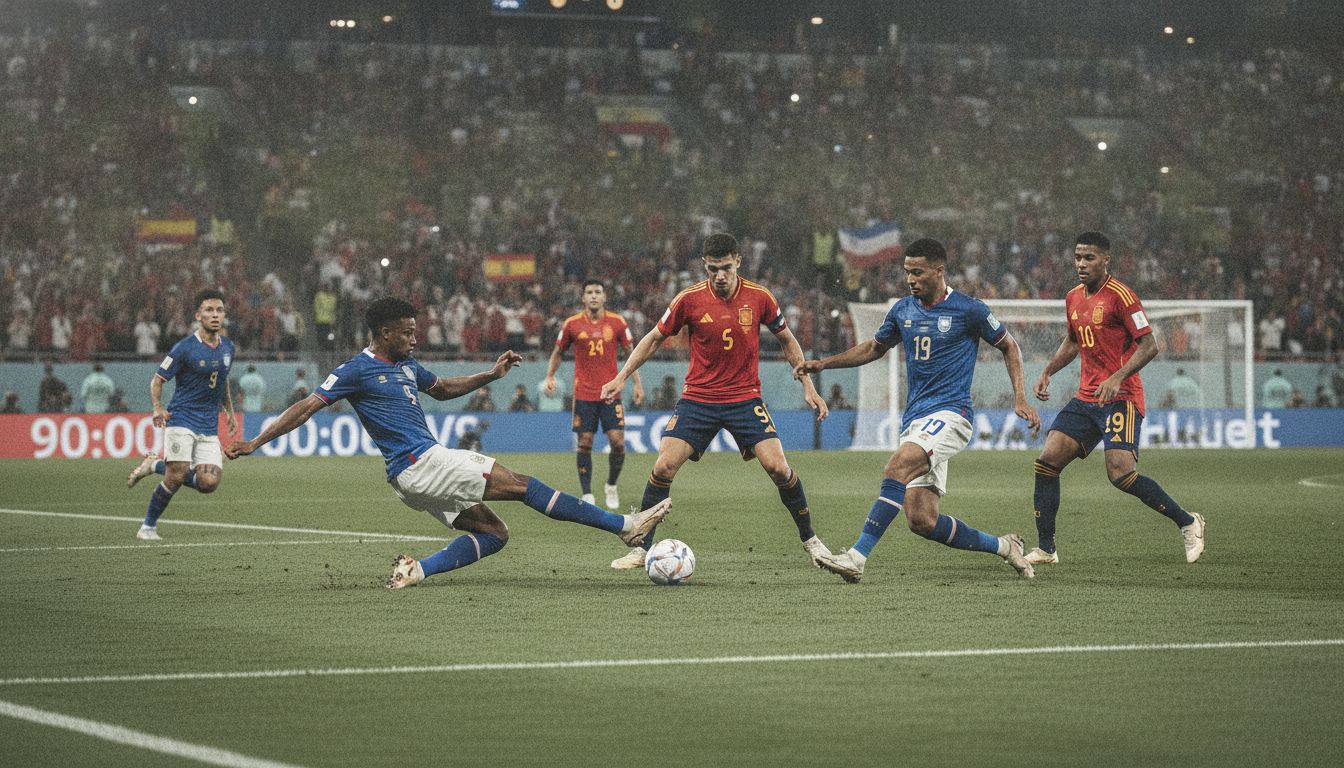
Cape Verde World Cup debut: Blue Sharks hold Spain to goalless draw in Atlanta
Cape Verde’s World Cup debut produces a 0-0 draw with Spain in Atlanta, a disciplined display that announced the island nation’s arrival on the world stage.


Cape Verde’s World Cup debut turned into a statement result as the Blue Sharks held European champions Spain to a goalless draw in Atlanta during the opening week of the 2026 tournament. The result represented more than a single point; it was an assertion of organisation and belief from a nation of just over half a million people. Veteran goalkeeper Vozinha, a compact defensive block led by Pico Lopes and the calm leadership of coach Bubista combined to frustrate a formidable Spanish side for 90 minutes.
Historic draw in Atlanta
Cape Verde arrived at the tournament with modest expectations but left the Mercedes-Benz Stadium with global attention and respect. The 0-0 scoreline does not capture the intensity of the match, in which Spain largely controlled possession but failed to break down a compact and disciplined opponent. For a team making its first World Cup appearance, frustrating the reigning European champions under the lights of a major US venue constituted a rare and memorable achievement.
The Blue Sharks defended in depth without sinking into panic, remaining balanced on the counter and showing readiness to transition when opportunities arose. Their shape limited Spain’s angles and forced low-percentage shots from distance rather than clear openings inside the box. That tactical clarity allowed Cape Verde to withstand extended pressure and finish the match with clean sheets for both the team and the goalkeeper.
This result immediately places Cape Verde in the tournament narrative as a nation that did not come merely to participate but to compete. The draw changes perceptions of the group dynamic and gives the islands a platform from which to build confidence for the remaining fixtures.
Defensive discipline and Vozinha’s influence
The single most decisive factor in Cape Verde’s performance was defensive organisation, anchored by the commanding presence of goalkeeper Vozinha. He made a series of reflex saves and smart interventions that preserved the clean sheet and kept Spain from converting sustained possession into goals. Vozinha’s leadership from the back was evident in his positioning, timely communication, and ability to marshal defenders under relentless pressure.
Central defender Pico Lopes marshalled the backline with composure, cutting out danger and winning multiple aerial challenges. The defenders operated as a unit, closing gaps, covering for each other and blocking lanes for through passes. That cohesion allowed Cape Verde to absorb waves of Spanish attacks without conceding the type of high-quality chances that normally decide matches against elite opponents.
Set-piece defending and disciplined pressing in selected moments further frustrated Spain’s rhythm. Rather than attempt to match Spain’s ball retention across the whole pitch, Cape Verde chose controlled aggression in the right areas and limited their exposure in others. The result was a textbook example of how organisation and focus can neutralise technical superiority.
Bubista’s tactical blueprint
Coach Bubista arrived in the United States intent on making Cape Verde visible to a global audience, and his game plan against Spain reflected pragmatic ambition. He deployed a compact formation that prioritized defensive balance while allowing quick transitions through midfield when possession was won. Players were given clear roles, which reduced the risk of disorganisation and allowed efficient defensive rotations.
Substitutions were used to preserve structure rather than overturn it, with fresh legs introduced to maintain intensity and concentration as Spain pushed for a winner. Bubista’s instructions emphasized discipline in defensive zones, quick recovery runs and selective counterattacks. The coaching staff’s preparation for Spain — focusing on defensive rehearsals and situational drills — was evident in how players executed during critical phases.
Bubista also deserves credit for the psychological preparation that kept players composed when the pressure rose. The team’s calmness under fire suggested a strong internal culture and belief that they could match the challenge of facing a top-tier opponent.
Cape Verde in the context of famous World Cup debuts
Cape Verde’s result belongs to a lineage of World Cup newcomers who made immediate impact, joining an exclusive list of debutants who challenged established powers. In recent memory, Iceland’s 1-1 draw with Argentina at the 2018 World Cup served as a reminder that smaller nations can engineer shock results through organisation and key moments. Iceland’s resilience and Halldórsson’s penalty save remain touchstones for debutant confidence.
Similarly, Slovakia’s 3-2 defeat of reigning champions Italy in 2010 showed that first-time participants could change the complexion of a group stage overnight. Slovakia’s victory eliminated the holders and underlined the tournament’s capacity for surprise. Senegal’s 1-0 win over France in 2002 stands among Africa’s most iconic World Cup moments, a debut performance that launched a deep run and reshaped expectations for the continent.
Even older narratives, like North Korea’s 1-0 upset of Italy in 1966, demonstrate how a single result by a newcomer can become a lasting part of World Cup lore. Cape Verde’s draw with Spain will be compared with these episodes not because it produced the same outcome, but because it validated the principle that debutants can be more than footnotes; they can be disruptors.
Immediate tournament implications
From a purely competitive perspective, the draw gives Cape Verde a crucial point and injects uncertainty into the group standings. Spain will now face the pressure of converting possession into goals against other opponents, while Cape Verde can approach subsequent fixtures with newfound belief. For tournament favourites, matches against well-organised debutants pose the risk of dropped points that accumulate and complicate qualifying scenarios.
The result also places a spotlight on Spain’s attack, which must now recalibrate to break down teams that sit deep and defend with discipline. Tactical analysts will note Spain’s difficulties in creating clear-cut chances and the necessity to vary their approach against low defensive blocks. For Cape Verde, the challenge will be to translate this defensive success into consistent results, and to manage the physical and mental demands that come with being the surprise story of the early rounds.
Beyond standings, the psychological benefit for Cape Verde is significant; the players will carry momentum, belief and external respect into the locker room. That intangible boost can be decisive in tight group campaigns where confidence and calmness determine final outcomes.
Longer-term impact and football development
The broader impact of a standout World Cup debut extends beyond the immediate tournament. Cape Verde’s performance has the potential to galvanize investment, inspire youth participation and attract attention from clubs scouting for talent. High-visibility results like this often lead to increased support from federations, sponsors and diaspora communities eager to ride a wave of national pride.
For players based in foreign leagues, the tournament acts as a showcase that can open career opportunities and raise the profile of Cape Verdean football internationally. The federation will likely face pressure to capitalise on the moment by investing in infrastructure, youth development and coaching education to sustain progress. Continued strategic planning will be necessary if the islands are to convert a memorable debut into long-term growth.
On the cultural front, the result will become a touchstone for a generation of fans, reinforcing football’s role as a unifying national narrative. The image of the Blue Sharks standing firm against a European heavyweight will be replayed and retold, creating a legacy that may influence the country’s footballing identity.
A final note on the group outlook: while one match does not determine qualification, Cape Verde’s draw changes calculations for all teams involved. Opponents must now prepare for a side that defends intelligently and is not intimidated by pedigree. The combination of tactical clarity and self-belief gives Cape Verde a realistic pathway to contest the group rather than merely observe.
Cape Verde’s first World Cup match confirmed that major tournaments still belong to the unpredictable and the courageous, and that reputation alone does not guarantee results. The Blue Sharks have arrived with a performance that will be discussed well beyond Atlanta, and their clean sheet against Spain represents both a moment of national pride and the start of a new chapter for football on the islands.