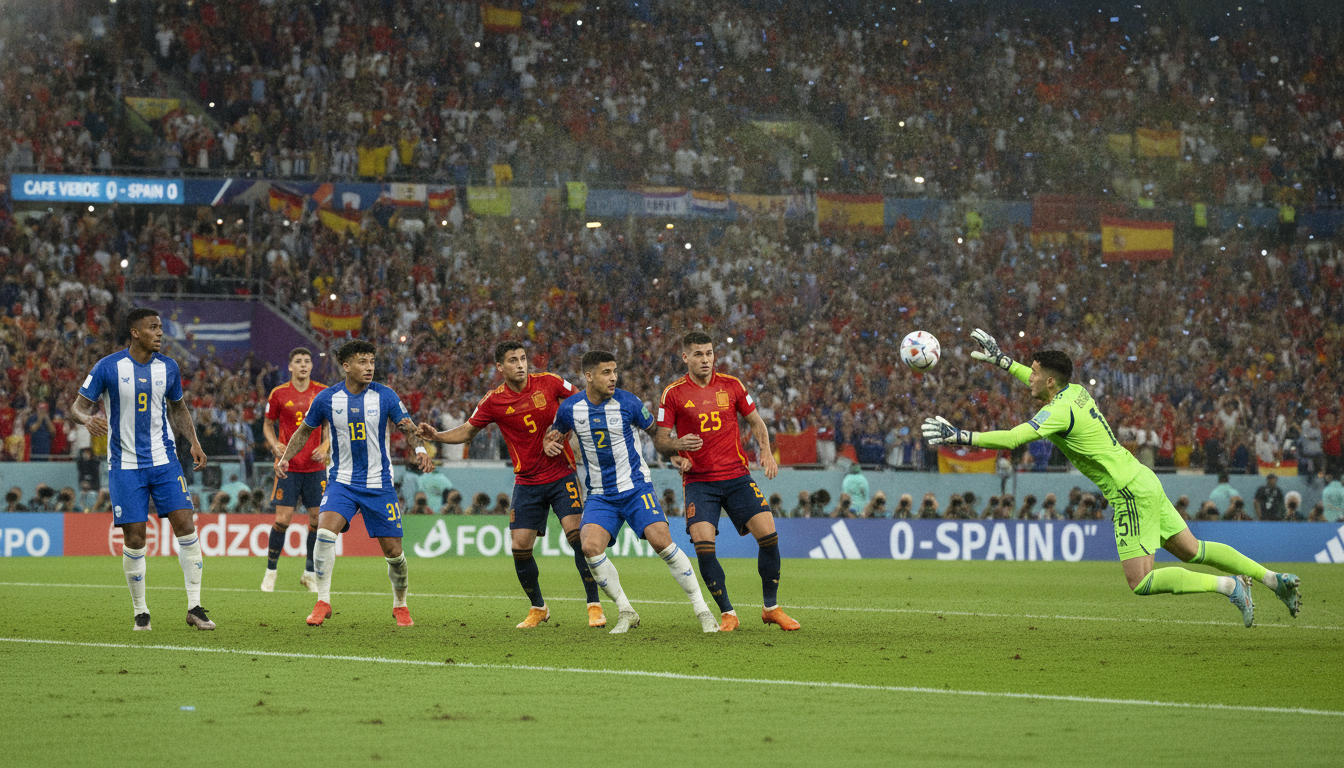
Cape Verde hold Spain to goalless draw as veteran goalkeeper Vozinha stars
Cape Verde hold Spain to a goalless draw at the FIFA World Cup, earning a historic point as underdogs in their tournament debut.


Cape Verde held Spain, the European champions, to a 0-0 draw in a result that will be remembered in the island nation’s sporting history. The Blue Sharks arrived as clear underdogs but left the pitch with a celebrated point and a demonstration of defensive organisation. The match was defined by an early milestone touch, a series of outstanding saves, and a dominant Spanish display that failed to produce a goal.
Historic milestone for Cape Verde
Just over a minute into the match, Dailon Livramento registered Cape Verde’s first ever touch at a FIFA World Cup, a symbolic moment for the debutant nation. The early sequence set the tone for a team determined to write its name into the tournament’s records. What followed was a disciplined defensive performance that preserved the clean sheet and secured a point against one of world football’s heavyweights.
The draw marks a landmark result for Cape Verde and will be referenced alongside the country’s qualification as a breakthrough for its football infrastructure. Players and officials will view the point as validation of long-term development and coaching work that produced a side capable of competing on the sport’s biggest stage. For a nation appearing at the World Cup for the first time, a measure of pride accompanied the tactical discipline shown throughout the 90 minutes.
Vozinha’s match-winning performance
At 40 years old, Cape Verde’s captain and goalkeeper delivered a performance that defined the contest, repeatedly denying Spain clear opportunities. Vozinha produced a series of crucial saves from high-quality strikes and close-range attempts, earning player of the match recognition for his contribution. His experience and composure under pressure frustrated the Spanish attack and kept his side in contention from start to finish.
Several of Spain’s best chances were thwarted by the veteran goalkeeper, whose reflexes and positioning prevented what looked at times like an inevitable breakthrough. Vozinha’s presence also had an organizing effect on his backline, helping maintain shape and communication against waves of Spanish possession. The captain’s leadership extended beyond shot-stopping; his calm distribution at key moments helped Cape Verde manage dangerous transitions.
Spain’s dominance without the final touch
Spain controlled the match in terms of possession and territory, registering 24 shots and enjoying the bulk of the ball throughout both halves. High-profile forwards and midfielders repeatedly tested Cape Verde’s defence, with Ferran Torres striking the crossbar and opportunities falling to Mikel Oyarzabal and Aymeric Laporte. Despite numerical superiority in chances and territory, Spain could not convert pressure into the decisive goal they sought.
The introduction of rising talent Lamine Yamal after the interval was an attempt to unlock a stubborn defence, but chances continued to be rebuffed. Marc Cucurella, newly transferred in the domestic window, also posed a persistent threat from the left flank yet found no way through. The statistical gulf between the teams in shot volume contrasted starkly with the final scoreline and underlined Cape Verde’s resilience.
Tactical discipline and defensive organisation
Cape Verde’s approach was built on compact defensive lines, disciplined marking, and rapid recovery when possession was lost. Coach and players committed to a structured plan that allowed Spain to keep the ball but limited high-quality opportunities inside the penalty area. The Blue Sharks’ midfield and full-backs worked in tandem to restrict central penetration and force Spain to attempt lower-probability chances from distance or wide areas.
Transitions were an area of focus for Cape Verde, who sought to relieve pressure and advance when possible without overcommitting numbers forward. When opportunities arose to counter-attack, they were cautious and measured, designed to preserve the defensive integrity of the team. That collective discipline proved decisive, and it reflected a clear game plan tailored to neutralise Spain’s technical and attacking strengths.
Key moments that shaped the match
The early touch by Livramento became a symbolic highlight, but the contest was shaped by a handful of significant interventions and near-misses. Ferran Torres’ effort that struck the crossbar was perhaps the clearest example where the match could have swung, while several saves by Vozinha prevented rebounds and follow-up attempts. Spain’s repeated probing and high shot count indicated sustained pressure, but Cape Verde’s ability to muddle or block critical attempts preserved the draw.
Substitutions also had an impact as coaches sought to change momentum; Spain’s replacements aimed to inject pace and creativity, yet the Blue Sharks’ defensive organisation absorbed those shifts. Tactical fouls and well-timed recoveries disrupted fluent Spanish build-up play on multiple occasions. Ultimately, a combination of individual brilliance from the goalkeeper and collective defensive resolve were the match’s defining elements.
Broader implications for Cape Verde and the group
The point provides Cape Verde with a foundation from which to build as the tournament continues, offering both morale and a tangible reward for the squad’s preparation. For a debutant nation, securing a draw against the reigning European champions can galvanize public support and raise expectations domestically. The result also complicates matters for Spain within the group, introducing questions about finishing and the need to convert dominance into goals in subsequent fixtures.
Beyond immediate standings, the draw has symbolic resonance for Cape Verde’s football program, potentially stimulating investment, youth participation, and international recognition. Players who performed well on this stage may draw attention from clubs and scouts, while the coaching staff can point to a successful implementation of tactics against elite opposition. The match will be analysed by both nations as they refine plans for the remaining group matches.
The Blue Sharks leave the pitch with a result that transcends statistics, combining a historic milestone with a clinical application of defensive principles. Spain depart having dominated possession and chances but will look inward for ways to improve their attacking efficiency. For Cape Verde, the goalless draw will be celebrated as one of the nation’s finest football achievements and remembered long after the tournament concludes.