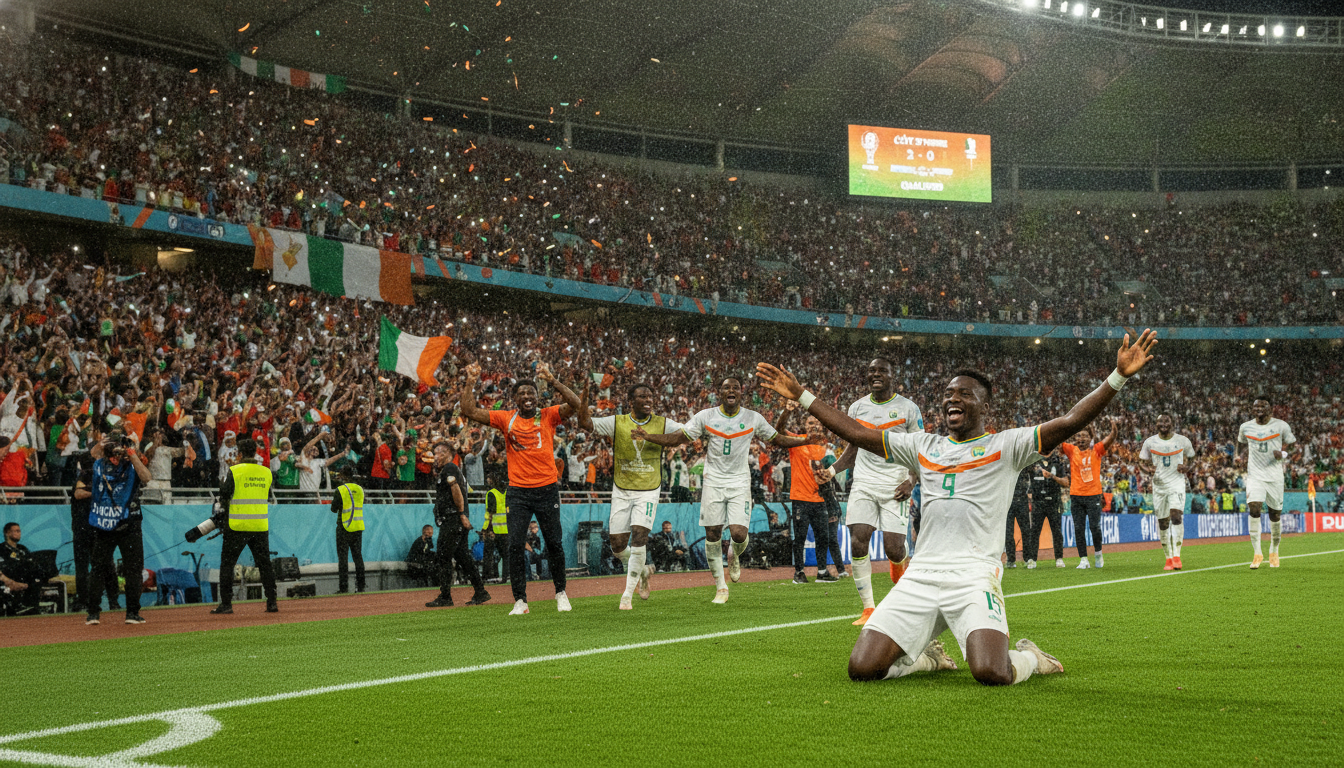
Pépé brace seals historic night as Côte d’Ivoire reach World Cup knockout stage
Nicolas Pépé’s brace earned Côte d’Ivoire a composed 2-0 win over Curaçao in Philadelphia, as the Elephants reached the World Cup knockout stage for the first time in their history. The victory completed a steady group campaign under Emerse Faé and sent Ivory Coast through to the round of 32.

Pépé’s early strike sets the tone
Côte d’Ivoire did not wait long to establish control, scoring inside the opening ten minutes and immediately shifting momentum in their favour. Yan Diomandé drove into space on the right and supplied a low cross that Pépé tapped home from close range to give the Elephants a perfect start.
That early goal was the fastest Ivory Coast have scored at a World Cup and it visibly unsettled Curaçao, allowing Faé’s team to dictate tempo without panicking. The opener let Ivory Coast play with greater composure, move the ball patiently and block Curaçao’s more ambitious moments.
Curaçao pressure tested Ivorian resolve
Despite the early setback, Curaçao produced several probing spells, showcasing the technical quality in their ranks and looking to exploit moments of transition. Tahith Chong and captain Leandro Bacuna had chances to level, with Chong firing a powerful shot over the bar and Bacuna forcing a scramble after beating two defenders.
A corner just before half-time produced the game’s most worrying moment for Ivory Coast as Sherel Floranus Gaari’s effort was only kept out by a goal-line clearance from Ange-Yoan Bonny. That intervention underlined how Curaçao could threaten from set-pieces and how fine margins might have altered the match.
Faé’s side absorbed sustained pressure with disciplined defending and collective work-rate, preventing Curaçao from turning possession into clear-cut opportunities. The balance of the first half left Ivory Coast with a slender but significant lead, bought at a cost of concentration and energy.
Second-half quality sealed the win
The heat and a succession of fouls slowed the second half, but Côte d’Ivoire retained the upper hand and eventually provided the finishing touch the occasion demanded. Ibrahim Sangaré threaded a precise pass to Pépé in the 64th minute; the forward cut inside onto his left foot and curled a high-quality finish into the far corner to make it 2-0.
Pépé’s second goal removed tension from the match and was notable both for its technical excellence and the timing, coming when Curaçao were still searching for a route back. The strike reflected Ivory Coast’s attacking pedigree and the ability of Faé’s forwards to punish defensive lapses at the highest level.
From that point, Ivory Coast managed the game intelligently, slowing play when necessary and selecting moments to press forward. The second goal effectively turned the contest into a control exercise for the Elephants rather than a frantic chase.
Fofana and defensive discipline protected the result
Goalkeeper Yahia Fofana played a decisive part in preserving the clean sheet, making a key save to deny Chong in the 74th minute and otherwise commanding his area with assurance. The backline remained alert to second balls and set-piece threats, with several important clearances late in the contest.
Ivory Coast’s defensive performance was a collective effort, with midfielders and forwards contributing to pressing and defensive coverage. Ange-Yoan Bonny’s goal-line clearance before half-time typified the team’s willingness to defend as a unit and protect the narrow lead when it mattered most.
The team’s tactical discipline under Faé — maintaining shape, avoiding unnecessary risks and closing down spaces — ensured Curaçao could not find the momentum to mount a meaningful comeback. That resilience was as crucial to the result as the two goals themselves.
Historic milestone for Ivorian football
The victory in Philadelphia represents a watershed for Côte d’Ivoire, breaking a long-standing barrier that had at times defined the nation’s World Cup campaigns. Previous Ivory Coast squads, including sides led by Didier Drogba and Yaya Touré, exited at the group stage in 2006, 2010 and 2014, making this progression a landmark achievement.
This generation has combined experienced leadership with emerging talent and tactical growth, producing results on an expanded World Cup stage. Across the group phase Ivory Coast opened with a win over Ecuador, contested a narrow defeat to Germany and then handled the pressure of a must-win fixture to secure advancement.
For supporters and administrators alike, the result confirms progress in domestic and international structures and offers tangible evidence that the national programme can compete deep into the tournament. The qualification is likely to be celebrated across the country and to shape expectations for the remainder of the competition.
Practical lessons and tactical takeaways
Côte d’Ivoire’s performance gave clear signals about the team’s strengths and areas for refinement as the tournament progresses. The side’s ability to score early and then control possession suggests a strategy that blends forward aggression with measured buildup play.
Set-piece defending and transitional moments will remain key focal points in preparing for the next opponent, with coaches able to address minor vulnerabilities exposed by Curaçao’s counter-attacks. Managing fitness and rotation will also be important given the condensed World Cup schedule and the physical demands on core players.
The balance between defensive solidity and attacking invention — exemplified by Sangaré’s pass and Pépé’s finishing — will be central to Ivory Coast’s hopes deeper in the tournament. Maintaining the discipline shown against Curaçao while finding ways to create more high-quality chances will be the coaching staff’s immediate task.
Looking ahead: round of 32 and logistical notes
By finishing as Group E runners-up, Côte d’Ivoire will meet the runners-up from Group I in the round of 32, a match scheduled to take place in Dallas on June 30. That fixture will present a new tactical challenge and require careful preparation, including recovery and travel plans after the Philadelphia game.
Faé will face decisions on whether to maintain a settled XI or make changes to safeguard player fitness, while opposition analysis will shape briefings on the forthcoming opponent’s strengths and weaknesses. Recovery sessions, set-piece work and video review will likely dominate the limited preparation window.
The logistical demands of a World Cup knockout tie — flight coordination, acclimatisation and medical checks — will test the squad’s support structure as much as the players themselves. How Ivory Coast handle those practicalities could influence their performance in Dallas and their prospects beyond the round of 32.
Côte d’Ivoire’s advancement to the knockout phase is both a sporting achievement and a moment with broader significance for African football at the expanded World Cup. The Elephants arrive in the knockout rounds with momentum, tactical clarity and a belief that they can now compete on the tournament’s next stage.
This result will be measured not only by progression but by how Faé’s team build on the foundations displayed in Philadelphia, sustain defensive discipline and seek greater attacking variety when the stakes rise again. The coming days will test their recovery, planning and ability to translate a historic night into further success.