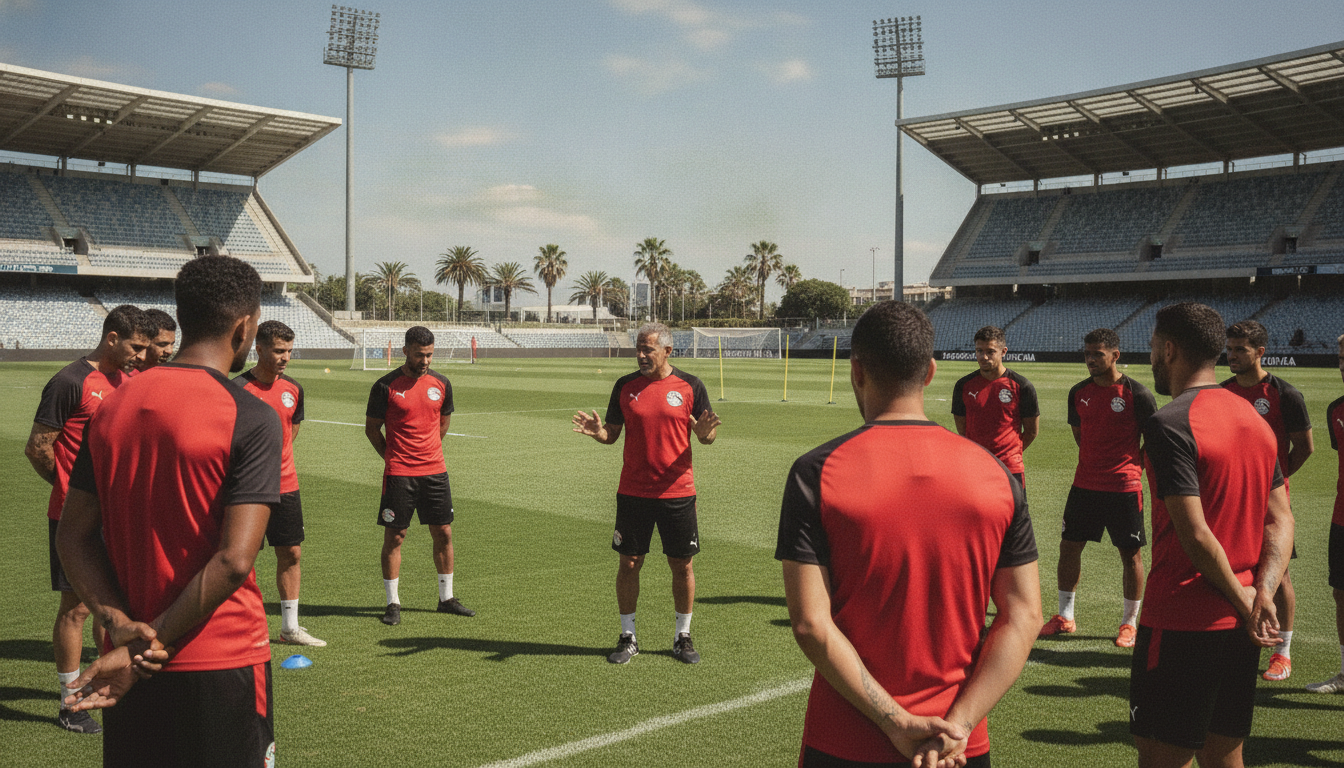
Egypt vs Australia: Hassan says African experience has primed Pharaohs for World Cup Round of 32
Egypt head coach Hossam Hassan insists Egypt vs Australia will be decided by organisation and discipline, saying African experience has prepared his team for the World Cup knockout test.


Hassan leans on African experience ahead of Egypt vs Australia
Hossam Hassan told reporters that facing physically robust opposition across Africa has readied his players for the Round of 32 meeting with Australia.
He rejected the notion that the Socceroos’ style demands a wholesale tactical change, arguing that the Pharaohs are accustomed to confronting athletic teams and set-piece battles.
Hassan emphasised that the squad’s preparation under his tenure focused on balance rather than individual matchups.
The coach said his side’s two draws and a win in Group G proved the work on organisation and defensive solidity has been effective heading into the knockout phase.
Group form and performance metrics that shaped qualification
Egypt progressed from Group G after a draw with Belgium, a win over New Zealand and a draw with Iran, finishing unbeaten in the group stage.
Across those three matches the Pharaohs scored five goals while conceding two, a defensive record Hassan described as central to advancing.
The mix of results reflected both resilience and a practical attacking output, with the team demonstrating a cohesive structure at both ends.
More than half of Egypt’s 26-man squad comes from the domestic Egyptian Premier League, which Hassan cited as a factor in the squad’s readiness for international competition.
Tactical approach: organisation, balance and aerial control
Hassan framed the match as a contest of organisation and balance rather than physical size, pointing to careful preparation for aerial duels and set-pieces.
He stressed that the coaching staff trained the side specifically to limit second balls, protect transitional phases and neutralise opponents’ dead-ball threats.
The manager’s remarks suggest Egypt will deploy a compact defensive shape designed to limit space between lines and force Australia into low-probability opportunities.
Offensively, Hassan indicated the team has worked on structured patterns to exploit gaps on the counter and from organised build-up play.
Collective ethic and squad identity under Hassan
Since taking charge two years ago, Hassan said the national team has developed a clear identity rooted in collective responsibility.
He dismissed the idea of depending on a single star, insisting the Pharaohs’ game plan is built on group discipline and shared defensive duties.
That collective ethic has been visible in the rotations and set roles across the squad, with local-club players integrating seamlessly alongside those based overseas.
Hassan credited the supporters across Egypt, Africa and the Arab world for recognizing the team’s organised approach during the group stage.
Mohamed Salah’s fitness and selection status
Hassan confirmed that Mohamed Salah returned to training after managing a hamstring problem and is available for selection against Australia.
The coach was careful not to inflate the forward’s role, however, reiterating that selection will be based on match-readiness and the team’s tactical requirements.
Salah’s presence offers a proven goal threat and a focal point for Egypt’s transitions, yet Hassan’s remarks indicate a measured approach to minutes and load management.
Medical staff and coaches have reportedly worked together to assess Salah’s conditioning ahead of a fixture the coach described as “like a final.”
Australia’s profile and the knockout challenge
Australia arrive in the Round of 32 with a reputation for physical intensity, aerial prowess and direct transitional play.
Hassan acknowledged the Socceroos as a dangerous opponent but framed the challenge in terms of neutralising strengths rather than being overwhelmed by them.
The coach’s preparations appear tailored to limit crosses into the box, to control second balls and to force Australia into longer build-ups where Egypt’s organisation can be tested.
Set-piece discipline and concentrated marking in wide areas are likely to be focal points when the teams contest both possession and territory.
Wider significance for Egypt and African football
A victory would extend Egypt’s World Cup run and serve as a statement for African football’s competitiveness in knockout rounds.
Hassan spoke in continental terms, saying the team wanted to “represent African football in the best possible way” and to make supporters proud.
Progress would also vindicate the domestic-based core of the squad, underlining the capacity of local leagues to supply players capable of performing on football’s biggest stage.
For Egypt, reaching the later stages would mark a significant achievement after years spent rebuilding the national setup.
The tactical game-plan, squad balance and Salah’s availability set the stage for a tightly contested match in which organisation and set-piece management could prove decisive.
Hassan’s focus remains narrow and pragmatic: treat the Round of 32 as a final, manage the squad intelligently, and rely on the collective identity his team has forged over two years.