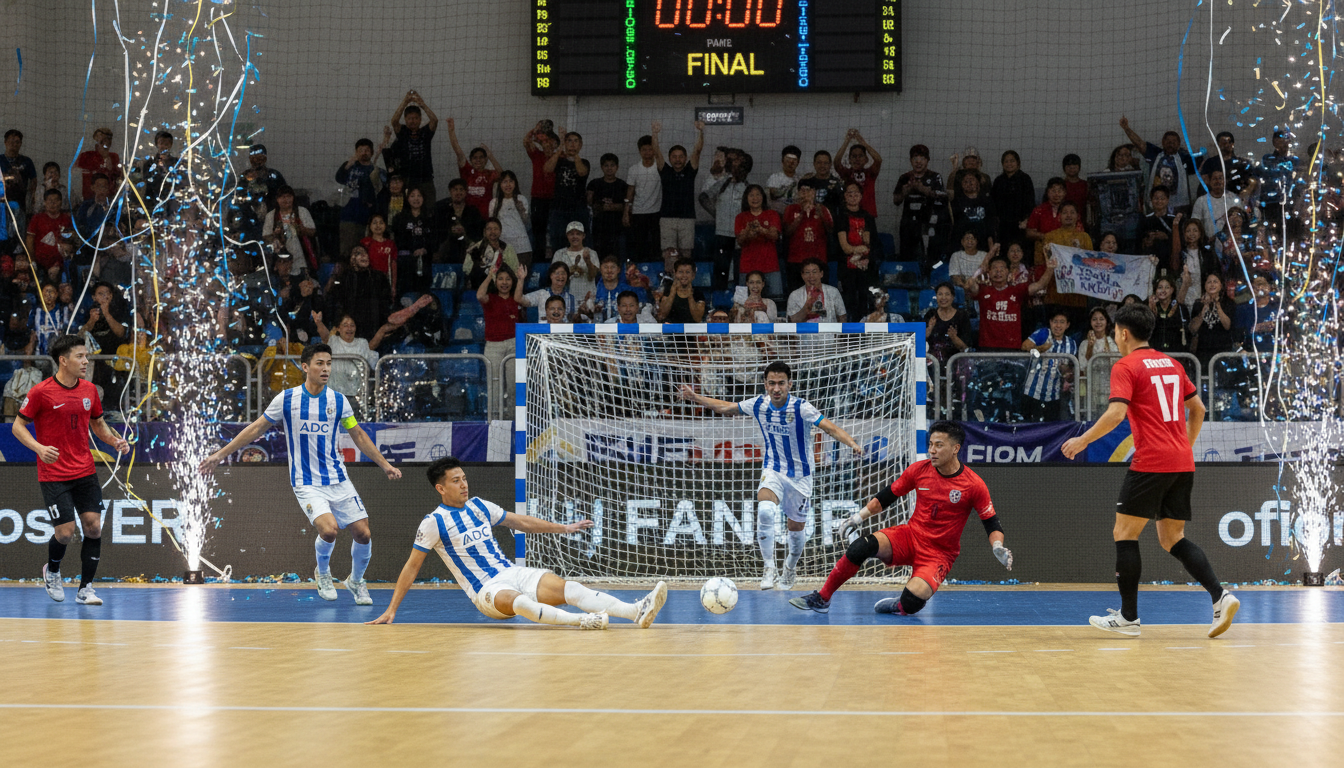
ADC clinches inaugural PFF Futsaliga title as ADC beats Enderun 5-4 in final thriller
ADC beat Enderun Colleges 5-4 to win the inaugural PFF Futsaliga title in a dramatic final at Philsports Arena, capping a competitive three-month season.


The inaugural PFF Futsaliga concluded in Manila with ADC overcoming Enderun Colleges 5-4 on the final possession to secure the Men’s Division crown. The PFF Futsaliga delivered a compact, high-intensity three-month competition that featured 32 teams across four divisions and produced 144 matches. The championship match on May 17 at the Philsports Arena — the House of Futsal — drew roughly 1,000 spectators and ended a season defined by parity and tight margins. The tournament, launched by the Philippine Football Federation with backing from the Philippine Sports Commission, now sets a benchmark for organized futsal competitions in the country.
ADC edges Enderun 5-4 in final
ADC claimed the title in a pulsating final that saw momentum swing repeatedly across the 40 minutes of play. The match’s deciding sequence came in the closing moments when ADC converted on the final possession to break a 4-4 stalemate and send the crowd to its feet. Enderun Colleges mounted a relentless challenge and matched ADC goal for goal, forcing drama until the last play. The result handed ADC the trophy and a landmark victory for a program linked publicly with former national team midfielder Stephan Schröck.
The final was staged at Philsports Arena, a venue now dubbed the House of Futsal after hosting key fixtures during the season. Organizers reported a near-capacity, enthusiastic crowd that amplified the game’s intensity and atmosphere. The close scoreline reflected a tournament where small margins decided many outcomes and tactical discipline was rewarded. Officials and club representatives on site emphasized the quality of play and the significance of a competitive domestic futsal showcase.
Final’s decisive moments
A late run of exchanges and a decisive ball in the final possession delivered the championship-winning moment for ADC. Players on both sides displayed quick transitions and situational awareness that are hallmarks of top-level futsal, with sharp passing and precise finishing under pressure. The contest featured several lead changes and dramatic saves that kept the outcome uncertain until the final whistle. Coaches from both teams commended their players for mental toughness in an encounter defined by intensity.
Enderun’s approach combined high pressing and rapid counterattacks that repeatedly threatened ADC’s defensive shape. ADC responded with controlled possession and targeted rotations, creating pockets of space and opportunistic shooting chances. The closing sequence underlined the tactical chess match between the benches, where substitutions and role adjustments influenced the tempo. Match officials managed a fast-paced affair with few stoppages, allowing the natural ebb and flow of futsal to dictate the drama.
Season by the numbers
The inaugural PFF Futsaliga ran for three months and featured 32 teams competing in four separate divisions, signaling a broad base of participation in the sport. Across the season organizers scheduled 144 matches, and 75 of those contests were decided by margins of three goals or fewer, illustrating competitive balance. Those figures point to a league where outcomes were rarely foregone conclusions and where multiple teams remained in contention late into the calendar. The breadth of participation also demonstrated growth in club-level futsal organization and capacity.
Statistical trends from the season highlighted strong attacking returns and tight defensive battles in equal measure, with several matches producing late winners and narrow margins. Attendance and engagement at marquee fixtures suggested a healthy appetite among local fans for futsal spectacles played under professional conditions. League administrators emphasized that these early metrics will inform next season’s scheduling and divisional alignments. Analysts expect those numbers to be a foundation for commercial discussions and future investment.
Path to the title
ADC’s campaign combined consistent results with key victories in high-pressure moments, allowing them to reach the final with momentum. The squad’s leadership and strategic approach were frequently cited by opponents as factors that made ADC difficult to break down. Players credited disciplined defending and opportunistic finishing for the team’s ability to prevail in tight matches throughout the season. The club’s performance in knockout phases illustrated an ability to execute game plans under duress.
Enderun Colleges’ run to the final was built on resilience and tactical adaptability, with the side upsetting several higher-seeded opponents on route to the title match. Their playing style emphasized direct transitions and set-piece organization, prompting praise for their coaching staff’s preparation. Despite falling short in the final possession, Enderun’s overall campaign marked them as a burgeoning program in domestic futsal. Both finalists demonstrated how club-level development can produce compelling competition when supported by structured leagues.
Boost from hosting FIFA Futsal Women’s World Cup
The emergence of the PFF Futsaliga was accelerated in part by the Philippines’ hosting of the FIFA Futsal Women’s World Cup in November–December 2025, an event that raised the sport’s profile nationwide. Officials from the Philippine Football Federation and the Philippine Sports Commission identified the World Cup as a catalyst for renewed investment in facilities, coaching education, and grassroots outreach. The domino effect from hosting an international event helped build momentum for a domestic league capable of sustaining year-round competition. Local stakeholders pointed to improved public awareness and media coverage as immediate benefits.
Infrastructure upgrades and scheduling of events at venues such as the Philsports Arena showcased the practical legacy of international hosting. Training programs and clinics delivered by visiting experts during the World Cup period left a measurable imprint on local coaching standards and youth engagement. The alignment between national policy, sporting authorities, and community clubs also allowed the PFF to fast-track administrative processes for the league launch. Organizers stressed that maintaining this momentum will require coordinated planning, funding, and community partnership.
Road ahead for PFF Futsaliga
With a successful first season concluded, the PFF and its partners now face the task of institutionalizing the league and planning sustainable growth. Priority areas identified by stakeholders include expanding youth and women’s participation, improving officiating, and securing commercial partnerships that can underwrite travel and operational costs. There is also an expressed interest in deepening club development pathways to ensure consistent talent pipelines from grassroots to the elite level. Long-term viability will depend on balancing competitive integrity with financial and logistical realities.
The league’s organizers are expected to review competition formats, calendar spacing, and divisional structures with an eye toward competitive balance and audience development. Enhancements to broadcast and streaming packages are likely to be considered to broaden reach and attract sponsors. Investment in coach education and referee development was also flagged as crucial to lift overall standards and reduce variability across matches. Partnerships with schools, universities, and community groups were cited as practical avenues to expand the sport’s footprint.
The inaugural PFF Futsaliga delivered an intense, emotionally charged season that concluded with ADC capturing a dramatic 5-4 final victory over Enderun Colleges on May 17 at Philsports Arena. The competition’s numbers and on-court quality suggest a promising foundation for futsal’s domestic future, and organizers are now positioned to translate this momentum into long-term growth and deeper community engagement.