Egypt vs Argentina: Enzo Fernández’s stoppage-time header stuns Egypt as Argentina rally to win 3-2 in Round of 16
Egypt vs Argentina clash in Atlanta ended 3-2 after Enzo Fernández’s dramatic injury-time header completed a late comeback for defending champions Argentina.


Late drama in Atlanta summed up World Cup upset bid
Egypt produced a stirring performance in the Round of 16, taking a 2-0 lead and holding that advantage for more than 75 minutes before Argentina scored three times in the final 13 minutes to win 3-2. The match, played in Atlanta, saw the Pharaohs open the scoring through Yasser Ibrahim and later double their lead via Mostafa Ziko, while goalkeeper Mostafa Shobeir kept Egypt in front with a pivotal penalty save from Lionel Messi. Enzo Fernández’s injury-time header from a Lautaro Martínez cross ultimately decided the game and sent Argentina into the quarter-finals.
Early set-piece brilliance gives Egypt the lead
A rehearsed corner routine produced the game’s opening goal in the 15th minute, when Marwan Ateya’s delivery found Yasser Ibrahim, who rose highest to head the ball into the net. The early score stunned Argentina and energized a confident Egyptian side that had gathered momentum throughout the group stage. That opener changed the tone of the match and forced the reigning champions to chase the game far earlier than expected.
The timing of the goal allowed Egypt to adopt a compact, counter-attacking approach, inviting Argentina to press while keeping midfield spaces congested. Coach and players adjusted quickly, ensuring the team did not overcommit and preserved the lead. The planned corner sequence illustrated Egypt’s preparation and willingness to exploit set-piece opportunities against technically superior opposition.
Shobeir’s penalty save shifts momentum
Six minutes after conceding, Argentina were awarded a penalty that presented an immediate danger, but Egypt’s goalkeeper Mostafa Shobeir produced a decisive low save to keep out Lionel Messi. That stop not only preserved the lead but also reinforced Shobeir’s status as a match-defining figure on the night. It was a psychological blow for Argentina, who expected to equalize early after the spot-kick.
Shobeir’s performance continued to frustrate Argentina through the remainder of the first half, with timely interventions and confident aerial handling. His saves allowed Egypt to maintain belief and execute their game plan, and the goalkeeper’s composure under pressure was a key factor in the match remaining tight at the interval. For Egypt, the penalty denial was a reminder that single moments can determine the course of knockout football.
Second-half counterattack extends Egypt’s advantage
Egypt emerged from the break seeking to extend their advantage and briefly thought they had doubled the lead before a VAR review overturned Mostafa Ziko’s effort for a foul in the build-up. The overturned goal was a setback, but it also reflected the Pharaohs’ continued attacking intent against one of the tournament favorites. Moments later, Egypt launched another precise counter.
In the 57th minute, Mohamed Salah initiated a swift transition that culminated in Haissem Hassan’s intelligent cut-back to Ziko, who scored clinically to make it 2-0. The move showcased Egypt’s ability to combine pace and precision on the break, while also exposing the vulnerabilities of Argentina’s defensive transitions. At that stage of the match, Egypt appeared on the verge of one of the most significant results in the country’s World Cup history.
Argentina’s response and the beginning of the comeback
With just over ten minutes remaining, Argentina found a route back into the game as Cristian Romero headed in from a Messi cross to reduce the deficit in the 79th minute. That goal injected fresh belief into the holders and forced a tactical shift as they searched for parity. Lionel Messi, who had earlier been denied from the spot, remained central to Argentina’s revival and influence on the final third.
Four minutes after Romero’s strike, Messi himself restored parity with a composed finish that levelled the score at 2-2 and completely altered the momentum of the contest. Argentina’s late pressure and the return of their talismanic leader to the scoresheet meant the balance had shifted, and a distinct psychological edge passed to the defending champions. Egypt, however, continued to defend with intensity and refused to retreat entirely.
Stoppage-time winner and emotional aftermath
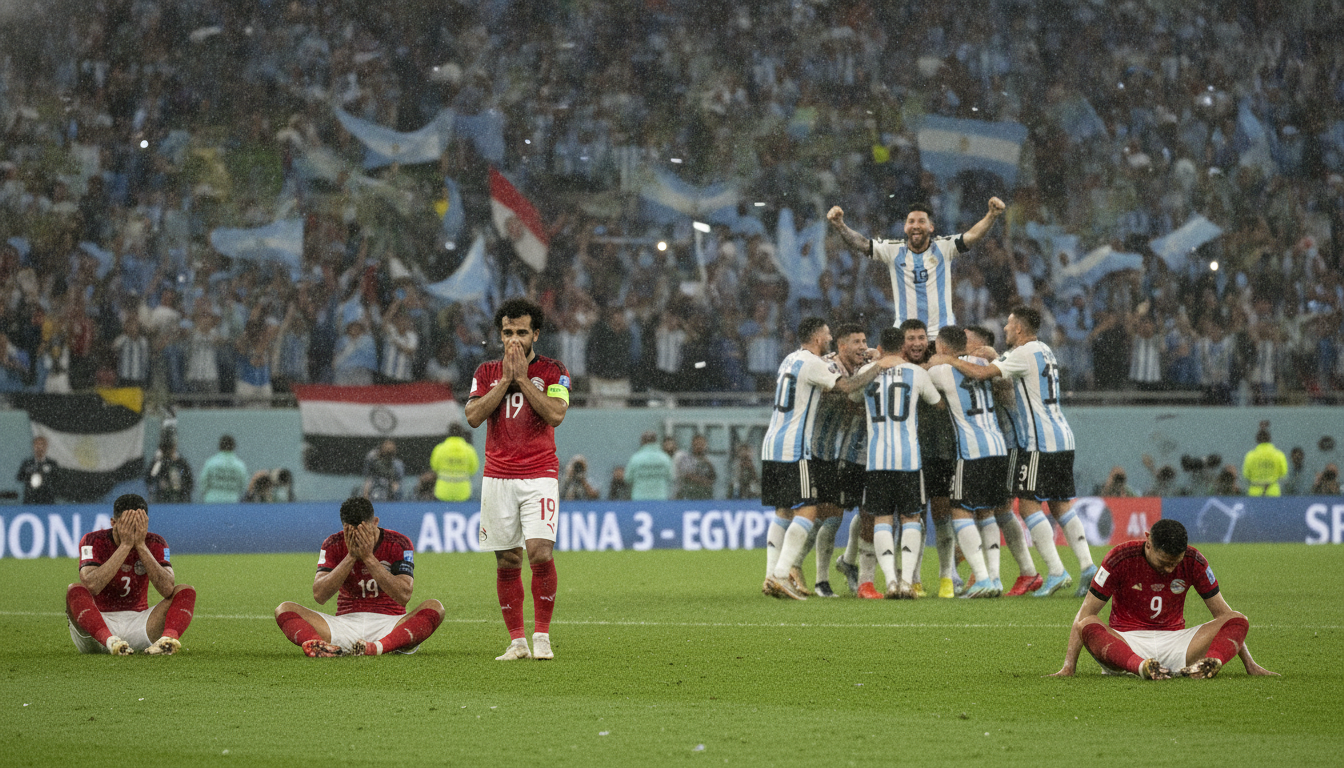
In stoppage time, Lautaro Martínez delivered a precise cross into the area where Enzo Fernández timed his run perfectly to head beyond Shobeir and clinch a dramatic 3-2 victory for Argentina. The goal was the culmination of relentless late pressure from the holders and a testament to their resilience in high-stakes moments. For Egypt, the concession in injury time was a crushing end to a heroic performance that had seemed to put qualification within reach.
The emotional contrast was stark: Argentina celebrated a comeback that preserved their title defence, while Egypt faced the immediate pain of elimination after an agonizingly close contest. Players on both sides displayed exhaustion and raw emotion at full time, with the hosts and neutrals alike acknowledging the quality of the match and the dramatic finish. The result extends Argentina’s progress in the tournament and ends Egypt’s memorable run.
Tactical lessons and individual performances examined
Tactically, Egypt’s compact defensive shape and rapid transitions caused Argentina problems for much of the match, particularly in exploiting the spaces left by a high Argentine line. The set-piece goal and the counter that produced Ziko’s strike highlighted Egypt’s planning and capacity to execute under pressure. Argentina’s initial inability to break down a well-organized opponent exposed vulnerabilities that the champions only overcame with sustained late pressure and individual brilliance.
Individual contributions were decisive on both sides: Shobeir’s penalty save and overall goalkeeping denied Argentina earlier opportunities, while Salah and Haissem Hassan played pivotal roles in Egypt’s attacking sequences. For Argentina, Messi’s influence—despite his missed penalty—proved decisive as he provided the cross for Romero’s goal and then delivered the finish that drew his side level. Enzo Fernández’s late header will be remembered as the decisive intervention that turned the tie.
Implications for tournament trajectories and next stages
Argentina’s comeback secures their place in the quarter-finals and continues their campaign as the team to beat, reinforcing both their depth and mental fortitude in knockout scenarios. The manner of their victory will be studied by opponents, who must prepare for a side that can produce late, high-quality finishes under pressure. For Egypt, the performance will be a source of national pride and a marker of progress on the world stage.
Egypt depart the competition having demonstrated tactical maturity and resilience, qualities that will be central to their development going forward. Their performance against the defending champions may influence future seeding, player valuations and coaching assessments. Meanwhile, Argentina move on with the benefit of experience and the knowledge that, despite difficulties, they can still deliver in decisive moments.
Egypt’s World Cup exit in Atlanta, forced by Enzo Fernández’s stoppage-time header, will be remembered for the Pharaohs’ bravery and Argentina’s late resurgence.
The game offered a reminder of football’s unpredictability and the fine margins that separate triumph from heartbreak in major tournaments.