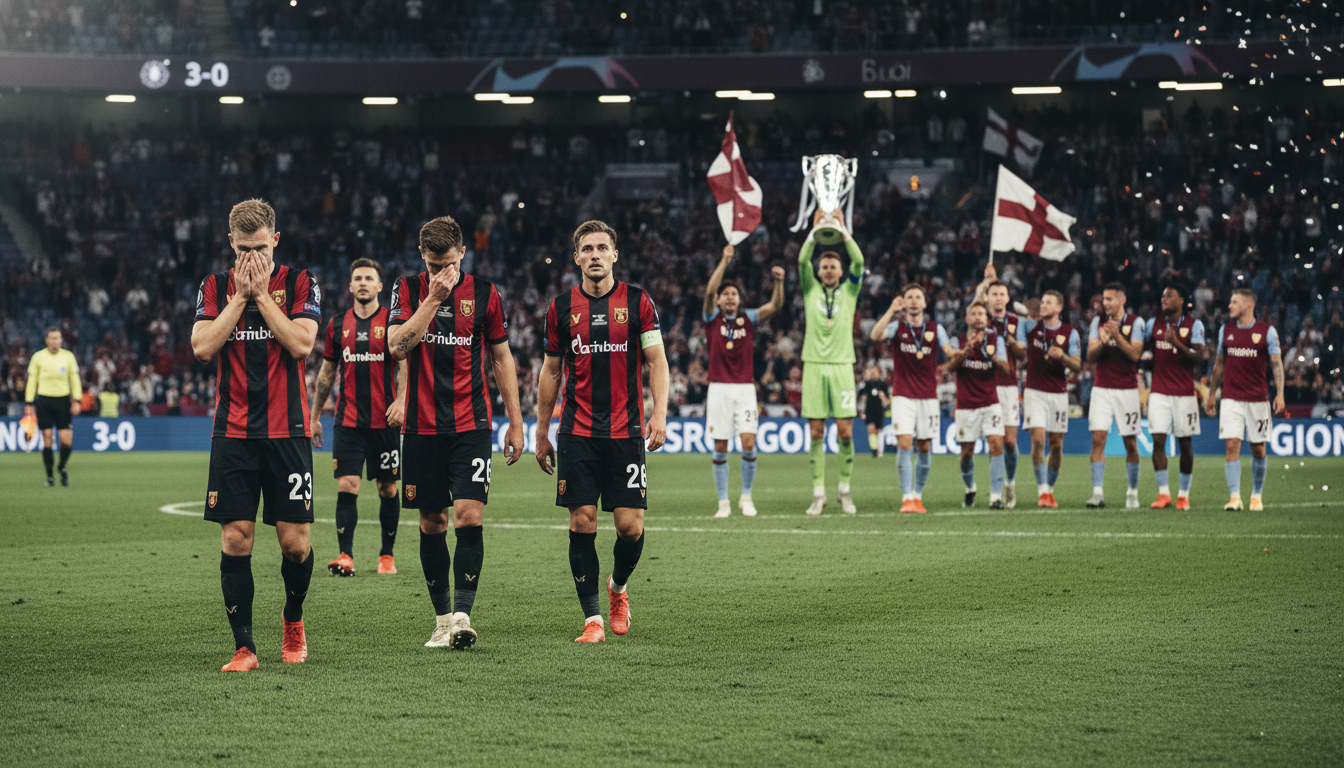
Freiburg player ratings: How SC Freiburg fared in 3-0 Europa League final loss to Aston Villa
Freiburg player ratings and match analysis from the Europa League final in Istanbul, where SC Freiburg were beaten 3-0 by Aston Villa on May 20, 2026.


Strong start, swift collapse
SC Freiburg began the Europa League final with hopes of upsetting Aston Villa but were outplayed as the match progressed, falling to a 3-0 defeat in Istanbul. The phrase "Freiburg player ratings" frames this report, which assesses individual performances from Julian Schuster’s side after a game dominated by Villa’s tempo and clinical finishing. Early signs of composure did not translate into control of the match, and Freiburg could not convert brief possession phases into consistent attacking threat.
Freiburg’s best moments came in the opening half when Johan Manzambi produced flashes of creativity, but Villa’s response — notably through Emiliano Buendía and Youri Tielemans — quickly swung momentum. Defending set pieces and recovering from transitions proved costly, and the final scoreline reflected a gulf in decisive actions rather than a one-sided statistical superiority.
Freiburg player ratings and brief verdicts
Noah Atubolu, Lukas Kübler, Matthias Ginter, Philipp Lienhart, Philipp Treu, Maximilian Eggestein, Nicolas Höfler, Jan-Niklas Beste, Johan Manzambi, Vincenzo Grifo and Igor Matanović were each assessed for their contributions across the 90 minutes. Goalkeeper Noah Atubolu receives a 5/10 for a performance that included routine saves but also moments of uncertainty when dealing with high balls into the box. The full-back pairing offered little going forward, with Lukas Kübler rated 4/10 and Philipp Treu 3/10 for limited penetration and defensive lapses.
The central defenders were inconsistent; Matthias Ginter is marked at 5/10 for occasional interceptions but overall lack of authority, while Philipp Lienhart is assessed 3/10 after being exposed on Villa’s transitions and failing to shut down key runs. In midfield, Maximilian Eggestein and Nicolas Höfler each register 4/10 — steady in possession at times but unable to impose themselves against Villa’s pressing rhythm. Jan-Niklas Beste and Vincenzo Grifo both managed a 4/10 for sporadic threat without sustained influence.
Johan Manzambi was the standout for Freiburg, earning a 6/10 as the primary creative spark with dangerous carries and the only consistent attempt to destabilize Villa’s structure. Igor Matanović finished with a 4/10 after a quiet night up front with little impact on Villa’s defensive block. Among substitutes, Max Rosenfelder was given a 5/10 for energy off the bench while Lucas Höler was assessed 4/10; other late changes were noted but did not register meaningful influence on the scoreline.
Manzambi the bright spot amid a muted attack
Johan Manzambi emerged as Freiburg’s most effective attacking outlet, combining dribbling and forward movement to generate their clearest openings. He showed composure on the ball and a willingness to take on Villa defenders, which produced the team’s most troubling moments for the opposition. That said, his influence was intermittent and he could not sustain those bursts into consistent goal-scoring opportunities for Freiburg.
Manzambi’s responsibility increased as the match tilted in Villa’s favor, and he was often the outlet for counterattacks and quick transitions. Despite the higher personal rating, his performance also underlined Freiburg’s broader problem: the team lacked a secondary creative source to support and capitalize on Manzambi’s work. When Villa tightened space around him, Freiburg’s attacking structure became predictable and easier to neutralize.
Defensive weaknesses and how Villa exploited them
Aston Villa’s goals capitalized on Freiburg’s susceptibility to quick interchanges and set-piece situations, exposing mismatches and hesitation in defensive assignments. The back line struggled with timing and positioning during moments of high pressure, with particular problems when tracking late runners into the box. Those lapses directly contributed to the scoreline, as Villa repeatedly found pockets of space in behind Freiburg’s defensive shape.
Set plays and transitional counters were decisive; Villa’s second goal came from a phase where Freiburg failed to clear their lines and misread the movement of the opposition. Philipp Lienhart and Philipp Treu were most affected, both judged to have been outmaneuvered in critical moments. The midfield’s inability to shield the center-backs compounded the issue, allowing Villa to feed their forward line with low-risk passing sequences that culminated in clear chances.
Midfield battle lost and Tielemans’ controlling presence
Freiburg’s midfield pair, Maximilian Eggestein and Nicolas Höfler, were unable to match the tempo and forward thrust produced by Villa’s central players. Youri Tielemans, in particular, dictated moments with forward passing and pressing intelligence, earning one of the higher individual marks on the night for Villa. Freiburg’s midfield often ceded the initiative, allowing Villa to progress play through the middle and switch the point of attack efficiently.
The lack of control in the middle limited Freiburg’s ability to build sustained possession and forced them into longer, less precise passes that Villa’s defense was comfortable defending. When Tielemans or Buendía received the ball in advanced positions, Villa found avenues toward goal quickly, and Freiburg’s tactical setup did not provide enough cover to shut those avenues down. That imbalance in midfield influence became a recurring theme throughout the match.
Substitutions and tactical responses from Julian Schuster
Julian Schuster’s substitutions were aimed at altering the game-state and injecting energy, but they arrived too late to change the momentum firmly established by Villa. Max Rosenfelder brought freshness to the midfield with a 5/10 appearance, while Lucas Höler provided a different profile up front but could not find a route to goal. Other changes were more peripheral and did not materially affect Villa’s grip on the match.
Schuster had to balance attacking urgency with defensive stability after falling behind, and that trade-off left Freiburg exposed on counters as they pushed for a way back into the game. Tactical adjustments attempted to press higher and recycle possession more quickly, but Villa’s defensive discipline and tactical awareness neutralized Freiburg’s alterations. In the end Schuster’s choices narrowed the margin for error while offering limited upside.
Aston Villa’s control and clinical finishing
Aston Villa combined compact defending with efficient attacking transitions, turning control of midfield into sustained attacking pressure. Emiliano Buendía and Morgan Rogers were influential in opening spaces and producing decisive passes, while Ollie Watkins provided focal points in and around the penalty area. Villa’s clinical approach to finishing and ability to follow up their own chances separated the teams in key moments.
Goalkeeping and defensive contributions from Emiliano Martínez and Pau Torres helped Villa absorb periods of pressure, and Youri Tielemans’ influence in the engine room steered the tempo when possession mattered most. Villa’s substitutes maintained the team’s structure, ensuring there was no drop in intensity late in the match. Their balanced display combined solidity at the back with incisive offensive moments that Freiburg struggled to counter.
Implications for Freiburg after the final
The 3-0 defeat closes a significant European chapter for Freiburg and highlights areas requiring attention ahead of the new season. Defensive coordination, midfield resilience and greater attacking variety are the chief priorities if the club is to compete consistently at this level. The individual ratings from this match reflect a side that has talent but lacked cohesion and tactical answers to a well-drilled Villa team.
For the coaching staff and squad, this final presents a clear blueprint for reinforcement and tactical refinement rather than a statement of long-term decline. Several players delivered performances that could be built upon, and the experience of a major final provides a platform for targeted improvement in the transfer window and preseason planning.
The final paragraph reviews the immediate fallout and what supporters can expect next. Freiburg’s season ends with a heavy defeat, but the club will regroup with an eye on strengthening the spine of the team and addressing the vulnerabilities exposed in Istanbul.