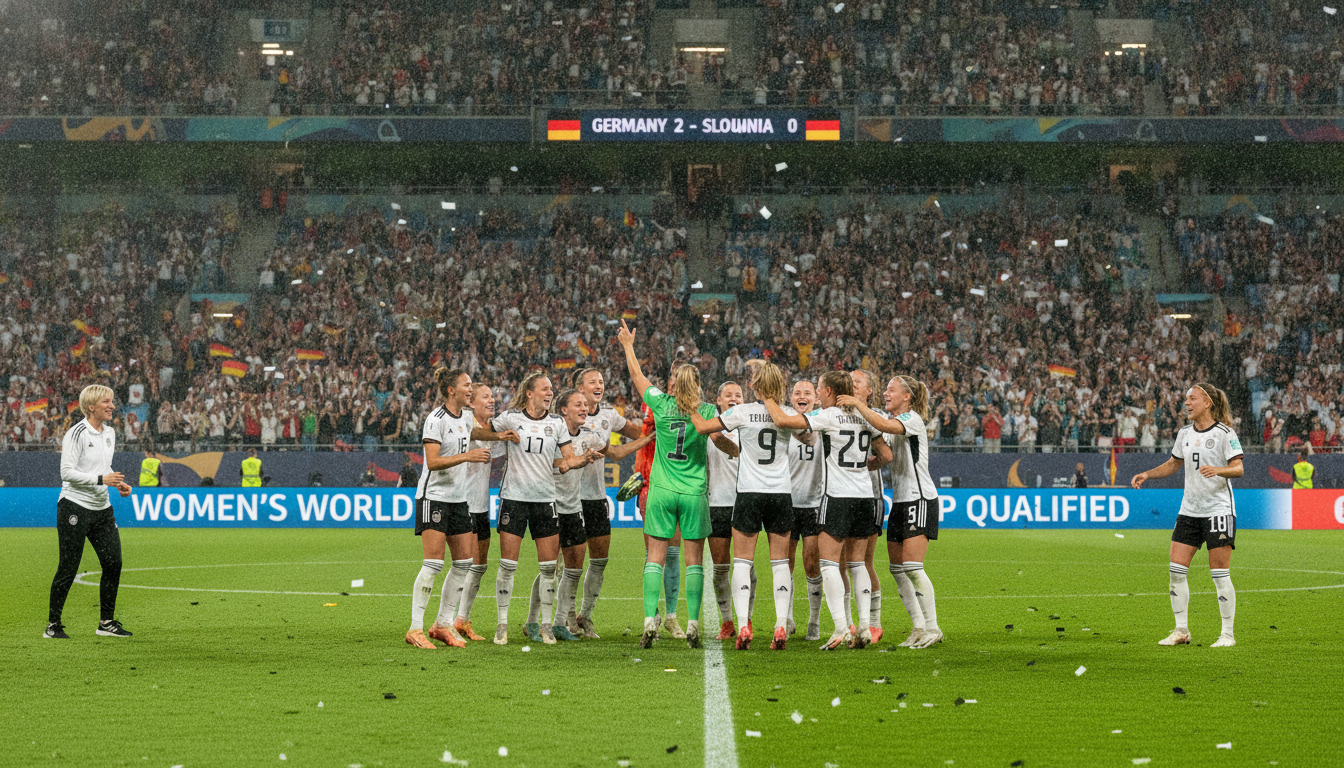
Germany complete unbeaten qualifying campaign with 2-0 win over Slovenia
Germany complete unbeaten qualifying campaign with a 2-0 victory over Slovenia in Ljubljana as Sarai Linder and Shekiera Martinez sealed a professional finish.


Germany completed their unbeaten qualifying campaign with a measured 2-0 victory over Slovenia at Stadion Stožice, securing a clean finish to their group stage on June 10, 2026. The result underlined Germany’s depth and discipline, with a scrappy first-half opener from Sarai Linder and a composed second-half finish by Shekiera Martinez providing the decisive margin. Slovenia frustrated the visitors for long periods with organised defending, but Germany’s patient buildup and bench impact proved decisive across the full 90 minutes. The win preserves Germany’s momentum as they look ahead to the 2027 Women’s World Cup.
Late first-half corner forces breakthrough
A piece of set-piece fortune delivered Germany the opening goal after a period of protracted pressure, altering the match’s dynamic on the cusp of halftime.
Klara Bühl’s corner created chaos inside the penalty area and, after a series of ricochets, the ball crossed the line with Sarai Linder credited for the decisive intervention. Slovenia had defended resolutely for most of the opening 45 minutes, crowding passing lanes and forcing Germany into patient, sometimes ponderous, possession. The goal came as a cruel reward for the hosts’ first-half discipline and proved to be the moment that opened the game in Germany’s favour.
Early second-half finish kills the contest
Germany struck again just five minutes after the break, extinguishing Slovenia’s hopes of a comeback and giving the visitors breathing room to manage the remainder of the match.
Melissa Kössler’s long-range effort tested goalkeeper Zala Mersnik and the rebound fell fortuitously to Shekiera Martinez, who reacted quickest to tuck the loose ball home. That rapid second goal changed the complexion of the contest and allowed Germany to control tempo without overcommitting players in attack. From that moment, Slovenia’s task became markedly more difficult, as they were forced to chase the ball against a side comfortable moving it across all areas of the pitch.
Rotation and depth under Christian Wück highlighted
Christian Wück’s selection choices emphasized Germany’s squad strength, with several changes to the starting XI failing to disrupt the team’s control or intensity.
Even with rotation, Germany dominated possession for extended spells and consistently pinned Slovenia inside their own half. The bench made a tangible impact as fresh legs preserved the visitors’ pressing shape and attacking threat late in the game. This display reinforced the notion that Germany’s qualification run was not only about a settled first XI but also about a broader pool of players capable of delivering results when called upon.
Slovenia’s defence shows progress despite defeat
While the scoreline reflected a clear margin, Slovenia’s defending for much of the match was disciplined and showed encouraging signs of progress against elite opposition.
The hosts sat deep for long stretches, relying on organisation and compactness to frustrate Germany’s attempts to break lines. Lara Prašnikar was a consistent outlet on the counter and offered Slovenia a focal point in transition, while goalkeeper Zala Mersnik produced important saves that kept the scoreline closer than it might have been. The team’s ability to remain competitive for sizeable portions of the contest points to improvements in structure and belief, even if one lapse proved costly.
Match management and tactical control defined the evening
Germany’s approach combined territorial dominance with clinical game management after the second goal, allowing them to protect the lead without unnecessary risk.
The visitors were content to recycle possession and use substitutions to maintain intensity and limit Slovenia’s opportunities to build sustained momentum. Defensively, Germany remained organised and disciplined, conceding few clear chances following the restart. The match never demanded a spectacular performance from the visitors; instead, it required concentration, patience and efficient execution of set-piece opportunities.
Implications for Germany ahead of the 2027 Women’s World Cup
The victory offers confirmation of Germany’s readiness and adaptability as they head towards the upcoming global tournament cycle, with the unbeaten qualifying campaign a tangible sign of form.
Finishing qualifying without defeat highlights Germany’s consistency and the effectiveness of their player development pipeline, both in starting roles and on the bench. The coaching staff can take solace from the squad’s ability to perform under different configurations and in varying match scenarios. For opponents and observers alike, Germany’s result in Ljubljana underlines why they remain among the favourites as preparations intensify for 2027.
Germany’s 2-0 win over Slovenia will be assessed alongside performances across the qualifying phase, but the immediate takeaway is clear: a balanced, professional display that closed out a faultless group campaign. The result leaves Germany with momentum and a platform from which to refine combinations and strategies ahead of the next competitive tests.