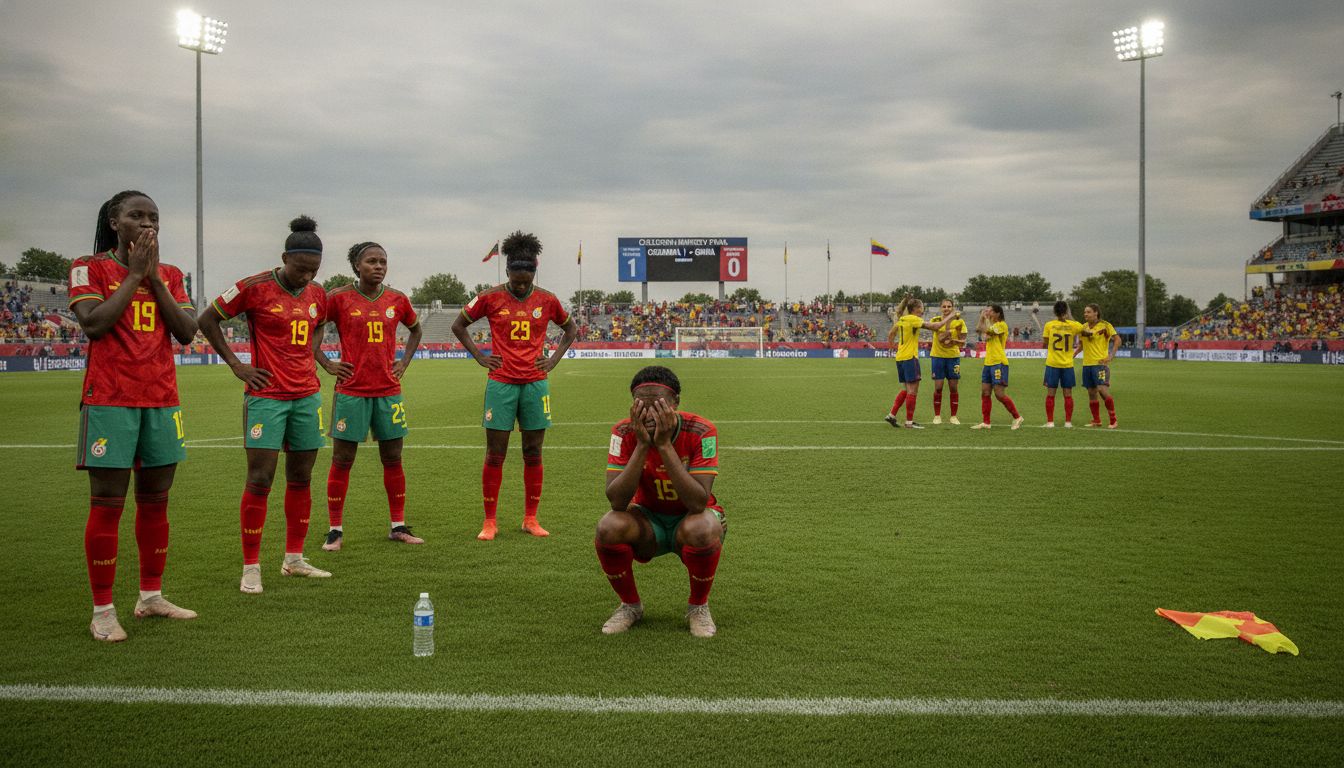
Ghana World Cup exit: Arias strike sends Colombia through as Black Stars eliminated
Ghana World Cup exit: Jhon Arias’ 14th-minute strike earned Colombia a 1-0 win in Kansas City, eliminating the Black Stars; Colombia will face Switzerland next.

Ghana’s 2026 World Cup run ended in the round of 32 after a 1-0 loss to Colombia in Kansas City, a match settled by an early Jhon Arias finish. The Black Stars had entered the knockout stage with realistic hopes but were unable to overturn the early deficit despite sustained battling and moments of promise. Colombia controlled large portions of the game and will now prepare to meet Switzerland in the round of 16.
Arias strike decides round of 32 tie
Jhon Arias produced the decisive moment in the 14th minute when he met a right‑wing delivery and finished powerfully into the corner, putting Colombia in front. The move began with space on the flank and a precise cross, and Arias’ clinical touch punished Ghana for a brief lapse in defensive positioning. That goal forced Carlos Queiroz’s side to chase the game and altered the tactical balance, with Ghana needing to take risks they had not planned for at the start of the match.
The timing of the strike proved particularly damaging in a one‑off knockout fixture where the first goal often dictates tempo and approach. Colombia were then able to sit deeper and manage possession, probing patiently for a second goal that would effectively end Ghana’s resistance. For Ghana, an early deficit meant adjusting their shape and intent long before they had fully settled into the match.
Colombia control midfield and tempo
After taking the lead, Colombia managed the midfield exchanges with sustained possession and intelligent passing, limiting Ghana’s opportunities to build consistent attacks. Gustavo Puerta and other midfielders rotated effectively, allowing Colombia to shift the ball and create overloads on the flanks. Their ability to keep tempo and recycle possession forced Ghana to defend in extended blocks rather than push numbers forward safely.
Colombia’s pattern of play invited Ghana to commit while maintaining defensive solidarity, and the South Americans repeatedly threatened on the counter and through well‑timed runs. Luis Suarez and Luis Diaz combined on several occasions to stretch Ghana’s backline, while Colombia’s full‑backs supplied width when needed. The visitors’ control of the midfield exchanges was a key factor in suffocating Ghana’s rhythm for much of the match.
Ghana struggle to create clear chances
Ghana had bright moments early, including an immediate threat from Thomas Partey, but could not fashion the sustained attacking quality required to overturn the lead. The Black Stars produced isolated efforts—Antoine Semenyo and Partey tested the defense at intervals—but their build‑up play lacked variation and often became predictable under pressure. When chances did arrive, Colombia’s defensive organization ensured they were either crowded out or forced into low‑percentage shots.
Carlos Queiroz’s side showed physicality and competitive spirit but rarely found the combinations or midfield link‑play to open the final third consistently. Substitute introductions late in the match sought to add pace and inventive spark, yet Ghana’s attacking moves too frequently culminated in blocked shots or speculative deliveries rather than clear opportunities on goal. The inability to convert possession into dangerous entries into the box ultimately determined the outcome.
Lawrence Ati‑Zigi keeps Ghana competitive
Despite the defeat, Ghana’s goalkeeper Lawrence Ati‑Zigi emerged as a major reason the final score remained narrow, producing several important saves at critical moments. He repelled a curling effort from Gustavo Puerta and denied Luis Diaz on a one‑on‑one opportunity, displaying sharp reflexes and command of his area. Ati‑Zigi also reacted instinctively to clear a stoppage‑time header off the line earlier in the match, a stop that preserved Ghana’s hopes at halftime.
His presence gave Ghana a realistic platform to chase an equaliser, and those interventions prevented Colombia from converting control into a more comfortable lead. Ati‑Zigi’s performance was a reminder that while defensive gaps appeared at times, individual quality in goal can keep teams alive in high‑stakes knockout ties. For the Black Stars, the goalkeeper’s display was a highlight in a match otherwise defined by limited attacking returns.
Queiroz’s substitutions fail to alter momentum
Carlos Queiroz introduced offensive options in search of an equaliser, bringing on Abdul Fatawu Issahaku, Elisha Owusu and Ernest Nuamah to inject pace and creativity. The changes shifted personnel and emphasized a more aggressive posture, but Ghana’s mid‑game structure became stretched and their passing sequences slowed under Colombia’s pressing. Even with fresh legs, the Black Stars struggled to fashion clear-cut chances or to sustain pressure on Camilo Vargas in the Colombia goal.
The tactical gamble reflected an understandable urgency but did not yield the necessary breakthroughs, as Colombia remained compact and disciplined defensively. Part of the problem lay in predictable patterns when Ghana attempted to move the ball into dangerous areas; defenders were able to anticipate and neutralize the final pass. The substitutions offered moments of promise, but they failed to change the match’s trajectory.
Injuries, key moments and defensive resilience
The match also featured pivotal physical moments: Jhon Cordoba was forced off early with an injury and Ghana lost Marvin Senaya in the first half, incidents that influenced both sides’ immediate game plans. Colombia came close to doubling their lead in stoppage time of the first half when Johan Mojica’s header was cleared off the line, a chance that would have severely complicated Ghana’s task. Those near‑misses underscored how fine margins in the game separated extended life for the Black Stars from a more decisive Colombia advantage.
Defensively, Ghana showed moments of disciplined organisation, particularly when the team retreated into a more compact block to limit central penetration. Colombia continued to create opportunities—Davinson Sanchez and Juan Fernando Quintero tested Ghana late in the second half—but the visitors were unable to convert their territorial advantage into a cushion. The mix of missed chances and timely Ghana interventions made the contest tense until the final whistle.
Lessons and prospects for Ghana after the World Cup
The defeat ends Ghana’s 2026 World Cup campaign, but the tournament also offered building blocks and measurable progress under Carlos Queiroz. The Black Stars succeeded in qualifying from Group L and produced a notable goalless draw with England, demonstrating defensive resilience in parts of the competition. Young players gained crucial high‑level experience and the squad registered moments of cohesion that can be developed ahead of future qualifiers and tournaments.
Moving forward, the priority for Ghana will be to translate the tournament’s positives into a clearer attacking identity that consistently creates high‑quality chances. The coaching staff and federation will likely weigh options to enhance creativity in midfield and add more variety to the final third. For supporters and stakeholders, the end of the World Cup is an opportunity to assess recruitment, youth development and tactical refinement with the aim of returning stronger at the next major competitions.
Ghana leave the tournament with lessons learned and a platform to build from, having shown resilience and signs of progress but lacking the decisive attacking edge needed in knockout football.