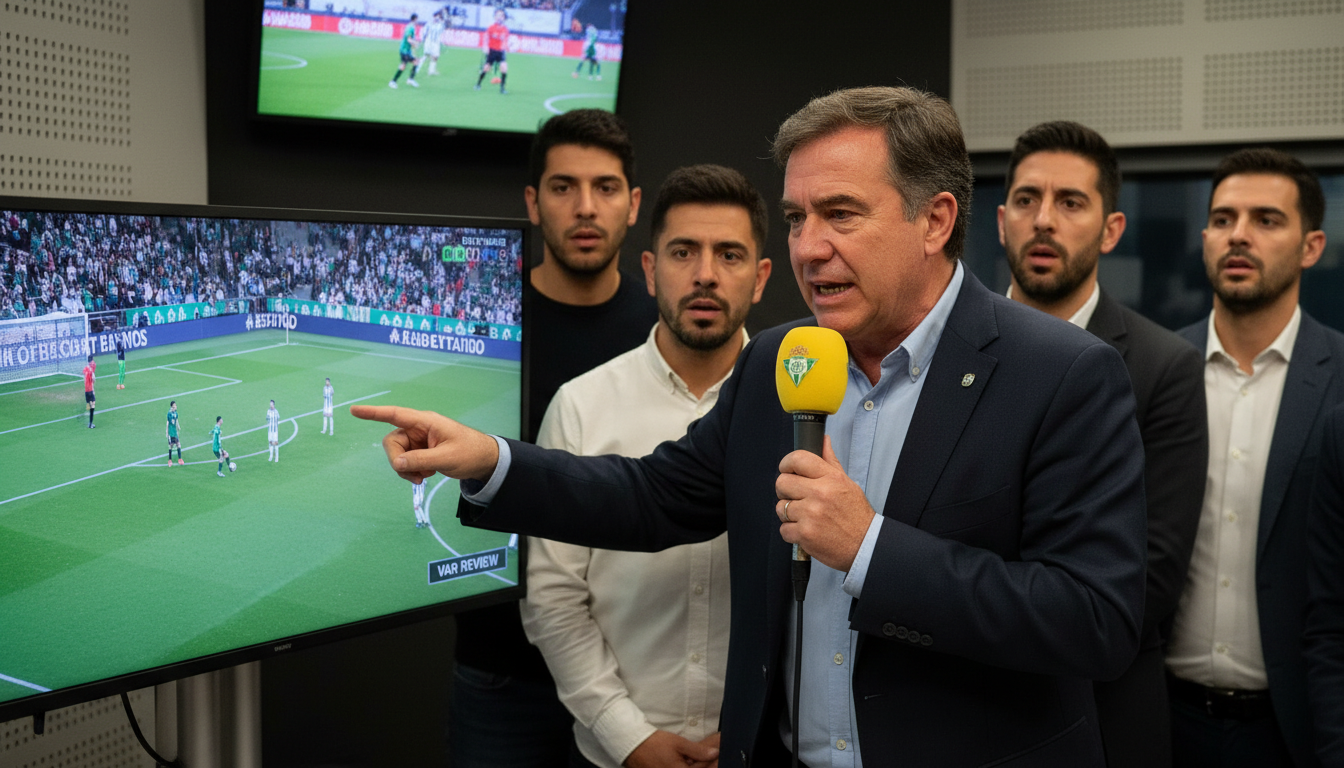
Betis-Oviedo dispute escalates as Paco González calls out CTA over contested Amrabat penalty
Betis-Oviedo controversy deepens after a challenge by Sofyan Amrabat left Thiago Fernández injured; radio director Paco González called the CTA’s decision into question, saying images show the ball on the line.


The debate over the Amrabat penalty flared after Real Betis defeated Real Oviedo 3-0 in the recent league fixture, when a first-half challenge by Amrabat on Thiago Fernández prompted strong protests from the visiting team. The CTA concluded there was no penalty because it judged the ball to be out of play at the moment of contact, a determination that has since been publicly disputed. Radio director Paco González, host of Tiempo de Juego, accused the committee of misrepresenting the footage and said television images prove the ball remained on the pitch.
Match context and the moment that sparked protest
The incident occurred while Betis led 1-0, a scoreline that ultimately grew to a comfortable 3-0 home victory. Real Oviedo players and staff immediately appealed for a spot-kick following Amrabat’s tackle on Thiago Fernández, arguing the contact impeded the defender and warranted a penalty. The club lodged formal complaints and the episode became the focal point of post-match analysis across Spanish sports media.
Refereeing officials reviewed the play after the match as part of routine post-game procedures, and the CTA issued a rationale for not overturning the on-field decision. That explanation centered on the position of the ball at the moment of contact and whether the action met the threshold for a penalty under the competition’s rules. The official response did not satisfy the visiting side or a swath of commentators who saw the challenge as clear-cut foul play.
CTA’s official justification and its implications
The CTA’s public statement emphasized that the ball was outside the field of play at the time of contact and described that fact as “a determining factor” in their ruling. Under standard interpretations of the Laws of the Game, the ball’s position can affect whether contact with an opponent constitutes a foul punishable by a penalty kick. The committee therefore concluded that the incident did not meet the criteria for a penalty, framing their position around the technicalities of the play.
That rationale has not quelled criticism because it hinges on a precise visual assessment of where the ball sat relative to the touchline, a judgment that can be difficult to confirm unequivocally from broadcast angles. Critics argue that if contact caused the defender to be disadvantaged, the spirit of the rule should favor a foul call, particularly when the tackle appears to include studs or a clear impact on the ankle. The debate exposes tensions between strict procedural readings of the rules and broader interpretations of fairness on the pitch.
Paco González’s public challenge to the ruling
Paco González, director of the long-running radio programme Tiempo de Juego, issued a blunt rebuke of the CTA’s explanation during his broadcast. He said broadcasters’ images show the ball on the line and accused the committee of misrepresenting the footage when it stated the ball was outside play. González’s comments were unequivocal: he labelled the ruling a mistake and said the visual record supports the argument for a penalty.
González’s intervention amplified the controversy because of his influence in Spanish football media and the program’s wide audience. His critique was not framed as partisan commentary but as a direct challenge to the accuracy of the official account, and it invited calls for greater transparency in how the CTA reaches retrospective decisions. The radio director’s stance has encouraged further scrutiny of the images and of the committee’s internal review process.
Video evidence, broadcast angles and the limits of certainty
Supporters of the penalty claim point to television replays that, they say, show the ball at least touching the line at the time of Amrabat’s challenge. Those images form the basis of the contention that the CTA’s assertion was incorrect or incomplete. However, broadcast angles vary, and minute differences in camera perspective can produce diverging interpretations of whether the ball fully crossed the boundary.
Officials typically rely on a combination of live footage, match reports and any VAR records when available to form a post-match judgment. In this case, public access to the exact frames or the VAR logs used by the CTA has not been made available, leaving independent observers to draw conclusions from televised replays alone. The resulting ambiguity has intensified calls for the release of the specific visual material cited in the committee’s decision.
Reactions from clubs, supporters and broader football community
Real Oviedo’s players and staff were visible in their displeasure at the time and have since reiterated their belief that the incident warranted a penalty. Club spokespeople framed the episode as an instance of on-field justice denied, while supporters used social media and fan forums to demand clarification from both the league and the CTA. The dispute also reverberated among neutral observers who view the case as another example of contentious interpretation affecting competitive balance.
Real Betis has not publicly disputed the CTA’s decision in detail, and the club’s position has largely been to concentrate on the positive result and the margin of victory. That restraint is not unusual when a favorable ruling benefits the home side, particularly if officials have already issued a formal explanation. Nevertheless, the public dispute led by media voices and the visiting team has kept the story in the headlines and ensured it will be revisited if similar incidents occur.
Potential consequences for officiating transparency and future reviews
The clash over the Amrabat penalty spotlights an enduring issue in modern football: the need for transparent, consistent communication from refereeing bodies about contentious decisions. Observers argue that publishing the specific video frames, VAR checks and the committee’s step-by-step reasoning would reduce speculation and help the public understand how determinations are made. Proponents of greater openness say such measures would protect referees from unfounded allegations while also shielding committees from accusations of error.
Conversely, some officials caution that releasing too much material could expose referees to undue pressure and subject routine assessments to partisan reinterpretation. The balance between transparency and protecting the integrity of officiating processes remains delicate, and this incident is likely to be used as evidence by both sides in ongoing discussions about post-match reviews and the public’s right to scrutinize them.
The CTA maintains that its statement reflects the committee’s considered judgment based on the evidence available to them, while critics continue to press for the visuals that underpin that finding.
The contested Amrabat penalty has become more than a single refereeing decision; it has evolved into a debate about how football adjudicates marginal calls, how evidence is communicated, and how influential voices in media can shape public perception. As clubs, fans and officials continue to dissect the broadcast footage, the episode may prompt renewed calls for procedural changes or for clearer standards on the publication of review materials.
For now, the match result stands and Real Betis claimed three points, but the controversy around the Amrabat challenge will likely persist in media coverage and among supporters until the governing bodies provide fuller transparency or new guidance on similar incidents.