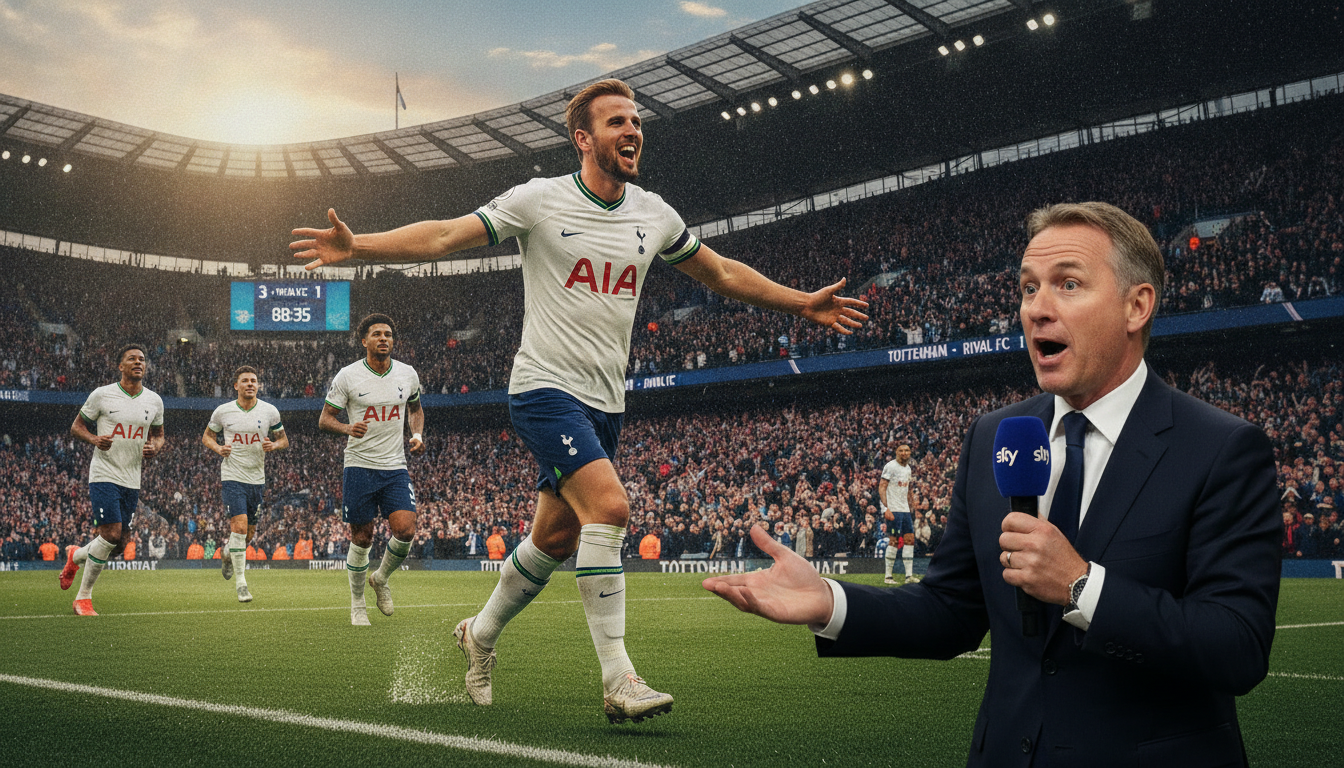
Jamie Carragher says Harry Kane deserves the Ballon d’Or despite World Cup doubts
Jamie Carragher argues Harry Kane should win the Ballon d’Or after a standout 12 months, though World Cup politics may sway voters away.


Jamie Carragher has made a clear and emphatic case that Harry Kane merits the Ballon d’Or following a year of consistently high-level performances for club and country. Carragher told TeleFootball that, judged strictly on the past 12 months, Kane has produced the kind of output that traditionally anchors winners of football’s top individual prize. The England captain’s goals, assists and overall influence on matches formed the crux of Carragher’s argument, even as he acknowledged the influence of major international tournaments on voting.
Carragher’s assessment of Kane’s year
Jamie Carragher framed his assessment around a simple principle: the Ballon d’Or should reward the best individual performer over the course of a year. Carragher said Kane’s sustained productivity and leadership at both club and international level meet that criterion. He conceded, however, that the award often tilts toward players who shine at major international tournaments, especially in World Cup years.
Carragher’s view draws attention to the tension between calendar-year club form and the sway of single-event success in voters’ minds. Voters frequently remember headline moments from major tournaments more vividly than steady excellence across league and continental campaigns. That reality underpins Carragher’s frank admission that Kane may be the most deserving player on merit but still face an uphill battle in the ballot.
Kane’s club and international contributions over 12 months
Over the last year Harry Kane has been central to his club’s attacking identity, offering consistent goal returns and chances created that few peers can match. His ability to combine penalty-box finishing with playmaking from deeper positions has broadened his influence beyond pure goal scoring.
For England, Kane remains the focal point of the national side’s approach, carrying his strike responsibilities while also providing leadership as captain. That dual role — delivering tangible attacking output while organizing and leading teammates — is the kind of contribution voters often find persuasive when weighing individual merit against team success.
How World Cup timing influences Ballon d’Or voting
The Ballon d’Or voting pool tends to be sensitive to major tournament narratives, and in World Cup years that effect becomes magnified. Players who deliver defining moments or carry a winning nation’s tournament run typically gather momentum in ballots, sometimes eclipsing players with stronger overall calendar-year resumes.
Carragher acknowledged this structural bias, noting that the trophy often becomes a reflection of who dominated the World Cup rather than who was most consistent across club and national competitions. That quirk of voting psychology presents a practical obstacle for Kane, whose many strong months could be overshadowed by standout performances from a World Cup winner.
England’s tournament prospects and their impact on Kane’s chances
Carragher was candid about England’s ability to compete for a World Cup, suggesting recent form offered little cause for confident predictions of tournament victory. That assessment matters because England’s progress — or lack of it — will materially alter Kane’s standing among voters who favor tournament-winning narratives.
If England were to go deep or win the World Cup, Kane’s Ballon d’Or case would be significantly bolstered by the combination of individual form and team success. Conversely, an early exit or an underwhelming campaign would hand narrative advantage to players from more successful nations, regardless of Kane’s steady club form.
Comparisons with other Ballon d’Or contenders
Any realistic Ballon d’Or conversation must weigh Kane against contemporaries who also delivered headline numbers or decisive tournament moments. In World Cup years especially, the shortlist often features players who either led their nations to glory or posted extraordinary club seasons in the absence of international success.
Comparative debates hinge on how voters balance goals, assists, match-winning contributions and the visibility of those performances on the biggest stages. Kane’s blend of scoring and creating makes him competitive in nearly every statistical category, but the final calculus can tilt toward players whose highlights occurred in more widely watched or emotionally resonant moments.
What Kane would need to secure the award
To convert merit into votes, Kane would ideally combine a strong end-of-season club run with a high-profile World Cup showing, or benefit from a lack of a single standout star at the tournament. Accumulating decisive, memorable moments in knockout fixtures often proves decisive in swaying the electorate.
Beyond on-field output, narrative and perception play a role: continued leadership, clutch goals, and visibly lifting teammates can create the kind of storyline that lingers with voters. For Kane, maintaining elite production while delivering a few unmistakable defining moments would narrow the gap between “deserving” and “likely winner.”
England’s tactical setup and how it uses Kane will also factor into perceptions of his candidacy. When a captain visibly shapes outcomes and carries responsibility for the team’s attacking identity, it enhances his award credentials, especially when paired with strong statistical evidence.
Voter tendencies and the mechanics behind the Ballon d’Or
Ballon d’Or voters include journalists, national team captains and coaches, and their selection patterns show regular tendencies toward dramatic tournament narratives. The aggregation of individual ballots often reflects a combination of objective metrics and subjective impressions formed during high-stakes matches.
This blend of quantitative and qualitative assessment means players who excel across all fronts still must contend with the memorable image bias that comes with tournament glory. Carragher’s observation about the award gravitating toward the World Cup’s star player is a reflection of how emotive tournament performance can outweigh consistency.
Voters also respond to context: overcoming adversity, lifting underperforming teams, or producing against top opposition can amplify a player’s standing. For Kane, creating a sustained narrative of influence against strong opponents could help counterbalance any tournament-related disadvantages.
Final paragraph reflecting on the debate and outlook
Jamie Carragher’s public endorsement places a spotlight on an ongoing debate about individual awards in football, pitting calendar-year consistency against the magnetism of tournament triumphs. Harry Kane’s credentials are difficult to dismiss on the basis of form and contribution alone, but the Ballon d’Or remains an award shaped as much by moments as by metrics. Voters will weigh a season of excellence against the emotional resonance of the World Cup, and that balance will determine whether Kane’s strong case translates into the sport’s highest individual honor.