Switzerland vs Qatar: Yakin names Bundesliga-heavy XI for 2026 World Cup opener in California
Switzerland vs Qatar opens Switzerland’s World Cup campaign in California, with Murat Yakin naming a squad featuring nine current Bundesliga players for the June 13 match.


Match overview
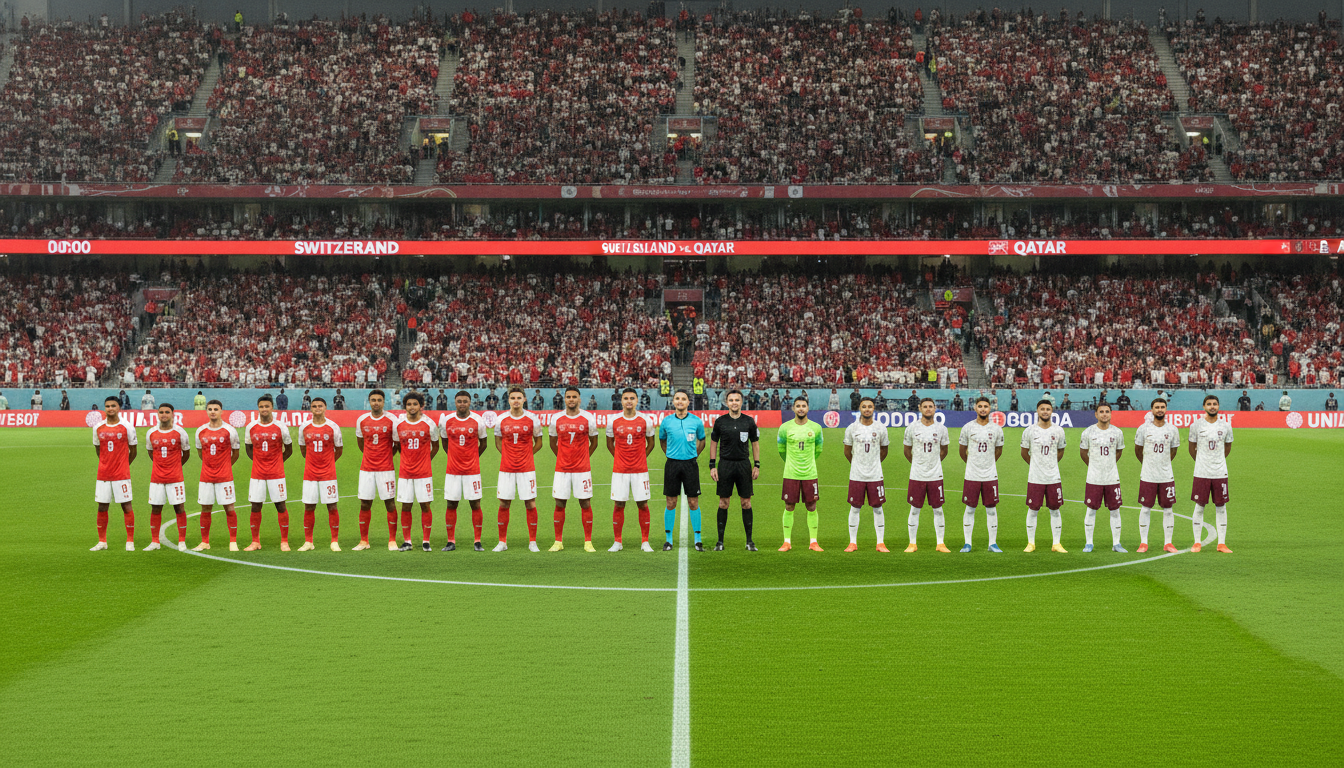
Switzerland vs Qatar kicks off Switzerland’s Group stage schedule at the 2026 World Cup in California, a fixture that pits Murat Yakin’s experienced side against the 2022 hosts. Switzerland arrive with a reputation for consistency at global tournaments, having reached the Round of 16 in each of the last three editions. Qatar return to the finals seeking a markedly improved outcome after a difficult debut on home soil in 2022.
The Swiss selection highlights a strong German-league influence, with nine players currently plying their trade in the Bundesliga included in the matchday group. That concentration underlines Yakin’s reliance on players familiar with high-tempo, organised league football as Switzerland attempt to begin their campaign with a win.
Switzerland name Bundesliga-heavy XI for World Cup opener
Murat Yakin has chosen a starting lineup that places several Bundesliga regulars in key defensive and midfield roles. Borussia Dortmund goalkeeper Gregor Kobel and Borussia Mönchengladbach centre-back Nico Elvedi both start, offering experience and familiarity with top-level German competition.
Beyond the starting eleven, additional Bundesliga players such as Silvan Widmer, Miro Muheim, Johan Manzambi, Fabian Rieder, Aurèle Amenda, Luca Jaquez and Cedric Itten are on the bench and could be introduced to influence the match. The heavy representation illustrates Yakin’s confidence in players accustomed to the tactical and physical demands of the Bundesliga.
Confirmed lineups and selection choices
Switzerland’s announced lineup shows a blend of experience and youth, with a number of players who have Bundesliga pedigrees anchoring the team. The starting eleven fields Gregor Kobel in goal, a back line containing Nico Elvedi, Manuel Akanji and Denis Zakaria, and midfield leadership from Ricardo Rodriguez, Remo Freuler and captain Granit Xhaka.
Qatar’s selection was largely unchanged from recent competitive games, with goalkeeper Meshaal Barsham Abunada named between the posts alongside a back four marshalled by captain Abdelkarim Hassan Al-Kohji and Pedro Miguel. Julen Lopetegui has selected a frontline that includes forwards Akram Afif and Almoez Ali in attacking roles, while Homam Ahmed, who recently earned promotion to Spain’s Segunda División with Cultural Leonesa, starts at fullback.
Qatar pick Homam Ahmed as the lone outsider in starting XI
Qatar’s starting eleven is notable for its domestic core, with Homam Ahmed the only player starting who is currently contracted outside the Qatari league. Ahmed’s recent success in Spain with Cultural Leonesa and his promotion to the Segunda División earned him a starting berth in Lopetegui’s plan.
For a squad that features many players based in domestic competitions, Ahmed represents a different profile: match experience in European lower tiers and exposure to a contrasting tactical environment. Lopetegui’s decision to include him in the XI signals an intent to blend homegrown stability with players who bring varied club-level experiences.
Tactical matchups and key battles
Control of the central midfield is likely to determine the tempo of Switzerland vs Qatar, with Granit Xhaka’s distribution and Denis Zakaria’s ball progression pivotal for the Swiss. Switzerland’s midfield balance of defensive cover and forward thrust should test Qatar’s compact shape, particularly in transitions.
Defensively, the duel between Swiss centre-backs and Qatar’s attackers will matter, with Nico Elvedi and Manuel Akanji expected to manage runs in behind and aerial threats. On the flanks, Ricardo Rodriguez’s experience and ability to interchange with wide players will be important against Qatari fullbacks who prioritise compactness and quick counters.
Bench options and in-game adjustments
Yakin’s bench mixes Bundesliga-proven depth with players who offer tactical flexibility, enabling shifts between a traditional back four and a more progressive midfield-centric approach. Substitutes such as Fabian Rieder and Aurèle Amenda provide midfield dynamism and defensive reinforcement respectively, should Yakin opt for midgame consolidation or a push for a decisive goal.
Qatar’s available replacements are built around continuity, with Lopetegui likely to maintain structure rather than drastically alter formation unless circumstances demand it. The presence of domestically-based substitutes gives Qatar an advantage in familiarity, but it may limit their ability to introduce players with recent European match intensity.
Tournament context and recent World Cup records
Switzerland enter this World Cup with a recent record of advancing beyond group play, making them a team that often combines discipline with an ability to compete in knockout settings. That pedigree gives them a psychological edge in what is technically a high-pressure opener on American soil.
Qatar’s 2022 campaign ended without points in the group stage, and the hosts of that tournament now arrive intent on reversing their fortunes at this edition. Both teams will treat this match as a crucial early opportunity to establish momentum and gather points in a competitive Group.
What to watch in the first 45 minutes
Early signs of how Switzerland vs Qatar will unfold should emerge within the opening 20 minutes as both teams probe for vulnerabilities. Look for Switzerland to attempt early control through midfield passes and compression, while Qatar may try to absorb pressure and strike through quick, direct plays.
Set-piece scenarios could prove decisive if the match remains tight, given the aerial presence of Swiss forwards and the organised marking patterns of both defensive units. Tactical discipline and the capacity to convert half chances will likely determine which side seizes the initiative before halftime.
Switzerland’s reliance on Bundesliga form and Qatar’s domestic continuity set the stage for a measured, strategic opener that carries significant group-stage implications in the early days of the 2026 World Cup.