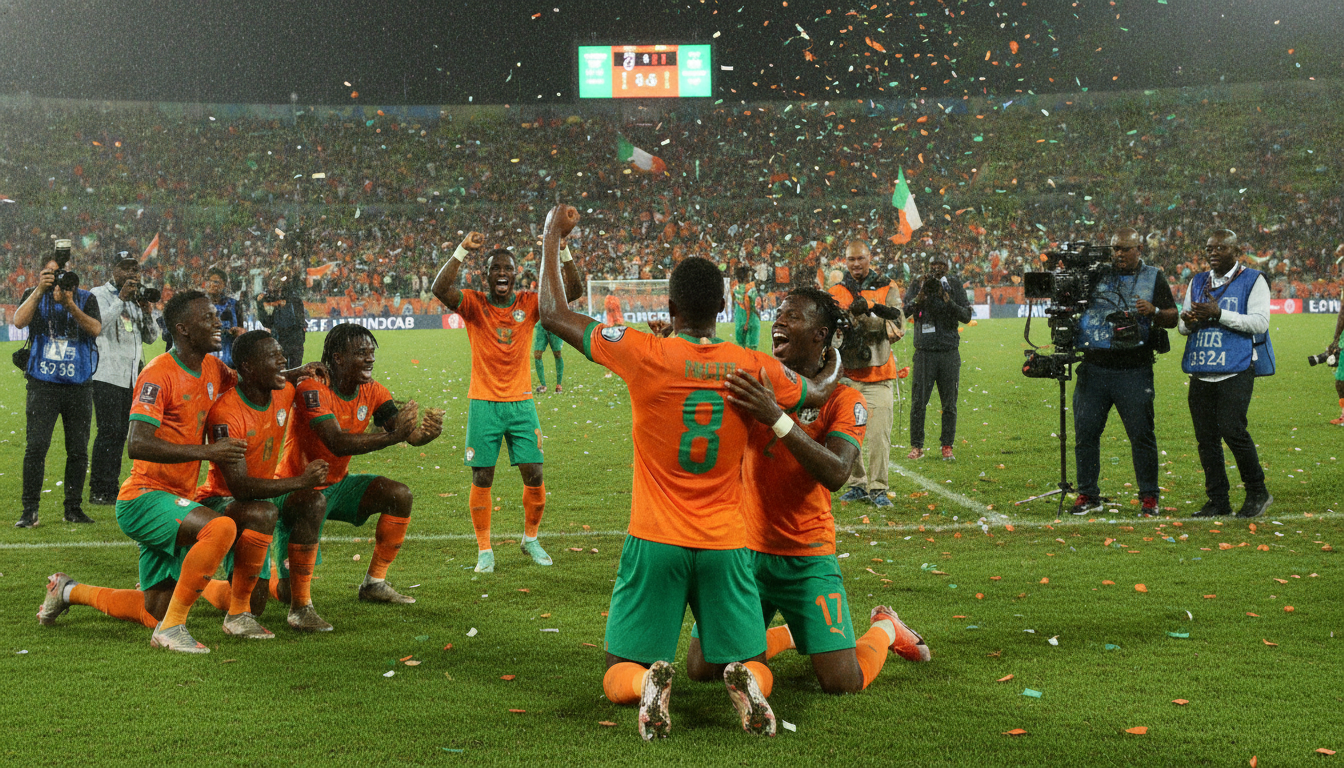
Côte d’Ivoire’s World Cup Run Ends in Dallas as Young Elephants Make Knockout History
Côte d’Ivoire’s 2026 World Cup ended in a 2-1 defeat to Norway, yet Amad Diallo and Emerse Faé’s young Elephants made history by reaching the knockout stage.


Côte d’Ivoire exited the 2026 FIFA World Cup after a 2-1 loss to Norway in the round of 32 at Dallas Stadium, but the result did not erase a landmark achievement for Ivorian football. The Elephants advanced from Group E to reach the knockout phase for the first time in the nation’s tournament history. The performance under coach Emerse Faé has been widely viewed as a breakthrough, showcasing a youthful core that can build on this experience.
Elephants make history despite exit
Côte d’Ivoire arrived in North America with the weight of previous World Cup disappointments, having failed to progress beyond the group stage in three prior appearances. That record changed when Faé’s side navigated a competitive Group E to claim a spot in the round of 32. The elimination to Norway ended the campaign, but it could not overshadow the significance of the milestone for players, staff and supporters.
The achievement held clear emotional resonance across Ivorian football, where past squads featuring stars such as Didier Drogba and Yaya Touré fell short of knockout qualification. Reaching the last 32 granted a sense of closure to that heavy history while offering a brighter outlook for the next cycle. As winger Amad Diallo reflected after the match, the progress of a predominantly young squad was a source of pride and a signal of promise for the future, a view echoed by supporters and analysts alike.
Diallo sparks late revival
Amad Diallo, introduced from the bench, injected pace and directness into Côte d’Ivoire’s attack and engineered the brief revival that brought his country back into the contest. His second goal of the tournament arrived in the 74th minute after an incisive one-two with Nicolas Pépé, a composed finish that levelled the score and reignited belief in a comeback. Diallo’s impact underlined the winger’s growing status as one of the competition’s bright young attacking talents.
The goal carried personal weight for the 23-year-old, who had already found the net during the group stage against Ecuador. In his postmatch comments to FIFA, Diallo described scoring on the World Cup stage as "a dream come true" and framed the team’s tournament as a collective success despite the exit. His performance in Dallas will strengthen his standing at club level and provide a valuable knockout-stage memory for a player still in the early years of his international career.
Tactical battle and key moments
The match in Dallas developed into a tactical contest in which Norway managed to create and convert decisive opportunities before the Ivorian response. Norway struck twice — once to establish a lead and again to regain control after Côte d’Ivoire had equalised — while the Elephants pressed and rotated their front line in search of an equaliser. Set-piece moments and transitional breaks emerged as defining episodes in a match of fine margins.
Emerse Faé’s decision to introduce Diallo and reshuffle his attack reflected a need for pace to unsettle Norway’s defence, and the substitution delivered an immediate attacking spark. However, the Ivorian backline’s earlier vulnerabilities were exposed in moments when the team committed numbers forward. The balance between risk and reward in that phase of the game ultimately decided the outcome, underscoring the tactical learning curve for a largely youthful squad.
Young core signals long-term promise
One of the tournament’s most striking narratives was the youth and athleticism of the Ivorian squad. Faé leaned on a generation of players who combined physical dynamism with technical ability, creating a team that could press high and transition quickly on the break. That profile contrasted with previous Ivorian sides that relied more on established stars; this iteration offered a clear template for sustained development.
Beyond Diallo and Pépé, several emerging figures produced performances that will encourage both national team selectors and club recruiters. The tournament provided many of these players with their first exposure to knockout-stage pressure, a form of competitive education that is difficult to replicate in friendlies or continental fixtures. The experience gained in North America should bolster the squad’s composure and decision-making in future high-stakes matches.
Impact on Ivorian and African football
Côte d’Ivoire’s run to the round of 32 carried significance beyond national borders, contributing to a wider African presence at an expanded World Cup. With several African teams reaching the knockout stage in this tournament format, the Elephants added a narrative of progression and generational renewal. Their advancement reinforced the argument that investment in youth pathways and coaching can deliver concrete results on football’s biggest stage.
The campaign also promises to influence talent pipelines within the country, as young Ivorians observe a pathway from domestic academies to international tournaments. For continental football, the performance underlines the competitiveness of African teams when given tournament experience and structural support. That wider context makes the Ivory Coast story part of a more substantial continental trend rather than an isolated success.
Next steps for Emerse Faé and the squad
Looking forward, Faé and his coaching staff will confront a sequence of decisions about squad continuity, tactical adjustments and player development priorities. Maintaining the momentum created in 2026 will require combining competitive fixtures with targeted training to convert one-off tournament lessons into systemic improvements. Managing club commitments and nurturing emerging talent will be crucial to sustaining upward trajectory.
The process will likely involve assessing performances at club level, integrating younger talent into senior roles gradually, and refining tactical frameworks to shore up defensive lapses while preserving the attacking verve that defined the World Cup campaign. Administrative and federation support for coaching, scouting and youth development will also shape the pace at which the Elephants translate this tournament experience into consistent results.
The defeat in Dallas may bring immediate disappointment, but the broader outcome for Côte d’Ivoire is unmistakably forward-looking, as a youthful squad has secured a first-ever knockout appearance and gained valuable experience that can underpin future success.