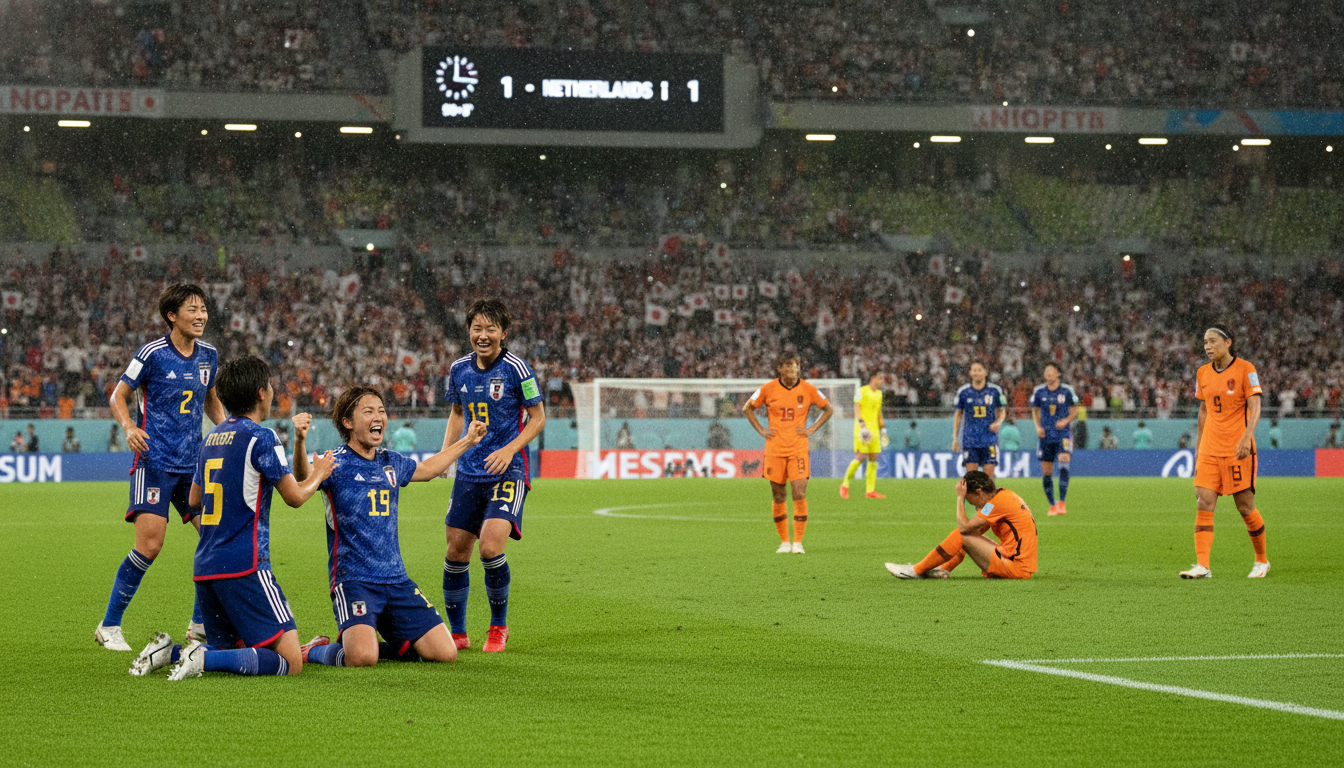
Japan vs Netherlands ends 2-2 after Daichi Kamada’s 88th‑minute header in World Cup opener
Japan secure a 2-2 draw with the Netherlands after Daichi Kamada’s 88th-minute header; match report, lineups, key moments and Group F implications and analysis.


Japan salvaged a dramatic 2-2 draw against the Netherlands in their opening match of the 2026 World Cup after Daichi Kamada nodded home an 88th‑minute equaliser at AT&T Stadium in Arlington. Japan vs Netherlands produced a frantic second half in which Virgil van Dijk and Crysencio Summerville put the Dutch ahead twice before Keito Nakamura and Kamada hauled the Samurai Blue back into the game. (apnews.com)
Kamada’s late header rescues Japan
Daichi Kamada’s header from Koki Ogawa’s corner flew in despite a sprawling save from Bart Verbruggen, handing Japan a point at the death and sparking wild celebrations among the travelling fans. The goal completed a comeback that underscored Japan’s resilience and kept their Group F campaign alive after a match that had swung back and forth. (apnews.com)
The equaliser came at a moment when the Netherlands had retreated into a compact defensive shape and appeared set to hold on, but Japan’s persistence on set pieces paid off. Kamada’s finish — a sharp connection on an aerial delivery — was the decisive action in an end-to-end contest that had threatened to elude either side. (apnews.com)
Three-goal flurry after the break
An otherwise subdued first half exploded shortly after the interval when Ryan Gravenberch’s probing cross found Virgil van Dijk, who met it with a towering header to send the Dutch in front. Japan responded within minutes when Keito Nakamura cut inside and drilled a low shot past Verbruggen to restore parity, setting up a frantic middle period. (apnews.com)
The Netherlands regained the lead after another incisive Gravenberch involvement, this time producing the assist for Crysencio Summerville’s curling left‑footed finish that gave Oranje a temporary advantage. The three goals arrived inside a short window and shifted momentum repeatedly, turning the match into a tactical test for both managers. (transfermarkt.com)
Gravenberch’s influence and Summerville’s strike
Ryan Gravenberch emerged as a central figure in the Dutch buildup, his long passes and crosses creating both of the Netherlands’ opening chances and directly assisting the goals by Van Dijk and Summerville. The Liverpool midfielder’s range and timing repeatedly unsettled Japan’s midblock, producing openings in transition that the Oranje exploited. (transfermarkt.com)
Crysencio Summerville rewarded that service with a piece of individual quality, cutting inside from the right and bending a left‑foot shot toward the far post in a finish that drew comparisons to classic Dutch wide attackers. The goal was Summerville’s first at senior international level in a major tournament and gave the Netherlands a cushion they hoped would endure. (transfermarkt.com)
Suzuki’s first‑half form kept Japan competitive
Japan goalkeeper Zion Suzuki produced a series of important interventions in the opening 45 minutes, including an early stop to deny Donyell Malen and several other sharp saves that prevented the match from tilting in the Dutch favour. Suzuki’s reflexes and positioning frustrated the Netherlands’ early threats and ensured the scoreline remained level until the break. (ca.sports.yahoo.com)
Those saves allowed Hajime Moriyasu’s team to regroup and execute the transitions that would eventually yield Nakamura’s response after the restart. Suzuki’s performance was a reminder of Japan’s defensive organisation and the value of a goalkeeper who can change the tenor of a match with timely interventions. (ca.sports.yahoo.com)
Lineups, captaincy and tactical tweaks
Hajime Moriyasu named a starting XI that blended experience and youth, with Eintracht Frankfurt’s Ritsu Dōan wearing the armband at the start of the match and Bayern’s Hiroki Itō alongside Mainz’s Kaishū Sano in the backline. The Japan formation aimed to squeeze the midfield while allowing the wide players to press and exploit quick transitions. (skysports.com)
Moriyasu’s substitutions altered the balance in the second half, most notably when Werder Bremen’s Yukinari Sugawara replaced Dōan to freshen the right flank and bolster defensive control. Japan’s bench ultimately had a critical role late on, with Koki Ogawa’s corner providing the platform for Kamada’s match‑saving header. (transfermarkt.com)
On the Netherlands side, Ronald Koeman’s selection leaned on a forward line that combined Premier League experience with young energy, and his tactical tweaks after going ahead reflected a desire to protect leads through controlled possession. That approach left the door open to Japan’s set‑piece threat in the closing stages. (sportsmole.co.uk)
Late management and match momentum
After regaining the lead through Summerville, the Netherlands appeared content to manage the game from the front, conserving energy and reshaping the midfield to choke Japan’s immediate counters. Japan, however, continued to probe and forced corners and half‑chances that eventually culminated in the decisive late set piece. (apnews.com)
The closing minutes illustrated the fine margins in major‑tournament football: a well‑timed delivery, a contested aerial duel, and a deflection that left the goalkeeper wrong‑footed. Those marginal moments tilted the outcome back toward parity and underlined how rapidly control can shift in high‑tempo international fixtures. (apnews.com)
Immediate Group F implications and next fixtures
The point leaves both nations level on one in Group F but with plenty of football still to play as the group phase unfolds. The Netherlands will head to Houston to face Sweden next, while Japan travel to Monterrey to meet Tunisia — fixtures that will shape the early dynamics of qualification from the group. (apnews.com)
For Japan, the draw echoes the character they displayed at the 2022 World Cup when they produced surprises against Germany and Spain, a reminder that Moriyasu’s side remain difficult to close out once they find momentum. The result gives Japan belief and a platform to build on in matches where set pieces and late‑game management will be decisive. (espn.com)
Japan’s performance in Arlington combined stubborn defence, moments of midfield invention from Keito Nakamura and Takefusa Kubo, and the finishing punch provided by Kamada and Ogawa. The Netherlands will rue missed chances and the decision to clear lines less aggressively in the final minutes, while both coaches now have immediate decisions to make about rotation and recovery heading into the next round of fixtures. (apnews.com)
The draw delivers an early reminder that the expanded World Cup will produce tight groups and unpredictable outcomes, and Group F looks set to remain open as Sweden and Tunisia prepare for their meeting later in the day. Both Japan and the Netherlands have work to do, but each demonstrated strengths to build upon as the tournament progresses. (apnews.com)
Japan showed late composure and earned a point from a match that could easily have swung either way; their campaign continues with lessons learned and momentum seized in the final moments.