

Laos national team stages closed-door friendlies in Gia Lai ahead of AFF Hyundai Cup 2026
Laos national team begins a focused training and match program in Gia Lai, Vietnam, as part of final preparations for the AFF Hyundai Cup 2026. The squad, coached by Vladica Grujic of Serbia, will use a series of closed-door friendlies to refine tactics and assess players ahead of the Group B opener. Laos remains in Vietnam through July 14 before returning to Vientiane for the AFF Cup match against Thailand on July 25 at the New Laos National Stadium.

Laos hold closed-door friendlies in Gia Lai
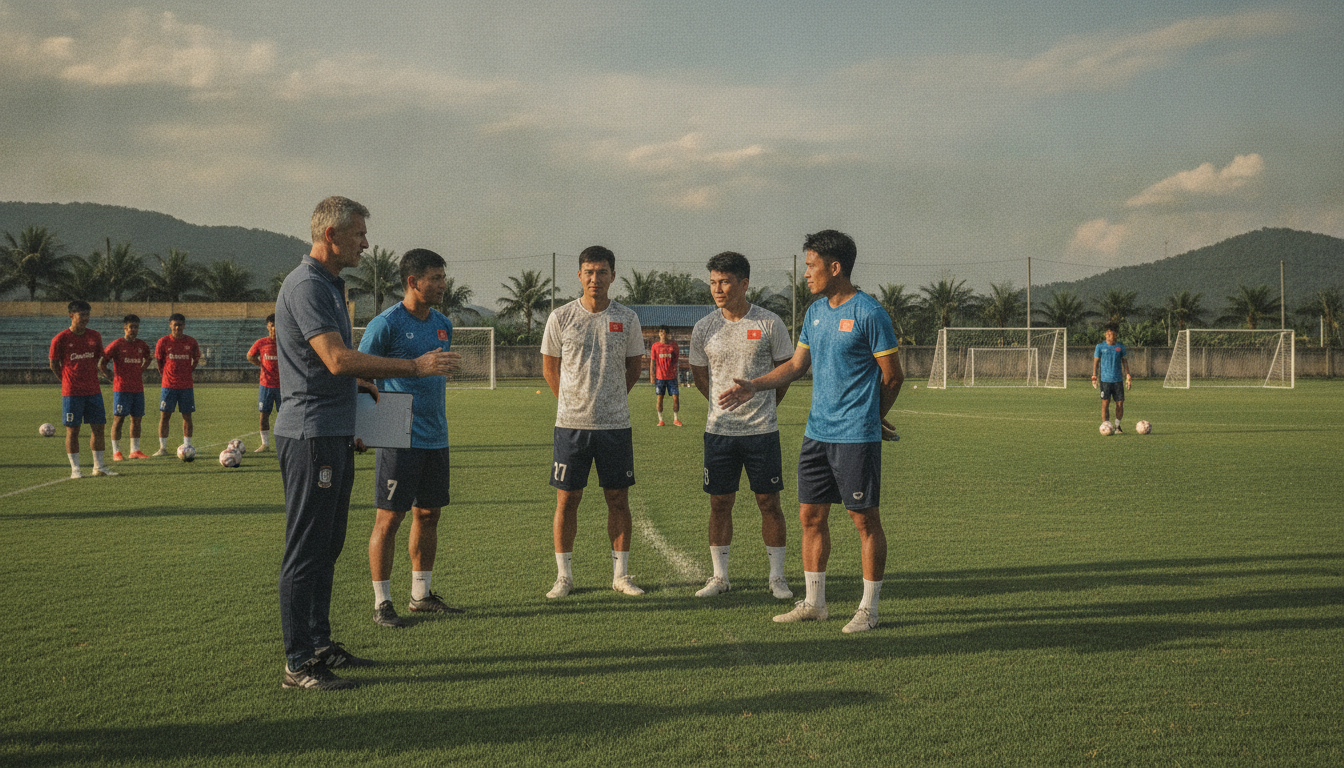
Laos arrived in Gia Lai to conduct an intensive period of training and match practice that the Laos Football Federation confirmed on July 1, 2026. The team will play four closed-door friendlies, providing the coaching staff with controlled environments to test formations and combinations. These matches are designed to simulate competitive conditions while allowing coaches to make adjustments away from public and media scrutiny.
The choice of Gia Lai reflects a preference for neutral, well-equipped venues in Vietnam that can accommodate privacy and high-intensity work. Facilities in the province have been used by regional teams for preparation in recent years and offer quality playing surfaces and training infrastructure. The controlled setting will enable Grujic and his technical team to monitor players’ fitness and readiness without the pressure of public fixtures.
The Laos Football Federation has emphasized that the friendlies will focus on building cohesion rather than producing results for their own sake. With the AFF Hyundai Cup less than a month away, the priority is to finalize the core lineup and clarify each player’s role. Observers inside the camp expect several tactical tweaks as Grujic shapes the team’s identity for the tournament.
Grujic outlines preparation strategy and objectives
Head coach Vladica Grujic, who brings experience from Serbian football, has centered the preparation plan on defensive organization and transitional play. Grujic’s approach places weight on structured defensive lines combined with quick forward transitions to exploit counter-attacking opportunities. The training agenda reportedly includes set-piece routines, positional drills, and small-sided games tailored to replicate match-phase scenarios.
Part of Grujic’s remit is to assess younger players who could add depth to the squad during the tournament’s congested schedule. The closed-door matches will allow fringe players to make a case for inclusion without the distractions of public scrutiny. Officials say the coach will balance experience and youth while prioritizing players who can adapt to multiple tactical roles.
Fitness and conditioning are central to the strategy, with the technical staff monitoring workloads closely to prevent injury and ensure match sharpness. Recovery protocols, tailored gym sessions, and nutritional plans form part of the daily routine, reflecting a professionalized approach to tournament readiness. This structured preparation is intended to help Laos navigate the demands of Group B.
Squad assessment and selection considerations
Laos’ squad selection for the AFF Hyundai Cup will hinge on the outcomes of the Gia Lai friendlies and the fitness status of key players. The coaching team is set to evaluate players across defensive, midfield, and attacking units to determine the best balance for the tournament. Versatility will be a valued trait as the team prepares to face a variety of tactical systems from Group B opponents.
The closed-door format gives coaches the freedom to experiment with formations, from compact defensive blocks to more expansive setups that encourage wide play. Decision-makers will watch closely for players who demonstrate consistency under pressure and the capacity to execute strategic instructions. Established starters will face competition from young prospects aiming to secure a roster spot.
Goalkeeping choices and central defensive partnerships are expected to attract particular attention, given the quality of attacking options in the group. Midfield dynamics—whether to field a holding pivot or a more mobile duo—will be determined by both performance and physical readiness. The final squad is likely to reflect a compromise between tactical needs and player availability ahead of the July 25 opener.
Logistics, schedule and travel plans
Laos will remain in Vietnam’s Gia Lai province until July 14, according to the federation’s schedule released at the start of the month. The extended stay provides time for multiple training sessions and the planned quartet of friendly matches. After concluding work in Gia Lai, the team will return to Vientiane in the lead-up to the AFF Hyundai Cup opening fixture.
The national side’s first competitive match of the tournament is scheduled for July 25, when Laos will host Thailand at the New Laos National Stadium. That fixture, which takes place on home soil, will be a key early test in Group B and will set the tone for Laos’ campaign. The federation has emphasized the importance of careful travel planning, rest periods, and final tune-up sessions between July 14 and the opening game.
Logistical arrangements also cover medical support, equipment transport, and coordination with tournament organizers to ensure smooth accreditation and match-day operations. The federation is working to streamline coordination so players and staff can focus solely on on-field preparation once they return home. Officials have also noted contingency plans in case of late injuries or other unforeseen issues.
Group B opponents and tactical challenges
Laos is drawn in Group B alongside Thailand, Malaysia, the Philippines, and Myanmar—opponents with differing strengths and tactical profiles. Thailand enters as a traditional regional heavyweight, known for technical quality and fluid attacking play, while Malaysia brings athleticism and physical structure. The Philippines and Myanmar both pose varied challenges with disciplined systems and counter-attacking tendencies.
Understanding the tactical identity of each opponent will shape Laos’ preparations, with specific match plans expected to be developed once scouting reports are completed. The friendlies in Gia Lai offer a chance to rehearse responses to high-pressing teams, compact midblocks, and quick transitional threats. Match analysis will focus on how best to neutralize opponents’ key playmakers and exploit spaces on the counter.
The group composition requires tactical flexibility from Laos, with an emphasis on defensive resilience and rapid structural shifts during transitions. Maintaining concentration across 90 minutes and converting key chances will be decisive in a tightly contested group. As such, the technical staff will prioritize situational training that mirrors the variety of challenges posed by Group B.
Expectations ahead of the New Laos National Stadium opener
The July 25 match against Thailand will be scrutinized as a barometer of Laos’ progress under Grujic and a chance to capitalize on home advantage. Playing at the New Laos National Stadium offers familiarity with the pitch and local conditions, as well as potential crowd support. However, Thailand’s pedigree and depth present a stern early examination of Laos’ tactical arrangements and mental preparedness.
The home opener will likely influence momentum and public perception of the campaign, making the build-up period particularly important. Coaches will aim to balance tactical discipline with an ambitious game plan that seeks to unsettle a favoured opponent. While cautious optimism is reasonable, realistic appraisal acknowledges the quality and experience Thailand brings to the fixture.
Beyond the opener, Laos will need consistent performances across the group stage to challenge for advancement, and early points could prove pivotal. The federation and coaching staff understand that incremental improvements in cohesion and execution during the friendlies are essential to broader tournament ambitions. The focus remains on controllable factors: preparation, fitness, and tactical clarity.
Laos’ training block in Gia Lai under Vladica Grujic reflects a deliberate attempt to enter the AFF Hyundai Cup 2026 as a better-prepared and more cohesive unit. With four closed-door friendlies scheduled, a clear logistical plan, and a home opener that will attract regional attention, the Laos national team is prioritizing structure, adaptability, and match readiness. The next weeks will determine whether those preparations translate into competitive results when Group B action begins.