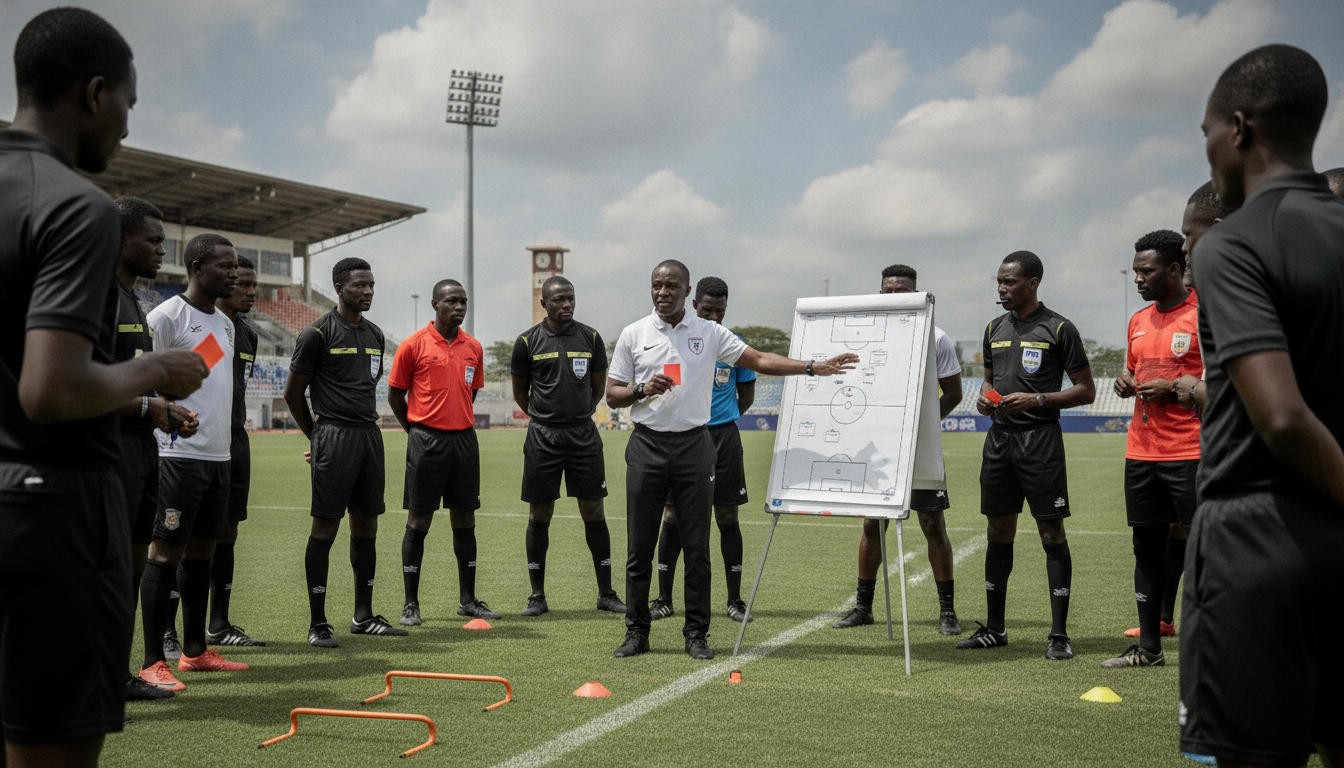
Liberia referee training workshop closed as LFA strengthens officiating standards
LFA closes intensive capacity-building program for referee instructors and assessors to unify Laws interpretation and raise domestic officiating quality.


In a move aimed at strengthening officiating standards nationwide, the Liberia Football Association (LFA) has formally closed a multi-day capacity-building workshop for referee instructors and assessors. The Liberia referee training program focused on creating a consistent interpretation of the Laws of the Game and establishing a rigorous evaluation framework for match officials. Led in part by FIFA Technical Instructor Al Mohammed Ahmed, the initiative was presented as a strategic step toward improving match-day decision-making and restoring public confidence in domestic competitions.
LFA closes intensive instructor and assessor workshop
The LFA’s refereeing department convened instructors and assessors for several days of concentrated technical instruction and assessment methodology. Sessions combined classroom review of the Laws of the Game with practical exercises designed to align judgment and judgement-crafting across the pool of national instructors. Organizers said the timing was deliberate, given recent expansion of the domestic league structure and upcoming international qualification campaigns.
Officials described the workshop as an effort to professionalize the third team on every pitch — those charged with enforcing the laws and preserving competitive integrity. Emphasis was placed on consistent application of rules, transparent assessment of referee performance, and developing a clear pathway for assessors to support referees at all levels. The LFA framed the program as part of a longer-term strategy to institutionalize refereeing standards across Liberia’s 15 counties.
FIFA instructor stresses adaptation to modern tactics and technology
FIFA Technical Instructor Al Mohammed Ahmed underlined that refereeing must evolve alongside changes in the sport’s tactics and technological tools. He argued that instructors need both theoretical mastery and practical techniques to translate rule changes into correct, repeatable match decisions. Ahmed emphasized agility in instruction so that referees and assessors can respond to new interpretations and innovations consistently.
Training modules addressed contemporary match scenarios and the decision-making processes behind them, with a view toward minimizing subjective variation between officials. Ahmed highlighted the importance of harmonizing classroom teaching with on-field behavior, ensuring that the interpretation conveyed in seminars is mirrored in real matches. He also signaled confidence in Liberia’s pool of officiating personnel, noting they possess the foundational skills necessary to meet international benchmarks with continued development.
Referee Committee chair frames workshop as investment in human capital
Judge Joseph M. Kollie, chair of the LFA’s Referee Committee, framed the workshop as part of a sustained investment in human capital rather than a one-off certification exercise. He reiterated the association’s commitment to creating avenues for former referees to remain engaged with the game in mentoring and assessor roles. Kollie said this approach preserves institutional knowledge while building technical capacity among a new generation of officials.
Kollie charged instructors with translating what they had learned into measurable improvements on the pitch, from grassroots fixtures to elite competitions. He said the LFA has supplied resources and external expertise, and that the responsibility now rests with the instructors to raise standards. The committee chair also indicated that further education and monitoring would follow, positioning the workshop as the first phase of a comprehensive refereeing development program.
LFA links training to transparency and public trust in competitions
Leaders at the LFA described the training as essential to restoring and maintaining public trust in officiating decisions and, by extension, the credibility of national competitions. They argued that consistent, accountable officiating reduces controversy and improves the fan and stakeholder experience. The training’s evaluation framework was presented as a tool to enhance transparency and to hold match officials to consistent professional standards.
Officials noted that enhancing referee accountability would benefit clubs, players, and supporters by producing fairer outcomes and clearer post-match explanations when controversies arise. The LFA intends to implement standardized reporting and assessment forms to document performance and guide targeted retraining. By institutionalizing these practices, the association hopes to reduce disputes and foster wider confidence in match-day governance.
Workshop positioned to support Lone Star and domestic league ambitions
The timing of the Liberia referee training coincides with a crucial qualification period for the national team, the Lone Star, as it prepares for AFCON 2027 qualifying fixtures. LFA officials tied referee development directly to the country’s broader competitive ambitions, arguing that high-quality domestic officiating raises the standard of play and better prepares players and coaches for international tests. Improving officiating at home, they said, contributes to a stronger national team environment.
Domestic clubs stand to benefit from clearer application of the laws and more consistent match management, which can reduce the influence of officiating inconsistencies on league standings. League administrators and club executives have expressed interest in the institutional changes, viewing them as complementary to investments in coaching and player development. The LFA believes that a more technically proficient officiating corps will help the domestic competitions become a more reliable talent pipeline for the national side.
County rollout and monitoring plan aims for multiplier effect
Following the workshop’s close, instructors and assessors will return to their respective counties to cascade the new material to active referees across Liberia’s 15 counties. LFA officials described this as a "multiplier" approach, where concentrated training for instructors produces downstream benefits for hundreds of match officials. The rollout will include district-level seminars, live-match mentoring, and periodic assessments to ensure the new standards are being consistently applied.
The association plans to track progress through structured evaluations and to convene refresher courses at intervals to reinforce learning and address emerging issues. Officials also signaled plans to integrate assessment data into referee selection for high-profile fixtures and to use performance metrics when assigning officials to league and cup matches. This monitoring architecture is intended to provide both accountability and a clear route for referees to progress based on demonstrated competence.
Expected outcomes for match quality and stakeholder confidence
The LFA anticipates several concrete outcomes from the instructor development program, including reductions in controversial decisions, improved fitness and positioning of referees, and more consistent disciplinary standards. These changes are expected to yield matches that are technically cleaner and administratively more defensible. The association also sees potential commercial benefits, as predictable officiating standards can enhance the marketability of domestic competitions to sponsors and broadcasters.
Fan and club confidence are among the key metrics LFA will watch as the program is applied across counties. By establishing transparent evaluation and public accountability mechanisms, the association aims to resolve disputes more efficiently and to provide clearer explanations when contentious calls occur. Over time, officials said, this should help to normalize expectations around officiating performance and to reduce the frequency of high-profile controversies.
The workshop’s organizers described this initiative as an early but important step in a broader, multi-year plan to professionalize football governance in Liberia. The LFA will now move into a phase of practical implementation and measurement, with instructors deployed to districts and assessors preparing to apply the new evaluation standards. If sustained, the program could reshape domestic officiating standards and support Liberia’s ambitions on the continental and global stage.