Liverpool 1-1 Chelsea as Gravenberch opener canceled by Enzo Fernández at Anfield
Liverpool 1-1 Chelsea at Anfield Gravenberch opener canceled by Enzo Fernández as both sides leave with questions over form and European hopes ahead.


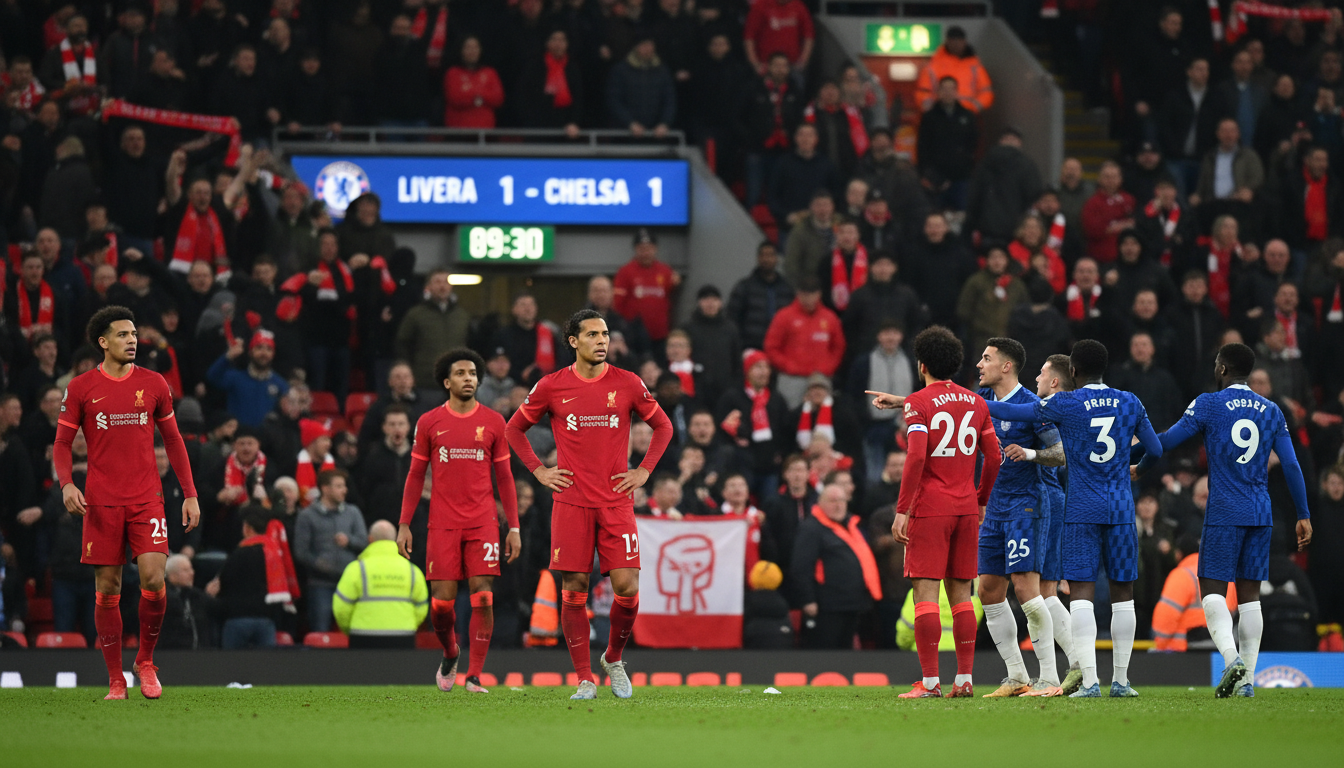
Liverpool 1-1 Chelsea summed up a season of missed opportunities for the hosts as an early Ryan Gravenberch goal was wiped out by Enzo Fernández and both teams left Anfield with more doubt than certainty. The draw left Liverpool clinging to Champions League positions but short on momentum, while Chelsea stopped a damaging losing run without converting the point into sustained revival. The match featured tactical tinkering, notable absences from both squads, VAR interventions that disallowed chances, and visible unrest among the home crowd.
Gravenberch gives Liverpool an early advantage
Ryan Gravenberch struck inside the opening ten minutes to put Liverpool ahead and raise hopes of a controlled, authoritative performance. The goal came from a scrappy situation after a set-piece, with the midfielder picking his spot and curling the ball beyond the goalkeeper. For a brief period Liverpool looked composed and capable of dictating the game against a Chelsea side reduced in options and confidence.
That early optimism soon dissipated as Liverpool failed to press the advantage and allowed Chelsea to grow into the contest. The hosts showed flashes of quality but lacked the sustained intensity needed to force a second goal. The opening minutes only emphasized how fragile momentum has become for Liverpool this season.
Enzo Fernández levels from a set play
Chelsea’s response gathered pace as they settled into possession and probed the Liverpool back line, exploiting the flanks through their wing-backs. The equaliser arrived from a dead-ball situation in the 35th minute when Enzo Fernández’s delivery slipped past bodies and found the net. The goal restored parity and shifted the match toward a tense, tactical stalemate.
Fernández’s strike underlined Chelsea’s reliance on moments of individual quality to counterbalance an improvised attacking structure. It also exposed Liverpool’s tendency to retreat after taking the lead, a recurring pattern that has cost them control in several fixtures this term. The remainder of the first half unfolded with neither side able to establish clear domination.
Lineups absentees and tactical shapes
Both managers selected formations that emphasized compactness and balance as much as attacking intent, with Liverpool lining up in a 4-2-3-1 and Chelsea mirroring the shape. Giorgi Mamardashvili started in goal for Liverpool with a back four featuring Curtis Jones, Ibrahima Konaté, Virgil van Dijk and Milos Kerkez. Ryan Gravenberch and Alexis Mac Allister sat as a double pivot ahead of a creative line that included Dominik Szoboszlai, Jeremie Frimpong and Rio Ngumoha.
Chelsea named a defensive core around Filip Jorgensen, Levi Colwill, Wesley Fofana and Jorrel Hato, with Malo Gusto and Marc Cucurella providing width. Moisés Caicedo and Andrey Santos offered midfield protection while Cole Palmer and Enzo Fernández supported Joao Pedro up front. The personnel choices reflected both plans and limitations rather than ideal matchups, with managers adapting to the resources available.
Significant absences shaped each side’s approach and momentum. Liverpool were without Mohamed Salah, Alisson and Florian Wirtz, a combination that curtailed their attacking fluidity and leadership in key areas. Chelsea’s squad was also depleted, missing Robert Sánchez, Pedro Neto, Alejandro Garnacho and other wide options, which forced a cautious game plan and inhibited sustained forward thrusts.
Second half VAR interventions and near misses
The second half produced intermittent sparks but few sustained periods of control or creativity from either team. VAR intervened twice to rule out potential go-ahead goals, first disallowing Cole Palmer’s effort for an offside and later overturning a Curtis Jones finish for the same reason. Those interventions punctured late momentum swings and left both teams retreating into caution.
Liverpool came close to converting pressure into a winner when Dominik Szoboszlai and Virgil van Dijk struck the woodwork, moments that illustrated both the hosts’ threat and their inability to find the net. Chelsea, for their part, defended resolutely and managed to frustrate Liverpool’s rhythm without producing a decisive counter. The overall tone of the half was one of attrition, with tactical adjustments aimed at damage limitation rather than expansive play.
The pattern of disallowed goals and near misses reinforced the match’s shapeless quality, where individual moments mattered more than coherent phases of play. Neither coach could extract a decisive plan from the contest, and the final whistle confirmed a shared return to uncertainty.
Anfield discontent and managerial scrutiny
Frustration at Anfield was audible at full time and intensified during key moments of the game, most notably when Rio Ngumoha was withdrawn. The substitution provoked a chorus of boos and signalled a growing disconnect between supporters and the manager’s choices. Ngumoha had been one of Liverpool’s liveliest attacking outlets, and his removal crystallised fan disquiet about in-game decisions.
Supporters’ criticism extended beyond one change to broader concerns about the team’s reluctance to press the advantage and an apparent tactical conservatism after taking the lead. Those reactions mirror a season-long tension at Liverpool, where patience is fraying and expectations remain high even as results fluctuate. The atmosphere around the club is increasingly defined by questions about leadership, strategy and the capacity to regain consistent form.
Manager Arne Slot acknowledged the reaction and framed it as an inevitable response to dropped points, but recognition has not quelled scrutiny. The relationship between the dugout and the stands appears strained, and rebuilding trust will demand clearer evidence of coherent planning and improved outcomes on the pitch.
League ramifications and the stretch run
The draw left Liverpool in fourth place on 59 points with two matches remaining, holding a precarious grip on Champions League qualification that still requires steady results. The single point maintains the club’s proximity to its objective but heightens the importance of finishing the campaign with at least one victory to secure their spot. Dropped points in fixtures against sides perceived as lesser threats have amplified the pressure heading into the season’s final fixtures.
For Chelsea the point halted a six-match losing sequence and offered a psychological reprieve more than a substantive reversal of fortunes. They remain well outside European qualification positions and will need a combination of improved form and favorable results elsewhere to climb into contention for continental competition. The draw provided a platform for recovery but did not cure deeper inconsistencies in personnel availability and attacking cohesion.
Both clubs face immediate tests in the closing weeks of the season, and the outcomes of those matches will shape managerial assessments, transfer planning and broader strategic decisions. The Premier League race for European places is tight, and margins for error are shrinking for teams on either side of the table.
Final preparations and what to watch next
With two fixtures left, Liverpool must find a sharper edge and a clearer plan to convert possession into sustained attacking threat. Restoring fluency and reestablishing the trust of the supporters will be as crucial as tactical tweaks. The club’s handling of absentees and rotation choices will also influence the closing run and managerial evaluations.
Chelsea’s immediate priority is to build on the halt to their losing run and to generate more consistent attacking patterns despite a limited squad. Integrating returning players and rediscovering forward momentum will be important if they are to turn this draw into a springboard for next season. Both sides will enter their next matches aware that small shifts can carry oversized consequences.
Liverpool 1-1 Chelsea at Anfield left as many questions as answers and underlined the fragility of momentum in a long season. The draw preserved existing positions while amplifying pressure on decision-makers and players to deliver clarity and results in the final stretch of fixtures.