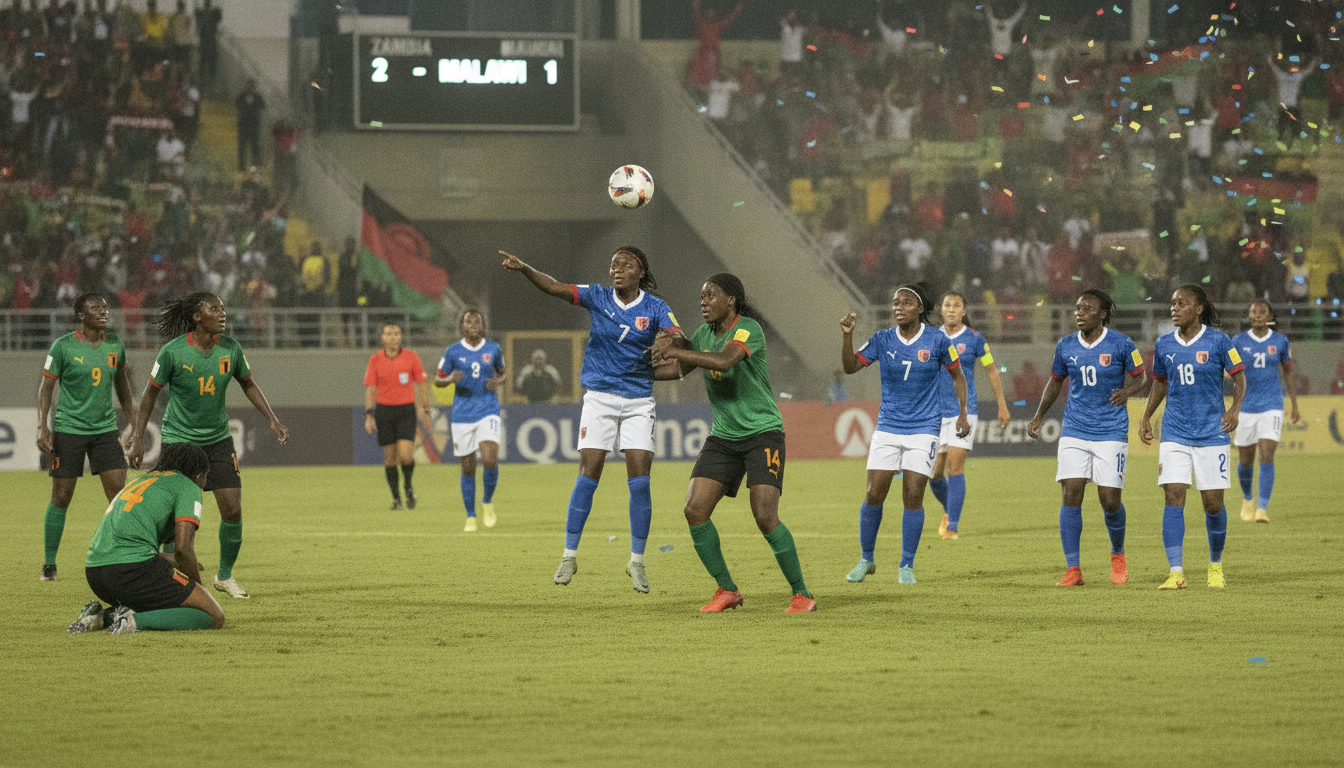
Malawi reach WAFCON 2026 quarter-finals despite 2-1 loss to Zambia
Malawi reach quarter-finals after finishing top of Group C on a head-to-head mini-league tiebreak, despite a 2-1 defeat by Zambia and Nigeria’s 6-2 win over Egypt.


Malawi secured progression to the 2026 Women’s Africa Cup of Nations quarter-finals despite losing 2-1 to neighbours Zambia in their final Group C fixture. The Scorchers advanced as Group C winners after a three-way tie on six points was resolved by a head-to-head mini-league that favoured Malawi on goals scored. Tabitha Chawinga’s late strike reduced the deficit but it was Nigeria’s decisive win over Egypt that ultimately handed Malawi the group victory.
Early setback as Banda’s deflected strike opens scoring
Zambia surged out of the blocks and opened the scoring inside two minutes when captain Barbara Banda cut in from the left and forced goalkeeper Mercy Sikelo into a parry that cannoned into the net. The early goal unsettled Malawi and set the tone for the first half as Zambia pressed their advantage. Sikelo’s positioning on the opening play came under scrutiny as the ball ricocheted off her and into the goal.
The immediate concession forced Malawi onto the back foot and they struggled to settle rhythmally in midfield. Zambia’s fast start allowed them to control the tempo and probe for openings down both flanks. The early deficit would prove decisive in match momentum even as Malawi sought to regroup.
Key substitution and defensive lapse help Zambia double lead
Malawi suffered another blow in the 27th minute when winger Sabina Thom was forced off with an injury, prompting Asimenye Simwaka to come on. The change disrupted Malawi’s attacking structure and they failed to reclaim authority in the wide areas. Zambia capitalised on the disorganisation 10 minutes later.
A lapse in Malawi’s defence created space for wing-back Margaret Belemu to surge forward and deliver a low pull-back that found Prisca Chilufya, who finished at the near post in the 37th minute. That strike doubled Zambia’s lead and left the Scorchers with a mountain to climb heading into the interval. Defensive cohesion and set-piece protection were clear areas of concern for Malawi at that stage.
Chawinga’s 72nd-minute strike offers slim hope
Malawi’s best chance to salvage the game arrived in the second half as Tabitha Chawinga produced a moment of individual quality in the 72nd minute. Chawinga weaved past her marker in tight space and composedly slotted the ball beyond the Zambian goalkeeper to make it 2-1. The goal injected urgency into Malawi’s play and forced Zambia to reorganise for containment rather than attack.
Despite the renewed impetus, Malawi struggled to create sustained pressure or generate clear-cut chances in the closing stages. Turnovers in midfield and a lack of penetration through central areas prevented the Scorchers from forcing a late equaliser. Zambia held on to claim the victory, while Malawi’s fate would hinge on results elsewhere in the group.
Nigeria’s rout triggers mini-league drama
In the other Group C fixture, Nigeria produced a resounding 6-2 victory over Egypt that dramatically reshaped the group standings. The result meant Malawi, Nigeria and Zambia all finished level on six points, with Egypt bottom of the group on zero points. Tournament regulations required that results against the bottom team be excluded when three teams were tied, creating a head-to-head mini-league to separate the trio.
That mini-league used points in matches among the tied sides first, then goal difference and goals scored in those matches to determine positions. With Egypt’s results discarded, the mini-table favoured Malawi on the basis of goals scored across the head-to-head fixtures. Nigeria finished second and Zambia were eliminated after failing to match the head-to-head goal tallies of their rivals.
How the head-to-head tiebreak favored Malawi
When the three-way tie was recalculated excluding Egypt, Malawi emerged with a total of four goals scored in the head-to-head encounters against Nigeria and Zambia. Nigeria recorded three goals in those matches while Zambia managed two, leaving the Zambians out on goal difference within the mini-league. Malawi’s offensive returns in the direct encounters proved the decisive metric in a tightly contested group.
The outcome underlines the marginal nature of group-stage arithmetic in short international tournaments, where a single extra strike or lapse can determine qualification. For Malawi, the tally of goals scored in the two relevant matches provided the crucial edge, even though they finished the final match on the losing side. Zambia’s stronger performance in open play was not enough to overcome the specific head-to-head criteria that applied.
Quarter-final assignment and tactical outlook
Malawi will advance to face the second-placed side from Group D in the quarter-finals, a section that contains Cameroon, Ghana, Mali and Cape Verde. The Scorchers will prepare to meet a side emerging as Group D runners-up and will need to adapt tactics to counter the likely physicality and pace of that opponent. Malawi’s coaching staff will be expected to shore up defensive organisation and find ways to release Chawinga more consistently.
On the attacking front, improving ball retention and midfield balance will be critical if Malawi are to make a deeper run in the knockout stage. The team’s knockout hopes rest on tightening moments of susceptibility at the back and converting control of the ball into meaningful chances. From a selection perspective, the fitness of players who picked up knocks in the group phase will be an immediate focus in the days ahead.
Implications for Zambia and Nigeria after group finale
Zambia’s victory provided a solid performance in open play but ultimately fell short because of the mini-league arithmetic that followed Nigeria’s big win. The Zambian squad can take positives from their offensive cohesion and early dominance in the match, yet they must confront the reality of elimination on a technical tiebreak. Analysts will point to marginal errors and the timing of substitute changes as factors that proved costly.
Nigeria’s 6-2 result against Egypt showcased attacking depth and firepower that will make them strong contenders going forward. Finishing as Group C runners-up still leaves the Super Falcons well positioned for a deep tournament run given their scoring form. For Egypt, the group stage exit will prompt reflection on defensive organisation and the gulf in quality encountered in the group fixtures.
Malawi reach quarter-finals after a tense group resolution that highlighted both the fragility and resilience of the Scorchers. The team now moves forward to a knockout tie where tactical discipline and clinical finishing will be essential. The margin between advancing and elimination in this WAFCON edition continues to be slim, and Malawi will be judged on how they translate this narrow triumph into a competitive quarter-final performance.