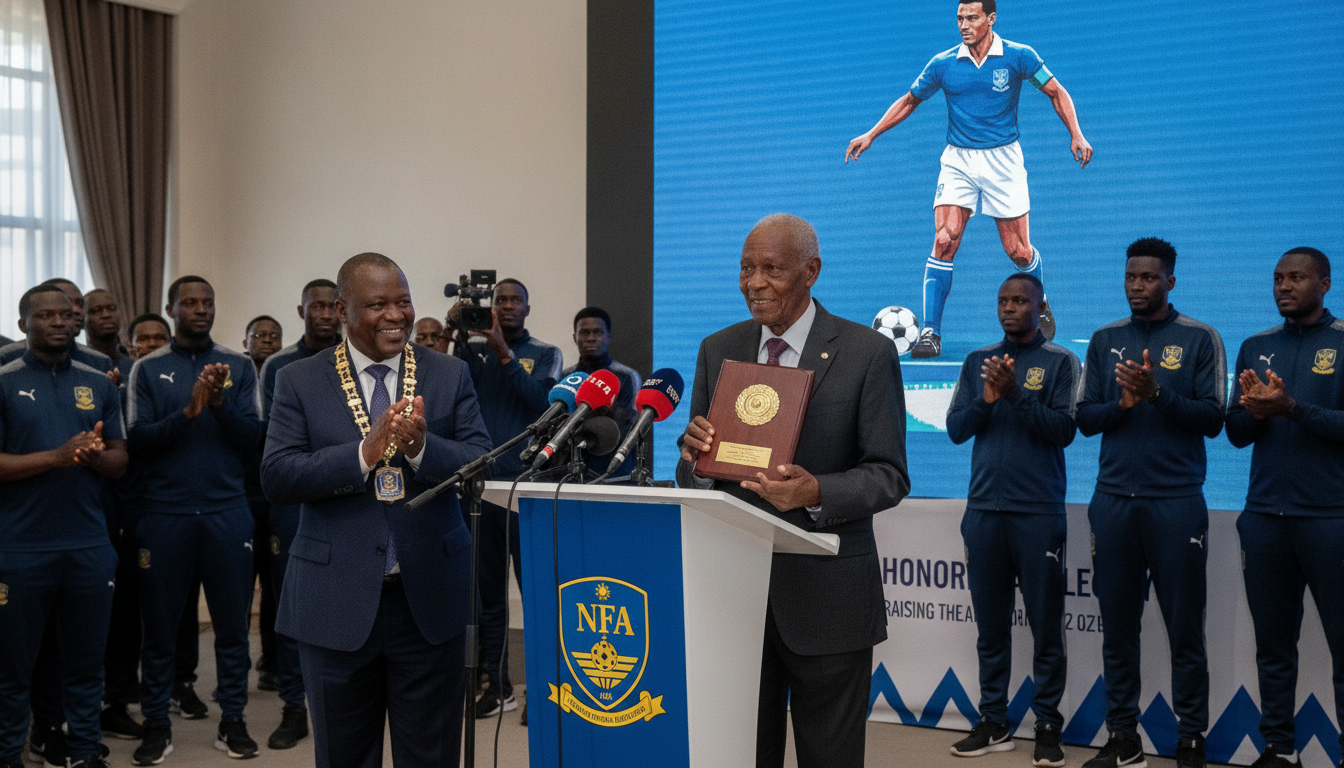
Namibian legend Oscar Mengo honoured by NFA as country pushes for professional league growth
Veteran player and coach Oscar Mengo was celebrated by the Namibia Football Association at the opening of a CAF B licence coaching course, highlighting calls for better pay, preparation and investment in the domestic league.


Oscar Mengo received formal recognition from the Namibia Football Association (NFA) during the official opening of the Confederation of African Football B licence coaching course, an event that doubled as a salute to his long service to Namibian football. The honour acknowledged Mengo’s playing career, club-building work and ongoing advocacy for improved structures and resources in the domestic game.
NFA ceremony highlights Mengo’s lifetime of service
The NFA presented Mengo with a commemorative acknowledgement at the coaching-course opening, placing his career in the context of a broader push to professionalize coaching and club administration. NFA officials framed the recognition as part of efforts to connect past leaders with emerging coaches attending the CAF B programme.
Delegates at the event heard Mengo reflect on the importance of well-trained coaches and a sustainable league calendar, remarks that reinforced the timing of the tribute with the start of the coaching diploma. The ceremony served both as personal recognition and a public reminder that experienced figures can shape policy conversations about the future of Namibian football.
Playing career: African Stars, Kaizer Chiefs and national representation
Mengo’s playing CV is distinguished by a long spell as a star performer for African Stars FC, the four-time Namibia Premier Football League champions where he was a central figure during their dominance. His performances at club level established him as one of the more prominent players of his generation in Namibia’s domestic game.
Beyond domestic success, Mengo also played for South African giants Kaizer Chiefs, exposing him to a higher level of professional football and broader regional competition. He represented the South West Africa national team in the 1970s, providing international experience at a formative time for the country’s football identity.
Founding Liverpool FC Okahandja and club achievements
In the 1990s Mengo founded Liverpool FC of Okahandja, a club that rose quickly to national prominence under his guidance and later won the NFA Cup in 1992. That team’s trajectory culminated in the 2001/02 Namibia Premier Football League title, a milestone that cemented the club’s place in early-2000s Namibian football history.
Although Liverpool FC Okahandja is now defunct, Mengo’s role in building the outfit is frequently cited as a model of local initiative: identifying talent, organizing competitive structures and securing competitive success. The club’s achievements remain part of Mengo’s legacy and a reference point in conversations about sustainable club development in Namibia.
Concerns over player pay, welfare and club priorities
At the ceremony Mengo reiterated long-standing concerns about low player salaries and inadequate welfare provisions, arguing that financial insecurity undermines commitment and development at club level. He described a persistent gap between the remuneration players receive and the benefits clubs expect them to deliver, a gap he said weakens both individual careers and league quality.
Mengo urged clubs and stakeholders to prioritise regular, competitive pay and basic welfare measures so players can focus on performance and development. He cautioned that without concerted action on salaries and support, talent retention will remain a challenge and progress toward a competitive, exportable product will stall.
Seasonal planning and professional fixtures as a development tool
Mengo criticised delays in season kick-offs and erratic fixture release, contrasting the situation with established leagues such as the English Premier League where fixtures and start dates are set and communicated well in advance. He said reliable calendars allow clubs, players and supporters to plan, which in turn creates a more stable environment for training, sponsorship activation and fan engagement.
He recommended that Namibian clubs and the NFA adopt clearer, predictable scheduling practices and improve administrative capacity to publish fixtures on time. That predictability, he argued, would help attract sponsors and enable players to prepare physically and mentally for a planned competition cycle.
Sponsorship, resources and the pathway to international recognition
Mengo stressed that domestic success and international visibility depend heavily on financial investment and professional management, calling for improved sponsorship channels and resource allocation to youth development. He suggested that strategic investment in academies, coaching education and club infrastructure is necessary to turn local talent into players capable of competing on continental and global stages.
The veteran outlined how sponsorship could be tied to measurable development outcomes such as coaching accreditation rates, youth tournament participation and player welfare programs. By linking commercial support to long-term growth metrics, Mengo said the league could build credibility and attract partners interested in substantive, sustainable development.
Assessment of Africa’s World Cup showing and lessons for Namibia
Reflecting on recent World Cup performances, Mengo praised Morocco’s deep run and Egypt’s progress to the knockout stages as evidence of the continent’s rising competitive level. He noted that Africa’s representation in the round-of-32 demonstrated depth across the continent, but he also warned that national teams’ short-term success must be matched by stronger domestic systems.
Mengo argued that thorough, long-term preparation is essential if Namibian football is to make similar strides, pointing to the need for structured talent pipelines and international exposure for players. He recommended that lessons from African teams’ World Cup campaigns be studied by clubs and federations to inform technical planning and resource allocation.
Final paragraph
Oscar Mengo’s formal recognition by the NFA came at a moment when coaching education and calls for league reform are converging in Namibia, and his remarks underscored the link between honoring past contributors and building the systems needed for future success. The tribute rekindled conversations on player pay, fixture professionalism, sponsorship and coaching standards, and it put a veteran voice at the center of a national debate about how Namibia’s domestic game can be organized to produce both competitive clubs and internationally capable players.