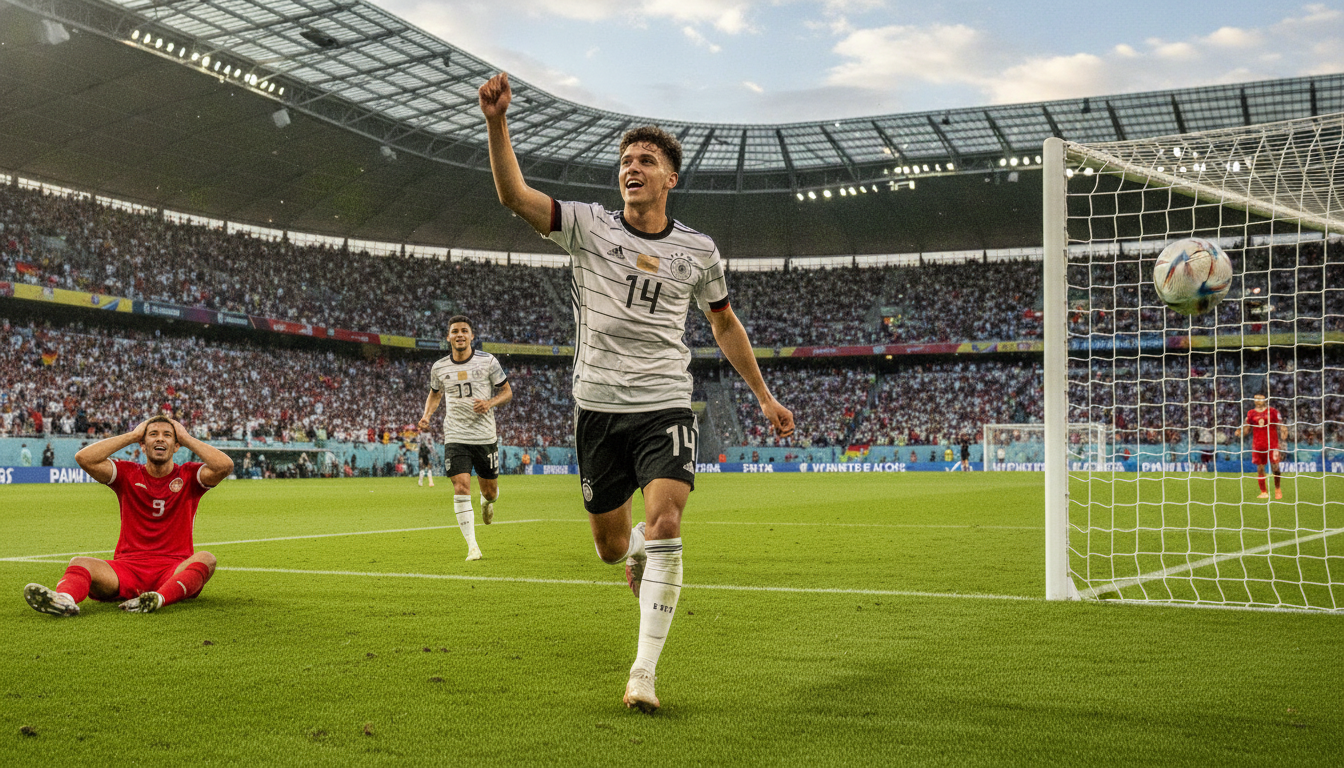
Nathaniel Brown World Cup Debut: Assist, Goal and Praise as Germany Dominates Curaçao
Nathaniel Brown World Cup debut: Eintracht Frankfurt defender provided the assist and scored in Germany’s victory, earning acclaim and marking a milestone two days before his 23rd birthday.


Brown’s World Cup Debut Sees Assist and Goal
Two days shy of his 23rd birthday, Nathaniel Brown made his first appearance at the FIFA World Cup and delivered a standout performance for Germany. The Eintracht Frankfurt defender started against Curaçao, provided the pass that set up the go-ahead goal, and later finished to make it Germany’s fourth of the night. The outing doubled as his sixth senior cap and represented a decisive personal milestone on football’s biggest stage.
Brown described the experience as overwhelming in the dressing room after the match, noting how much it meant to have family present in the stands. His immediate contributions — an assist and a goal — shifted the narrative from debut nerves to tangible influence on the scoreboard. For a player at the outset of his international career, the match offered a clear introduction to the demands and rewards of World Cup competition.
How the Assist and Goal Changed the Game
Brown’s assist came at a crucial moment, feeding Nico Schlotterbeck for the go-ahead strike that tilted momentum firmly in Germany’s favor. The sequence underlined his spatial awareness and composure when transitioning from defence to attack. That ability to deliver a decisive pass in a high-pressure environment illustrated why coaches had trusted him with a starting role.
Later in the match, Brown found the net to register Germany’s fourth goal, a finish that combined opportunism and technical execution. The goal gave him the rare distinction of both creating and scoring in his first World Cup match, a contribution that will be highlighted in match reports and highlight reels. Those two actions together helped close out the contest and demonstrated his influence at both ends of the pitch.
Nagelsmann’s Selection and Tactical Trust
Julian Nagelsmann’s decision to start Brown reflected a wider plan to blend youth and experience within the German defence. The coach’s selection suggested confidence in Brown’s readiness to perform on an international stage and in a system that demands defenders participate in build-up play. Nagelsmann has repeatedly emphasized fluidity in defence and the value of players who can step into midfield spaces, qualities Brown displayed during the game.
Brown’s inclusion also speaks to the national team’s search for versatile centre-back options capable of adapting to different opponents. Starting against Curaçao offered a managed opportunity for integration without compromising tactical cohesion. The performance will likely encourage Nagelsmann and his staff to continue examining Brown’s role in forthcoming fixtures.
Teammate Reactions and Kai Havertz’s Commendation
Inside the German camp, teammates reacted warmly to Brown’s breakthrough, acknowledging his work ethic and demeanour in training. Arsenal forward Kai Havertz publicly praised Brown, noting his tireless approach on the training pitch and calling his World Cup performance “outstanding” for a player of his age. Havertz also highlighted Brown’s humility and respectfulness, traits that have helped him settle into the squad environment.
Those endorsements from established internationals carry weight in locker-room dynamics and can smooth a young player’s path to more regular selection. Positive peer evaluations also reinforce the club-level impressions that earned Brown this opportunity. For a newcomer, having senior players amplify confidence can be as influential as tactical fits or individual metrics.
Implications for Eintracht Frankfurt and Club Season
Brown’s showing at the World Cup will be monitored closely back at Eintracht Frankfurt, where his form has already been drawing attention. A strong international display tends to raise a player’s profile and can influence transfer speculation, contract discussions, and the club’s planning for next season. Frankfurt’s defensive setup may also benefit from lessons learned about Brown’s capacity to contribute going forward and in transition phases.
At club level, Brown can return with elevated confidence and reinforced leadership credentials, particularly if he carries match sharpness from tournament play into domestic preparations. Eintracht’s coaches will likely assess whether his World Cup minutes should shift his role at the club or be managed carefully to avoid fatigue. Either way, his market value and standing within the squad are likely to be positively affected by the performance.
Broader Impact on Germany’s Defensive Options
Brown’s immediate impact adds another dimension to Germany’s defensive pool as the team navigates a multi-match tournament. His ability to assist and score shows he can be more than a traditional defensive anchor — he offers offensive contributions that align with modern centre-back expectations. That versatility increases selection dilemmas for the coaching staff but provides useful strategic depth as the tournament progresses.
Competition for places is a natural outcome when a newcomer performs well on such a stage, and Brown’s rise will intensify debates about partnerships and rotational patterns. For Nagelsmann, having additional reliable options allows tactical flexibility against varied opponents. The result in the Curaçao game will therefore resonate beyond a single fixture by informing squad planning and match-day choices.
Brown’s development trajectory also underscores Germany’s ongoing focus on integrating younger players into major tournaments. The pathway from youth setups and club form to senior international minutes has accelerated for several prospects, and Brown’s contribution serves as a case study of that process. How the staff manage minutes and responsibilities will shape not only his immediate involvement but also the long-term composition of the defensive unit.
Germany’s performance in the match against Curaçao provided an important test-bed for rotation and for evaluating players who could have expanded roles later in the tournament. Brown seized the opportunity, blending defensive duty with decisive offensive actions. That dual impact is likely to ensure he remains part of tactical conversations moving forward.
This match will be remembered in Brown’s career as the point where potential translated into measurable international influence. The combination of starting responsibility, an assist for the match-winner, and a personal goal created a high-impact debut that few players achieve. As he returns to club duties and brings this experience with him, observers will watch how he consolidates this moment into sustained progress.
The presence of family in the stadium, the congratulations from teammates, and public praise from respected players captured the human side of Brown’s milestone alongside the professional significance. Such personal validation can be motivating, but the tests ahead will determine whether this performance marks the start of a regular international role or a memorable singular highlight. For now, Brown has laid down a marker and given Germany another option to consider in their pursuit of tournament success.
Two days before turning 23, Nathaniel Brown converted opportunity into result on the World Cup stage, delivering both the pass that turned the game and a finish that sealed his night. The performance won immediate plaudits and will shape discussions at club and national levels about his role in the months and years ahead. As the tournament continues, his form and fitness will decide whether this debut becomes the first chapter of a long international career.