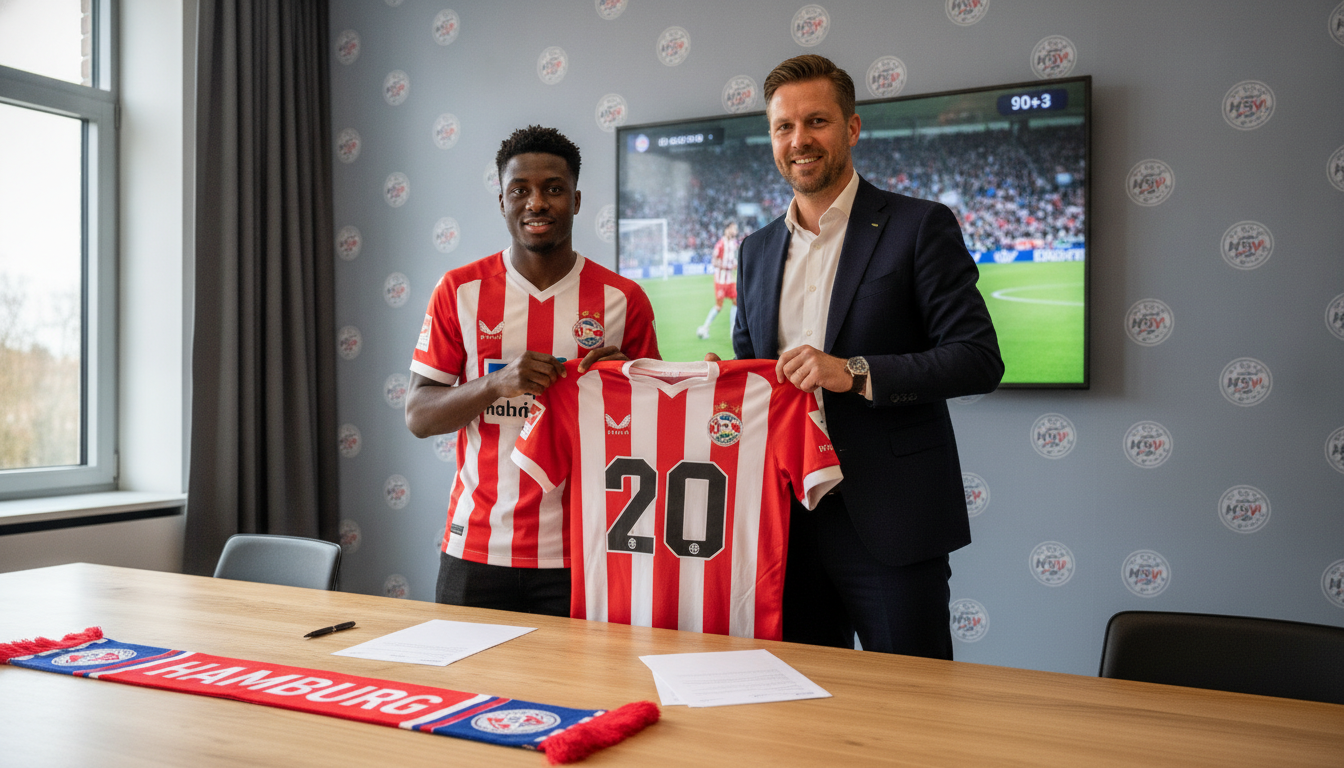
Patson Daka Signs for Hamburg as Zambian Forward Seeks Career Revival at HSV
Patson Daka joins Hamburg on a one-year deal with an option to extend, aiming to restart his career after a difficult spell at Leicester and to stake his claim for regular Bundesliga action.


Patson Daka arrived at Hamburg’s Austrian training camp on Friday, completing a free transfer that marks a fresh chapter for the 27‑year‑old striker. The move follows Leicester City’s relegation and closes a five‑year spell that began with a significant transfer fee, while offering Daka a short‑term contract structured to reward strong performances. He is expected to take part in Hamburg’s friendly against 1. FC Heidenheim as the club and player begin a period of assessment and adaptation. For Daka, the signing is explicitly about regaining form and consistency in the Bundesliga setting.
Contract and arrival specifics
Daka’s contract with Hamburg is initially for one year and includes a performance‑linked option to extend his stay at the club. The agreement allows both player and club to evaluate fit and impact across a single season while providing a clear pathway to a longer commitment if results meet expectations.
The striker comes to Hamburg on a free transfer after his time at Leicester concluded amid the club’s drop out of the English second tier and into the third division. He touched down at the club’s training base in Austria, where he will be integrated into preseason work and is likely to feature in non‑competitive fixtures before the Bundesliga season begins. The short‑term deal reflects mutual caution but also gives Daka a platform to rebuild his reputation at a high level.
Why Hamburg appealed to Daka
Daka said he was drawn to Hamburg after researching the club and speaking with former teammates who had experience in the city. Conversations with colleagues who had played in Germany helped shape his impression of the club’s environment and the support available to players adjusting to life and football in Hamburg.
Beyond personal recommendations, the club’s recent trajectory and its emphasis on attacking players presented a clear opportunity. For a forward seeking regular minutes and a system that values movement and pace, Hamburg offered both a receptive fan base and a sporting project where Daka could realistically expect to play a central role. The city and club culture also played a part in his decision to sign.
From Salzburg goalscorer to Leicester struggles
Daka’s rise began with prolific scoring in Austria, which led to a high‑profile move to England for a significant fee five years ago. Expectations were high when he arrived as a young forward with a strong scoring record, but his time in England did not unfold as planned, with form and consistency proving elusive.
A combination of tactical fit, competition for places and periods of limited minutes contributed to a difficult spell that culminated in his departure. The move to Hamburg follows a chapter that Daka and those around him view as an interruption rather than the defining element of his career. The switch back to a Bundesliga setting offers him the chance to align his game with a league that rewards dynamic attacking play.
Hamburg’s recruitment and the ‘second chance’ narrative
Hamburg have signalled a recruitment policy focused on players seeking to reassert themselves, with Daka joining fellow new signing Bilal Nadir in arriving on free transfers. The club’s strategy appears aimed at blending potential resale assets with experienced players who can deliver immediate impact and restore momentum in the side’s second season after promotion.
This approach also fits a wider narrative within the squad, where personnel returning from suspension or other setbacks are being reintegrated into a reshaped group. For the coaching staff, the priority is to convert these fresh starts into measurable contributions on the pitch—goals, assists and improved attacking cohesion—while keeping an eye on long‑term stability in the squad.
Performance expectations and pathway to extension
Hamburg have given Daka a clear incentive: strong performances will unlock the option to remain beyond the initial year. For a striker in his late twenties, the immediate targets are straightforward—find the net regularly, adapt to the tactical demands of the Bundesliga and demonstrate the work rate and link‑up play necessary in Hamburg’s system.
Coaches and analysts will assess Daka on several fronts, including movement behind the defence, ability to hold up play, pressing intensity and an eye for goal from varied positions. Equally important will be his adaptation off the pitch; quick assimilation into team routines and fitness levels at the start of preseason will shape how much responsibility the coaching staff entrust to him early on.
Preseason test and short‑term timeline
Daka is expected to make an unofficial debut in Hamburg’s friendly against 1. FC Heidenheim, a first opportunity for supporters and staff to gauge his match sharpness. Preseason fixtures will serve as practical examinations of his link with teammates and how quickly he can integrate into the patterns of play the coaching staff want to implement.
The coming weeks will determine his readiness for competitive action, with training sessions focused on tactical drills, combination play and set‑piece routines that could highlight his strengths. If Daka adapts quickly and produces tangible attacking returns in these games, the club is likely to fast‑track his involvement into early Bundesliga fixtures.
Fan reaction and broader implications for the squad
Supporters have responded to the Daka signing with cautious optimism, recognising both his raw talent and the potential for him to reignite the club’s attacking options. For a team aiming to consolidate its place in the Bundesliga, adding a forward with top‑flight experience, even if inconsistent, represents a low‑risk, potentially high‑reward move.
Within the squad, Daka’s arrival raises the competitive bar for forward positions and gives the coaching staff tactical flexibility. His presence will require existing attackers to maintain standards, while also offering different stylistic options—whether through direct runs in transition or finishing in the box when service arrives. The broader implication is a renewed emphasis on offensive productivity as a pathway to points.
Patson Daka views his move to Hamburg as a clear chance to reset and to turn a challenging period into a springboard for renewed success. The one‑year deal with an extension option places responsibility on immediate impact, and preseason will be the decisive phase for both player and club. If he can convert the opportunity into goals and consistent displays, Daka could not only secure a longer stay but also help Hamburg strengthen their position in the Bundesliga.