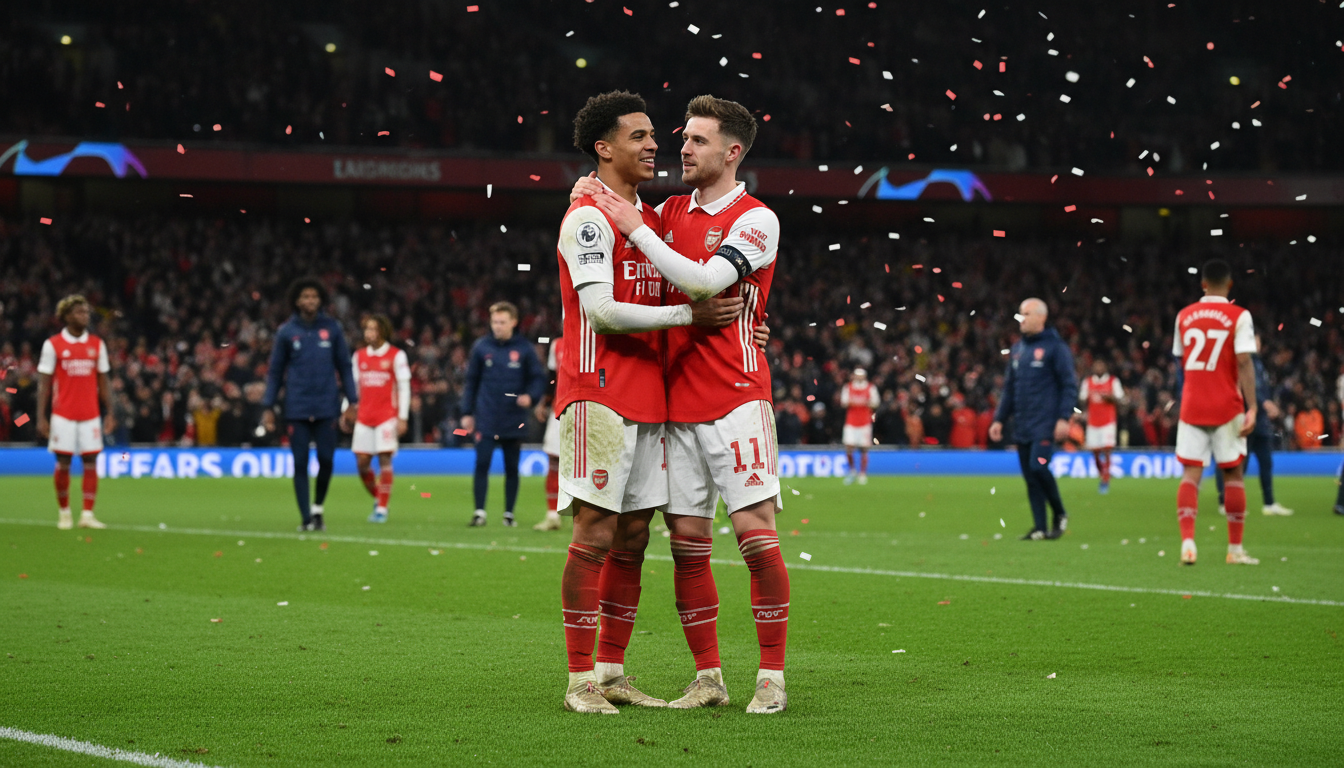
Declan Rice hails Myles Lewis-Skelly after composed display sends Arsenal to Champions League final
Declan Rice praised Myles Lewis-Skelly after the 19-year-old’s composed, assured display in Arsenal’s win over Atletico, helping the Gunners into the Champions League final.


Arsenal booked their place in the Champions League final with a 2-1 aggregate victory over Atletico Madrid, a result sealed by Bukayo Saka’s first-half strike at the Emirates Stadium. Myles Lewis-Skelly, handed a start alongside Declan Rice, drew particular praise from his midfield partner for stepping up in a high-pressure semi-final. Rice singled out the teenager’s resilience and preparation after a season of intense development and intermittent playing time.
Rice praises Lewis-Skelly’s calm under pressure
Declan Rice pointed to Lewis-Skelly’s temperament as a defining factor in his performance against Atletico. Rice highlighted the youngster’s off-field work — early arrivals, gym commitment and disciplined training — as the foundation for his readiness on a night that mattered most.
Rice said he had noticed Lewis-Skelly’s progression across last season and into the current campaign, noting the defender’s ability to respond when called upon. The senior pro framed the start as reward for consistency, and underlined that being "thrown in at the deep end in a Champions League semi-final" was no impediment to the player’s display.
Third Champions League semi-final start for a teenager
Myles Lewis-Skelly started a Champions League semi-final for the third time in his young career, a rare run of big-game exposure for a 19-year-old. That frequency of appearances at this stage of the competition places him among a small group of teenagers who have been trusted in high-stakes European ties.
Arsenal’s decision to field Lewis-Skelly again reflected confidence bred from prior outings, including significant minutes last season in Europe and domestic fixtures. The club’s willingness to continue integrating him into crucial matches shows an emphasis on accelerating his development through experience rather than sheltering him from pressure.
Statistical snapshot of a composed performance
Lewis-Skelly completed 44 of 49 attempted passes against Atletico, the third-highest total for an Arsenal player in the match, demonstrating both volume and accuracy in possession. He also delivered a dangerous cross into the six-yard box in the first half that narrowly failed to produce a goal, underlining his attacking threat from wide positions.
Defensively, Lewis-Skelly won all three of his aerial duels and helped the team limit Atletico’s forward options before being substituted in the 74th minute. His game combined reliable distribution, situational attacking intent and effective defensive work — a blend that fits the tactical demands Arsenal asked of him on the night.
Managerial faith and squad management
Mikel Arteta’s handling of Lewis-Skelly has been a mix of careful rotation and targeted exposure to high-level fixtures. The manager’s reported firmness behind the scenes — pushing the player to earn minutes rather than gifting starts — appears to have produced a focused and physically prepared youngster.
Arteta’s broader approach to young talent at Arsenal has emphasized readiness and responsibility, with players frequently introduced into competitive environments to accelerate learning. Lewis-Skelly’s recent run of starts suggests Arteta and his coaching staff view him as a long-term asset who can handle immediate demands.
Arsenal’s defensive milestone and route to the final
The clean sheet against Atletico marked Arsenal’s 30th across all competitions this season, a defensive tally that equals the club’s best single-season return since 1993–94. That number also places Arsenal among the most resolute defensive sides in England in recent seasons and underpins their progress to the Champions League final.
Defensive solidity has been a team-wide accomplishment, involving consistent organization, individual concentration and well-drilled transitions to limit opponents’ clear chances. Lewis-Skelly’s contribution on the night fit into that collective framework, helping the backline maintain control at a pivotal stage of the tie.
Context and wider implications for Lewis-Skelly’s development
Being exposed to consecutive high-profile fixtures accelerates the experiential learning curve for a young player and offers invaluable lessons that training alone cannot replicate. For Lewis-Skelly, starts in Champions League semi-finals amount to a crash course in tempo management, decision-making under pressure and physical duels against seasoned internationals.
The teenager’s performances will likely influence how the club structures his pathway over the coming months, balancing competitive minutes with targeted rest to avoid burnout. With senior players such as Declan Rice endorsing his readiness, the internal case for increased responsibility is now stronger.
Arsenal’s progression to the Champions League final is a collective achievement that rests on coordinated defending, creative spark and tactical discipline, and Myles Lewis-Skelly’s performance was a meaningful piece of that puzzle. Rice’s public endorsement amplifies the narrative that the club’s investment in youth development can deliver in the sport’s biggest fixtures.
Lewis-Skelly’s growth will be watched closely by supporters and analysts alike as Arsenal prepare for the final, where experience and composure will again be at a premium. The teenager’s ability to replicate his Emirates composure on the biggest stage will be a key subplot as the Gunners target European glory.