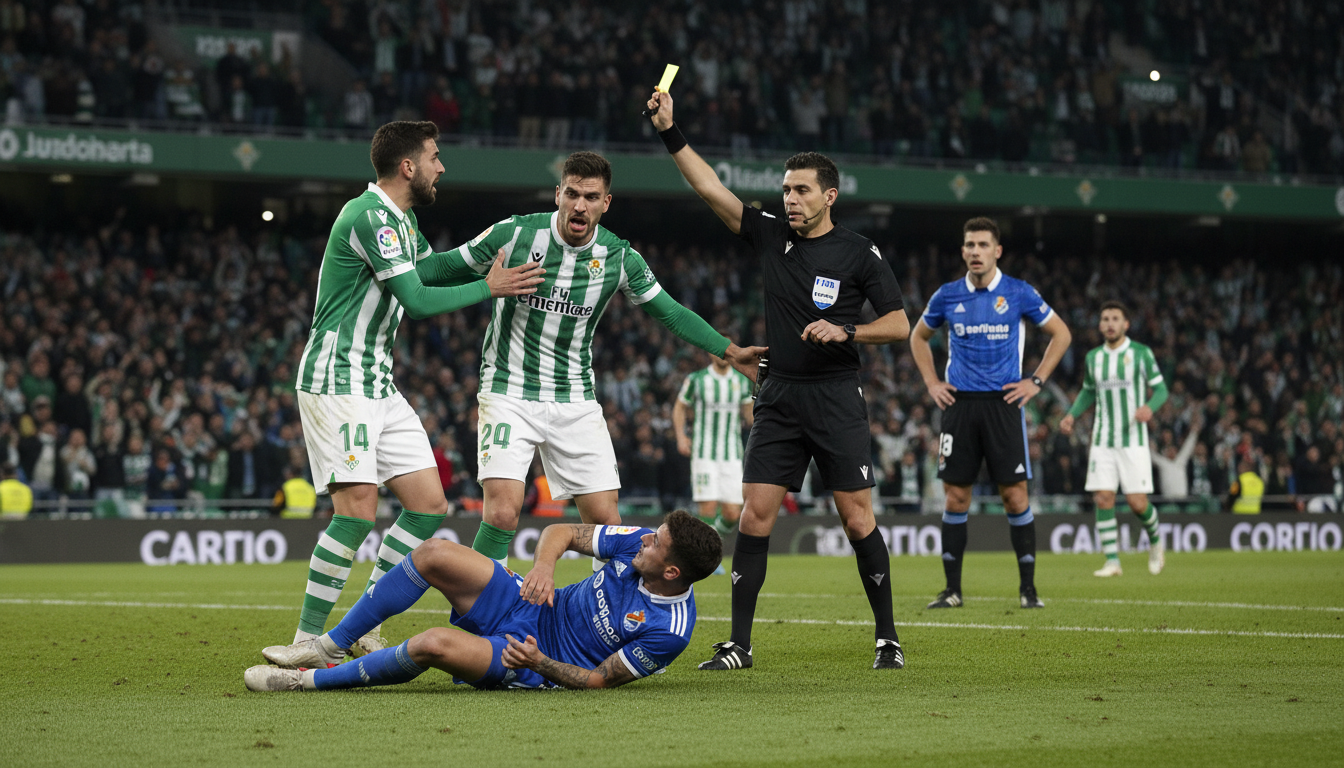
Betis vs Real Oviedo VAR controversy: CTA upholds corner but says Amrabat should have been sent off
CTA rules on Betis vs Real Oviedo VAR controversy: technical corner decision stands, but committee says Amrabat’s studs-to-ankle tackle warranted red and VAR intervention.


The Technical Committee of Referees (CTA) has published a video explanation that crystallizes the Betis vs Real Oviedo VAR controversy, concluding the referee correctly awarded a corner but that the tackle by Sofyan Amrabat on Thiago Fernández should have been sanctioned as serious foul play. The incident occurred in the 38th minute of the match refereed by Adrián Cordero Vega, with Raúl Martín González operating as VAR, and the game finished 3-0 in favour of Real Betis.
What happened at the 38th minute
The episode began when Amrabat launched into a challenge on Thiago Fernández just as the ball crossed the goal line, prompting protests from the visiting team who believed a penalty should be awarded. Match officials on the pitch signalled for a corner and play resumed without a disciplinary sanction for the Betis player. Replays showed the Moroccan midfielder made heavy contact with studs to the opponent’s lower leg, a point the CTA later highlighted in its analysis.
The CTA’s timeline confirms the contact took place after the ball had left the field of play, making the initial decision to award a corner consistent with the Laws of the Game for the technical restart. The committee emphasized that whether the contact was inside or outside the lines is irrelevant to the technical ruling when the ball is out of play. That distinction formed the foundation of the CTA’s support for the on-field outcome.
CTA: technical ruling correct, but disciplinary assessment lacking
While upholding the corner decision, the CTA criticised the match officials for failing to properly assess the severity of the foul from a disciplinary perspective. In its video analysis the committee described the contact as high-intensity and as having the potential to cause a torsion injury to Thiago Fernández, wording that aligns with the definitions of serious foul play. The committee said the defender’s challenge endangered the opponent’s physical integrity and therefore required stronger disciplinary action.
Because the referee did not issue a card and the VAR did not recommend a review, the CTA concluded there was a clear shortcoming in the application of disciplinary protocol. The committee made a point of separating technical and disciplinary outcomes, arguing that a technically correct restart does not absolve officials from sanctioning violent or dangerous conduct when it occurs in conjunction with play.
VAR responsibility and missed intervention
Central to the Betis vs Real Oviedo VAR controversy is the CTA’s finding that VAR should have intervened to recommend an on-field review for possible dismissal. According to the committee, the contact met the threshold for a red card under the serious foul play criteria, and VAR is obliged to check potential red-card incidents even when the ball has gone out of play. The failure to prompt the referee to review the footage meant a corrective opportunity was lost.
The CTA criticised the practical handling of the sequence, arguing that the VAR team must be attuned to incidents where player safety is at risk and not be constrained by the narrow framing of the technical decision. The committee’s view reinforces the expectation that VAR must act decisively where disciplinary measures are warranted, irrespective of the restart that is later taken on the field.
Regulatory clarification on fouls outside the field
The CTA used the incident as a teaching moment to clarify an often-misunderstood area of the Laws of the Game: fouls committed off the pitch while the ball remains in play. The committee explained that any infringement occurring outside the field should be restarted from the nearest boundary point to where the offence occurred. That procedural guidance aims to ensure consistent application of restarts in borderline situations.
Importantly, the CTA added that if the nearest point of demarcation is the goal line that defines the penalty area, the appropriate technical sanction for an inside-the-area foul can be the awarding of a penalty. This nuance underscores how spatial relationships between the point of contact and boundary lines can determine the correct restart, and it was central to the objections from Real Oviedo after the match.
Impact on the match and potential disciplinary follow-up
The immediate sporting outcome was unaffected on the scoreboard, with Betis securing a 3-0 victory, but the CTA’s findings deepen the argument that the match should have seen a more severe disciplinary outcome for the challenge. While the committee did not itself retroactively alter match results, its public appraisal creates pressure on governing bodies to consider post-match disciplinary measures when VAR or on-field officials fail to act. Clubs and referee associations will take note of the CTA’s insistence on player safety.
For Real Oviedo, the ruling offers formal support for complaints about the officiating and may inform any appeals or requests for retrospective action, though such steps typically follow their own procedural paths. From a broader perspective, the episode increases scrutiny on how VAR teams and referees communicate and on whether additional training or protocol refinement is needed to avoid similar oversights.
Broader implications for VAR protocol and referee training
The CTA’s detailed breakdown in the Betis vs Real Oviedo VAR controversy underscores systemic tensions in modern officiating between strict technical application and safeguarding player welfare. The committee’s recommendation that VAR should have prompted a review is likely to be cited in future assessments of VAR performance and could accelerate adjustments to the instruction sets that guide video officials. Clearer prompts and accountability measures for VAR teams may be among the topics examined by refereeing authorities.
This incident also highlights the importance of referee education on the separation of technical and disciplinary responsibility. Referees must be confident to manage dual aspects of an incident—awarding the correct restart while simultaneously evaluating whether the conduct merits caution or dismissal. Coaches, players and supporters can expect continued debate about these trade-offs as leagues seek consistent enforcement that protects player safety without undermining on-field refereeing authority.
The CTA’s public explanation of the incident at Benito Villamarín has reinforced that a correct technical call can coexist with an incorrect disciplinary outcome, and it has amplified calls for VAR to be more proactive in protecting player welfare. The analysis will now feed into conversations among refereeing bodies, clubs and competition organisers about how best to reduce similar controversies in future.