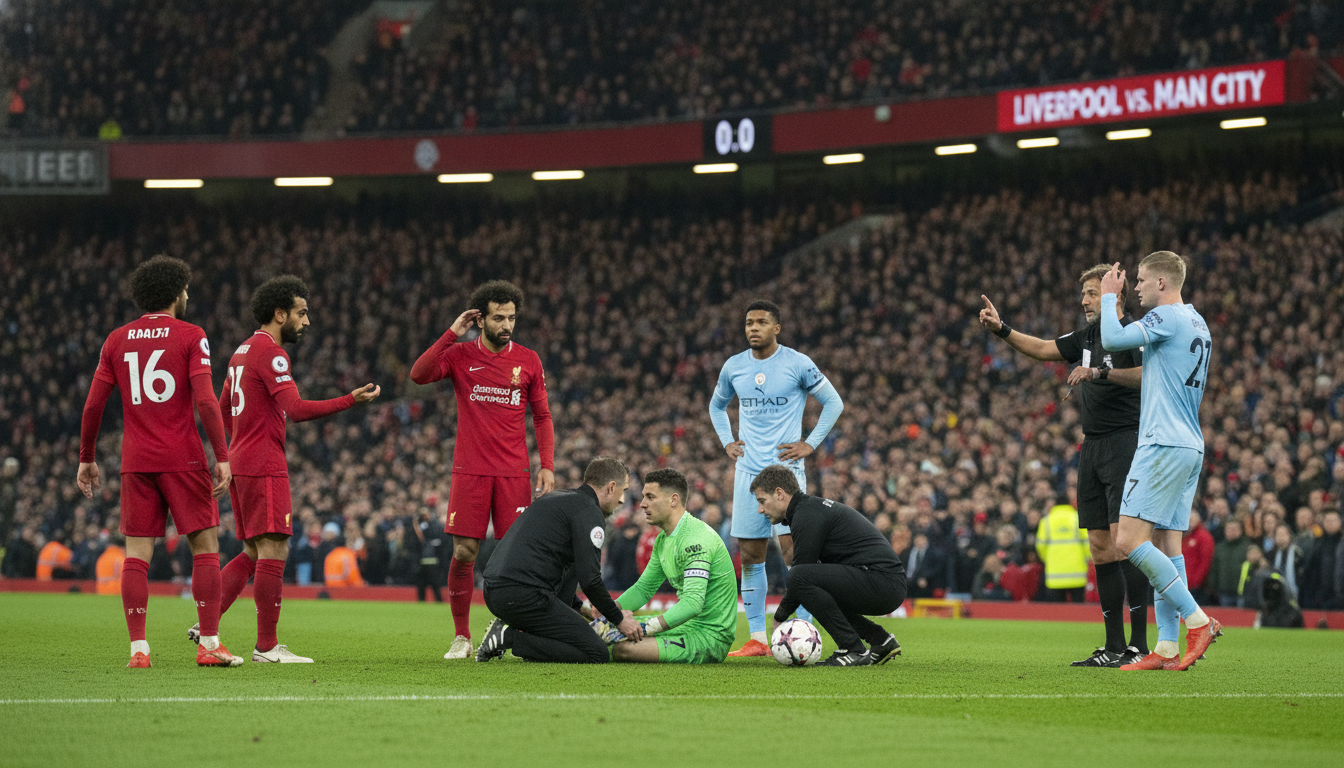
Premier League goalkeeper medical protocol to be enforced from this weekend
Premier League applies IFAB goalkeeper protocol from this weekend: a one-minute sideline penalty to deter tactical keeper injuries and curb time-wasting.


The Premier League will implement IFAB’s updated goalkeeper medical protocol beginning this weekend, introducing a one-minute sideline requirement designed to deter deliberate time-wasting by goalkeepers. The new Premier League goalkeeper medical protocol requires that when a goalkeeper receives on-field medical attention for a suspected or actual injury, an outfield player must leave the pitch for one minute. The measure is explicitly aimed at preventing feigned injuries and stopping last-minute delays that disrupt the flow of matches.
Premier League to adopt IFAB’s goalkeeper medical protocol
The IFAB update targets situations in which a goalkeeper lies down or signals for medical help with the apparent intent to interrupt play and slow proceedings. Under the new protocol, when play is stopped because a goalkeeper needs or is suspected of needing treatment, the referee will enforce a mandatory one-minute reduction in on-field personnel by asking an outfield teammate to leave. The intention is to make it less beneficial for teams to use goalkeeper interventions as a tactic to break momentum, particularly in the closing stages of matches.
This change is narrowly focused on medical stoppages involving goalkeepers and will operate within the Laws of the Game as revised by IFAB. Referees will be instructed to apply the measure when the stoppage is caused by the goalkeeper’s apparent need for attention, regardless of whether the injury is later judged to be genuine. Teams will face a short-term numerical disadvantage on the field intended to discourage time-wasting without permanently altering the substitution balance.
Implementation in the Premier League will be monitored closely during the opening rounds after the rule takes effect, with match officials and competition administrators collecting data on its frequency and impact. Clubs, managers and player unions can expect communications from the league clarifying referee expectations and the practical mechanics of how the one-minute absence will be tracked and enforced during matches.
How the one-minute sideline rule will operate in practice
When the referee stops play for goalkeeper treatment under the new protocol, one named outfield player must immediately leave the field and remain off for one minute. The minute begins once the player has left the playing area and the referee signals that the one-minute sanction is in force, after which the player may re-enter at the referee’s discretion if no further delay or misconduct occurs. The rule is focused on maintaining the match’s competitive integrity rather than creating additional disciplinary sanctions.
If the outfield player does not comply or if the team attempts to gain advantage by delaying the player’s exit, referees retain the authority to take further disciplinary action, including cautions, if the behavior amounts to time-wasting or unsporting conduct. Match officials will be encouraged to use clear signals and pre-game briefings to ensure all teams understand the deployment and timing of the one-minute requirement. Stadium timekeeping and fourth official procedures may be adapted to document the period and provide visible confirmation when the sanction is complete.
The league’s match operations team will also advise clubs on practical issues such as which player should leave in various tactical scenarios, and how teams may plan substitutions and positioning to mitigate the impact. Coaches are expected to develop simple, repeatable responses to the situation so that the enforced one-minute absence does not create additional confusion or safety issues on the touchline.
Exceptions for immediate, severe or contact injuries
IFAB and the competition guidelines carve out explicit exceptions where the one-minute rule will not apply, most notably in cases that require immediate goalkeeper intervention or where a player’s integrity is at serious risk. The protocol does not apply when the stoppage is caused by a penalty kick, when an immediate play is required, or when the goalkeeper is injured in a collision with an opponent and needs urgent treatment. Similarly, the rule is suspended for grave medical incidents such as suspected head injuries, cardiac problems, seizures, or any condition that poses an immediate threat to life or consciousness.
Referees will be trained to distinguish between stoppages that constitute serious medical emergencies and those that are likely tactical or minor, and they will be expected to err on the side of player safety where doubt exists. If the player indicates clearly that no attention is required or voluntarily leaves the pitch without delaying play, the one-minute sanction will not be applied. The guidance aims to ensure that the new deterrent does not compromise the game’s primary duty of care to the players.
The competition’s medical advisers and the referees’ technical committee will maintain oversight of these exceptions and will publish clarifications and case studies as needed to help referees, teams and broadcasters understand how the rule will be interpreted under different circumstances. That will be important in preventing inconsistency and in protecting players in genuinely dangerous situations.
Substitution timing and red-card clarification tied to the 10-second rule
Alongside the goalkeeper protocol, IFAB’s clarification on the substitution 10-second rule and expulsions will be applied, affecting how red cards and substitute entries are handled in timing disputes. If a player who is being substituted commits an act that warrants a sending-off before they have left the field, that player must be sent off and cannot be replaced. Conversely, if the sending-off occurs after the substituted player has already left the field, the named substitute may enter after the one-minute period, provided no other disciplinary action intervenes.
The update further addresses scenarios where a substitute who is due to enter the match commits an expellable offense prior to the replaced player exiting; in that case the substitute must be sent off and another available substitute may take the place only after the mandated one-minute interval. These permutations are designed to close loopholes and prevent teams from exploiting the substitution window to circumvent disciplinary measures. Referees and fourth officials will be given precise procedural checklists to follow when these situations arise to maintain fairness and clarity.
Competition administrators will likely circulate detailed flowcharts and match-day protocols to clubs to minimize confusion, and to ensure that match officials can implement the rules uniformly. Clubs should review their substitution procedures to avoid avoidable disciplinary incidents and to prepare contingency plans if a sending-off affects planned tactical changes.
VAR, identity reviews and the league’s approach to ‘Vinicius’ incidents
IFAB’s other clarifications include limits on what VAR may review in relation to identity and certain pre-play attacks during corners or free kicks, and these will be followed in the Premier League application. VAR will be permitted to intervene for an attacker’s infringement occurring before the ball enters play from a corner or an attacking free kick, but only if the sequence ends in a goal, a penalty, an obvious promising attack affected by the infraction, or an expulsion. Identity confusion for yellow cards may only be corrected to identify the actual offender; the underlying decision about the nature of the infringement cannot be changed beyond that scope.
Domestic competition authorities have also signaled that the so-called "Vinicius" rule — a reference to measures aimed at penalizing simulation and certain types of disciplinary infractions — will be interpreted in a manner that results in a yellow card rather than a straight red in league play, diverging from FIFA’s harsher approach. Competition officials argue that consistent domestic interpretation provides referees with proportional tools to manage dissent and simulation without escalating to match-altering dismissals in borderline cases.
These adjustments reflect a broader emphasis on consistency and proportionality in adjudicating incidents that arise in and around set pieces and substitutions. Leagues and referees’ committees intend to publish explanatory guidance and illustrative clips so that teams, media and fans can see how the framework will be applied across the season.
Tactical consequences for managers and likely reactions from clubs and players
Coaches are already expected to adjust late-game tactics to account for the risk of a one-minute numerical deficit if their goalkeeper requires on-field treatment. In close matches, the prospect of losing an outfield player for 60 seconds may deter teams from encouraging goalkeepers to seek stoppages unless truly necessary. Managers may designate a low-risk player or one already positioned near the substitutes’ area to be the one who steps off, and will likely rehearse quick reorganization plans to limit exposure during the enforced period.
Players and goalkeeper coaches will also face new behavioral incentives: goalkeepers will be reminded of the reputational and competitive costs of feigning injury, while medical teams will be under pressure to balance genuine care with the new procedural consequences. The league and referees’ body expect initial disputes and debate over borderline cases, but also anticipate that the visible deterrent will reduce the incidence of deliberate stoppages over time.
Supporters’ groups and pundits are likely to watch early applications closely, and disciplinary committees may receive appeals or requests for clarifications after contentious incidents. The success of the protocol will be judged not only on reduced time-wasting but also on whether it preserves player welfare and allows referees to apply the law consistently across all fixtures.
This weekend’s rollout of IFAB’s goalkeeper medical protocol in the Premier League introduces a targeted tool to discourage tactical stoppages while protecting players in genuine medical distress, and it arrives alongside complementary clarifications on substitutions, VAR scope and identity. The coming weeks will test how smoothly referees and teams adapt to the new procedures and whether the one-minute sideline measure achieves its aim of safeguarding match flow without compromising safety.