Raúl Martín Presa: Rayo Vallecano eyes new stadium and squad consolidation after historic Leipzig final
Rayo Vallecano targets a new stadium and stronger squad after a historic season, president Raúl Martín Presa says following the Leipzig final and transfers.


Rayo Vallecano president Raúl Martín Presa reflected on a landmark season that included the club’s first-ever European final in Leipzig, an extended run in LaLiga and renewed ambitions off the pitch. In an interview on José Ramón de la Morena’s channel, Martín Presa described the emotional aftermath of the final, provided a frank assessment of coach Iñigo Pérez, and outlined plans to build a new stadium in Vallecas. The president also addressed transfer processes, the club’s financial recovery and the priority of constructing infrastructure that secures Rayo Vallecano’s future.
Presidential reaction to the Leipzig final
Martín Presa said the Leipzig final left him visibly affected, describing a moment of private frustration after a game the club had hoped to win. He acknowledged that the team did not deliver their best performance on the night and framed the defeat as motivation to return to that stage. The president emphasized that the result must become a foundation for future ambition rather than a final judgment on the club’s progress.
He stressed that the appearance in Leipzig is proof of what Rayo Vallecano can achieve with continuity and careful planning. The president called on the club to work methodically to re-establish itself among Europe’s competitive sides. That determination underpins both short-term sporting goals and longer-term projects such as infrastructure and squad building.
Assessment of Iñigo Pérez’s tenure
Martín Presa offered a measured appraisal of coach Iñigo Pérez, praising his contribution while resisting superlatives. He said Pérez had been “a very good coach” and had grown alongside the club, but stopped short of calling him the best in Rayo’s history out of respect for other figures. The president noted that Pérez showed professional development during his time at the club and helped implement a clear identity on the pitch.
Presa described a strong working relationship with Pérez, noting mutual satisfaction and shared ideas about the club’s direction. He said he had hoped Pérez would remain and build a long-term project similar to those seen at other clubs. The assessment underlines the club’s preference for stability and coherent coaching trajectories when possible.
Transfer policy and sporting direction
On the subject of transfers, Martín Presa reiterated that Rayo Vallecano operates as a modest club with clear financial parameters. He said the club aims to negotiate signings in a way that aligns with its resources and long-term model. The president made clear that while coaches are consulted, the final responsibility for signings rests with the sporting or technical direction.
Martín Presa framed that structure as a way to protect institutional continuity and ensure decisions are taken in the club’s best long-term interest. He emphasized consensus in recruitment but insisted the sporting management must make the ultimate call. That approach, he argued, helps Rayo compete prudently against clubs with larger budgets while seeking to maintain a coherent squad philosophy.
Plans for a new Vallecas stadium
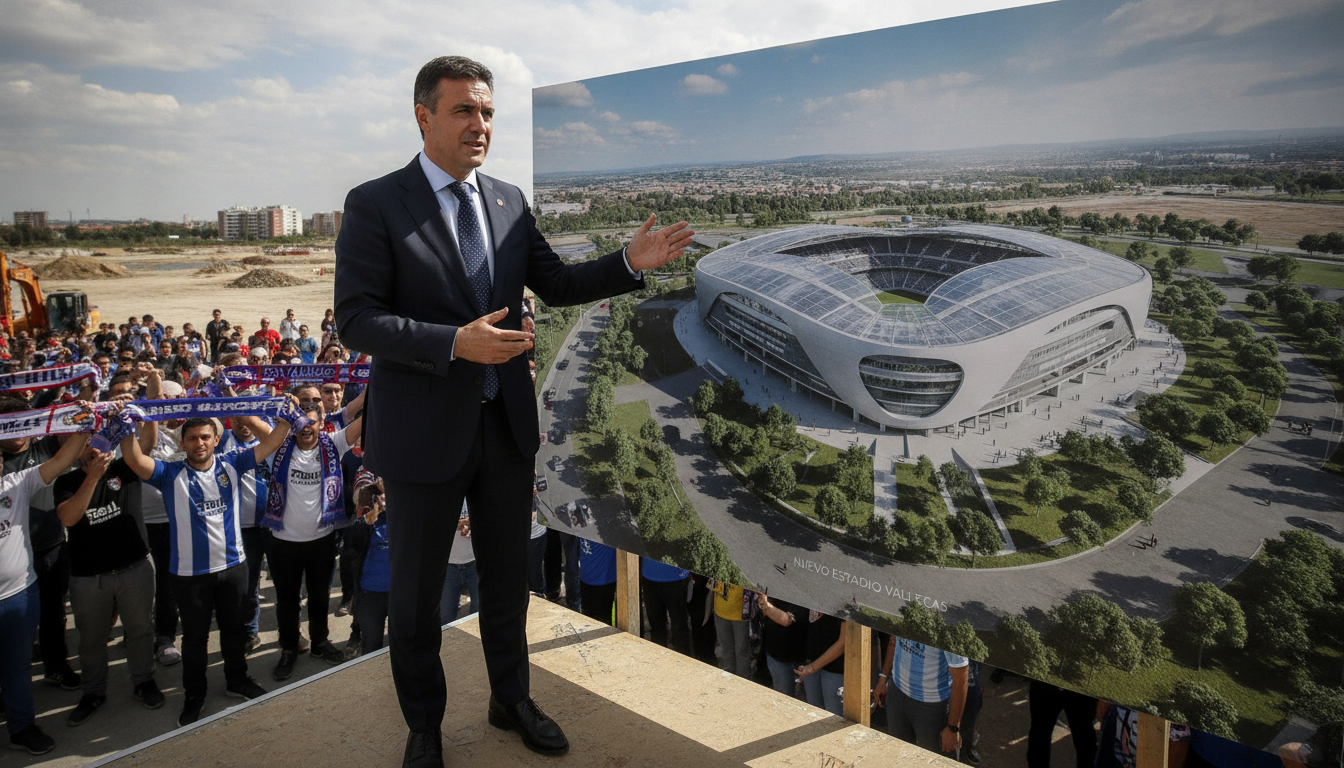
A central focus of Martín Presa’s remarks was Rayo Vallecano’s plan to secure new facilities and build a stadium owned by the club. He said the ambition is to acquire land in or very near the Puente de Vallecas neighborhood to construct a venue with an initial capacity around 30,000–35,000 seats and room for later expansion. The president framed stadium ownership as essential to income generation and sporting competitiveness, enabling the club to invest in infrastructure and challenge similar clubs in European competition.
Martín Presa highlighted the need to avoid political influence over club decisions, saying ownership of the ground would strengthen autonomy. He admitted the difficulty lies in securing an appropriate plot of land, and that negotiations and planning will require time and persistence. The stadium project was presented as a strategic priority that could reshape Rayo’s commercial profile and long-term sustainability.
Financial rescue and ownership history
The president returned to the club’s recent financial history, noting the precarious situation Rayo faced before his intervention. Martín Presa explained that an initial capital contribution was necessary when the club teetered on bankruptcy, and he referenced a personal payment of 960 euros at the point of takeover as a symbolic start to a larger financial rescue. He said a significant capital injection followed, which helped to erase debts that had reached approximately one hundred million euros when accounting for prior obligations.
Those actions, Martín Presa argued, laid the groundwork for the club’s current stability and on-field achievements. He portrayed the financial overhaul as a collective effort that restored viability and allowed sporting planning to proceed. The president used that history to justify ongoing prudence in recruitment and infrastructure investment.
Zozulya departure and player exits
Martín Presa addressed the transfer saga surrounding forward Roman Zozulya, clarifying the club’s stance on the move and subsequent sale. He said Rayo was not in favor of the player leaving and that the decision to depart ultimately came from the player rather than from club management. The president framed the episode as an example of the club’s willingness to accommodate players’ wishes while maintaining institutional principles.
He reiterated that Rayo welcomes anyone but also upholds a broader view of squad construction and atmosphere. Martín Presa used the example to explain the balance the club seeks between individual choices and collective needs. The comments underline the club’s sensitivity to player relations as it plans its next transfer window.
Vallecas community and club identity
Martín Presa was emphatic about the club’s roots in the Vallecas neighborhood, describing it as a safe area populated by humble, hard-working residents. He defended the stadium and the fans, saying there had never been incidents resulting in serious injury at the ground and emphasizing the community’s integral role in the club’s identity. The president positioned Rayo Vallecano as a club that represents its locality and draws strength from a passionate but family-oriented supporter base.
He framed plans for a new stadium not as a break with the past but as a way to secure the club’s future in Vallecas. The notion of a modern facility still located near the traditional neighborhood reflects a desire to keep Rayo’s identity intact while professionalizing the club’s infrastructure. That balance is a recurring theme in Martín Presa’s vision.
Sporting aims and next season priorities
Looking ahead, Martín Presa identified assembling a competitive squad as the primary sporting objective to avoid a precarious league position next season. He said the club must create a roster capable of consistent top-flight performance and that recruitment will target both immediate needs and structural depth. The president also mentioned learning from clubs that balance domestic competition with European ambitions, citing examples of teams that have built sustainable models to challenge in continental tournaments.
Martín Presa signalled a careful approach to the upcoming transfer market, prioritizing players who fit Rayo’s style and financial model. He stressed the necessity of building a squad capable of stability rather than short-term fixes. That pragmatic stance will shape the club’s summer strategy.
Moments of pride and long-term perspective
When asked about personal highlights, Martín Presa singled out the club’s promotion milestones and specifically cited Girona’s ascent as a happy moment in the broader landscape, reflecting his interest in wider developments in Spanish football. He reiterated that historic achievements like the Leipzig final should be celebrated but also seen as steps toward sustained progress. The president’s comments combined immediate pride with an insistence on disciplined, long-term planning.
Martín Presa closed the interview by stressing that ambition must be matched by institutional readiness: secure finances, coherent recruitment, and infrastructure investment. He argued that only with those elements in place can Rayo hope to compete regularly at higher levels and protect the club’s identity. That synthesis of accomplishment and realism frames the club’s next chapter.
As Rayo Vallecano moves into the off-season, the club faces a busy agenda: finalizing transfer targets, continuing dialogue about a new stadium, and translating the momentum of a historic campaign into durable progress. The president’s remarks sketch a roadmap focused on autonomy, financial prudence, and competitive consolidation.
The coming months will test whether the plans announced by Raúl Martín Presa can be translated into concrete outcomes that secure Rayo Vallecano’s place in the top tier and strengthen its ties to Vallecas.