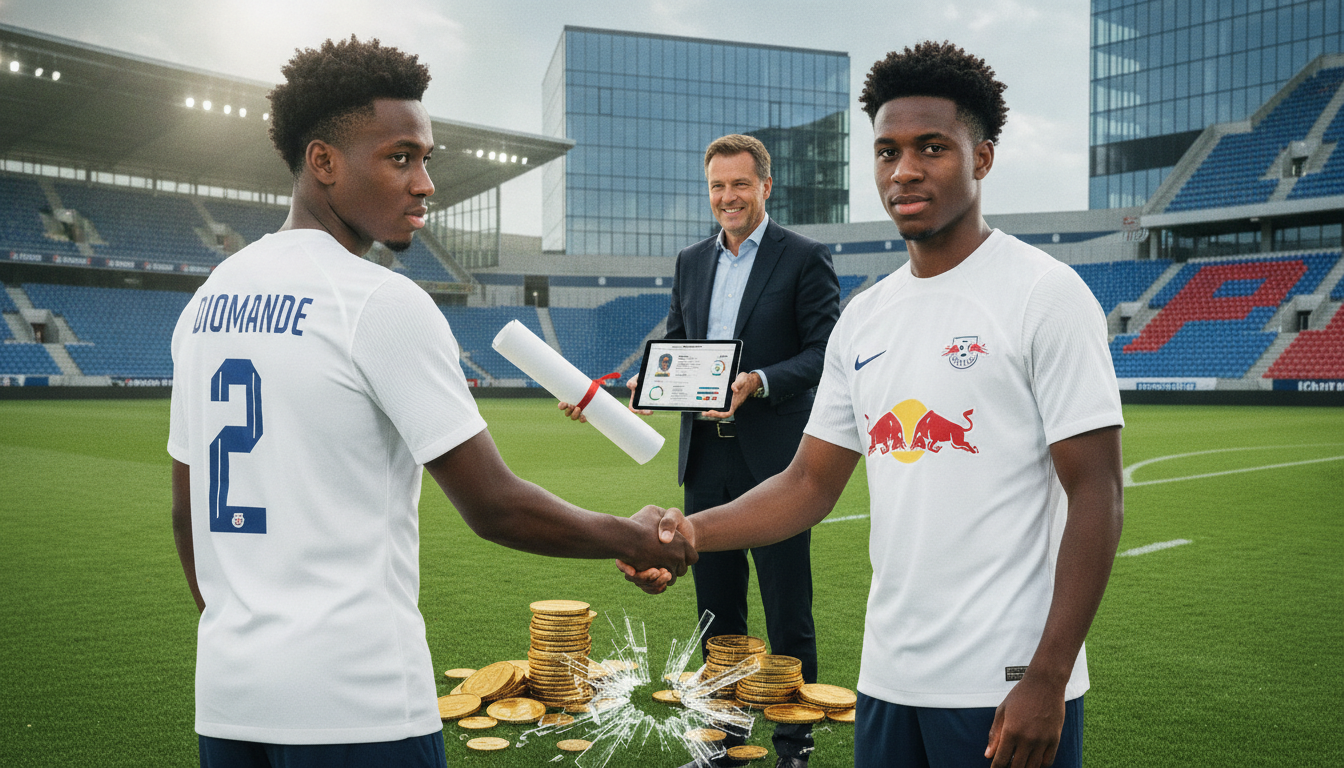
RB Leipzig transfer model set to smash record as Diomande sale sparks bidding frenzy
RB Leipzig transfer model under the spotlight as club prepares to command a record fee for Yan Diomande, a player bought from Leganés for €20m and now linked with top European suitors.


Leipzig poised to break its selling record with Diomande
RB Leipzig appear set to eclipse their previous club-record sale after a rapid valuation climb for winger Yan Diomande, whose performances have prompted multiple clubs to submit high offers this summer.
The Ivorian left Leganés last year after Leipzig met his contract clause, a move that cost the German side roughly €20 million and now has potential buyers preparing bids well into eight figures. (cdleganes.com)
Competition for Diomande has intensified in recent days, with reports indicating that Real Madrid and Manchester City are among the parties that have shown concrete interest and submitted formal approaches. Recent coverage suggests a significant bid from Real Madrid was rejected, underlining how market demand is pushing his price sharply upward. (skysports.com)
Record to beat: how Gvardiol set the benchmark
The fee paid for Joško Gvardiol when he moved from Leipzig to Manchester City has long stood as Leipzig’s benchmark for player sales.
City’s acquisition of the young Croatian defender was widely reported at around €90 million, a figure that set a high-water mark for what Leipzig can achieve when a player developed by the club becomes a top-tier asset. (espn.com)
Industry insiders and transfer-market analysts now expect the Diomande deal to surpass that sum if Leipzig elect to sell now, driven by intense bidding from elite clubs and the premium often paid for dynamic attackers in the current market. (skysports.com)
From Leganés release clause to a lucrative resale
Leipzig’s acquisition model in Diomande’s case was straightforward: activate a release clause at a modest cost relative to his present market value, then use coaching, playing time and exposure to multiply that investment.
Leganés confirmed the transfer mechanics last year and retained sell-on protections that will benefit the Spanish club if Leipzig completes a lucrative onward sale, illustrating how smaller clubs can profit when top teams execute rapid revaluation strategies. (cdleganes.com)
That initial outlay and the structured contractual protections have become central to Leipzig’s approach: purchase young talent with clear potential, provide a platform for growth, and then monetize the player when interest peaks. This cycle has produced consistent and measurable returns for the German club. (cdleganes.com)
A proven transfer factory: Leipzig’s profitable exits
RB Leipzig’s transfer ledger reads like a case study in player revaluation, with several high-profile exits generating substantial revenue for the club.
Joško Gvardiol’s €90 million move to Manchester City remains one of the most visible examples of that model delivering top-line cash for Leipzig’s recruitment and development program. (espn.com)
Dominik Szoboszlai’s move to Liverpool for roughly €70 million further demonstrates Leipzig’s ability to turn relative bargains into marquee sales after on-field performance elevated the player’s market value. (bbc.co.uk)
Benjamin Šeško’s transfer activity has also followed the pattern, with Manchester United agreeing a deal in the region of €73–76 million plus add-ons, underscoring how Leipzig’s method consistently attracts top bids for young, well-scouted talent. (theguardian.com)
Other notable departures — including Christopher Nkunku, Ibrahima Konaté, Dayot Upamecano, Timo Werner, and Naby Keïta — reinforce the narrative that Leipzig, often in partnership with the wider Red Bull network, specializes in converting scouting and development into profitable sales.
How the RB Leipzig transfer model functions
Leipzig operates within a clear commercial logic that blends recruitment, performance management and strategic timing of sales to maximize returns.
The club targets players with specific athletic and tactical profiles who can be accelerated through first-team minutes, European exposure and tailored coaching, all of which increase the player’s visibility and perceived value.
Economically, Leipzig’s approach balances transfer fees and amortization against wage structures and resale percentages, allowing the club to reinvest in scouting and infrastructure while maintaining competitive squads on the pitch. This cyclical reinvestment has become a defining characteristic of the team’s sporting strategy.
Real Madrid interest and market dynamics shaping the price
The potential sale of Diomande highlights how elite clubs—particularly Real Madrid and Manchester City—can distort market values simply by expressing interest and submitting competitive proposals.
Sources reporting on the situation say Madrid tabled an offer in the region of £85 million that Leipzig rejected, demonstrating how even a single bid from a global heavyweight can recalibrate negotiations and spark bidding wars. (skysports.com)
That dynamic benefits Leipzig in two ways: it elevates the baseline price for young attacking talent and puts the club in a position to extract maximum economic value when deciding whether to sell or retain a player for further development. (skysports.com)
Financial calculus and sporting trade-offs for buyer and seller
For Leipzig, the choice to sell rests on a balance of immediate transfer income versus the projected upside of keeping a player for another season.
Selling at peak interest secures capital that can be redeployed into new signings and academy development, but it also risks weakening the squad’s competitive edge in domestic and European competitions.
For buying clubs, paying a premium for a developed but still-young star like Diomande carries both reward and risk; the cost is high but the potential returns on pitch success and commercial upside can justify the outlay.
The tug-of-war between sporting ambition and financial prudence is therefore central to why these negotiations attract such intense scrutiny from media, supporters and analysts.
What a record Diomande sale means for the transfer market
A confirmed transfer exceeding Leipzig’s previous top fee would reinforce a market trend in which clubs that specialize in rapid player development now command outsized influence.
It would also likely incentivize other clubs to replicate Leipzig’s blueprint: acquire young talent early, provide structured development, and seek tactical sales windows to maximize returns.
The broader ripple effect would extend to smaller selling clubs, who increasingly seek sell-on clauses and protections to capture a share of future windfalls when their products are flipped for substantial sums. (as.com)
Leipzig’s model, already validated by multiple big-money exits, appears to have entered a new phase as the club converts scouting accuracy and developmental capacity into record-level financial outcomes.
If Leipzig completes a blockbuster deal for Diomande this summer, it will reaffirm the club’s standing as one of Europe’s most effective talent factories and underline the growing commercial sophistication of player trading in elite football.