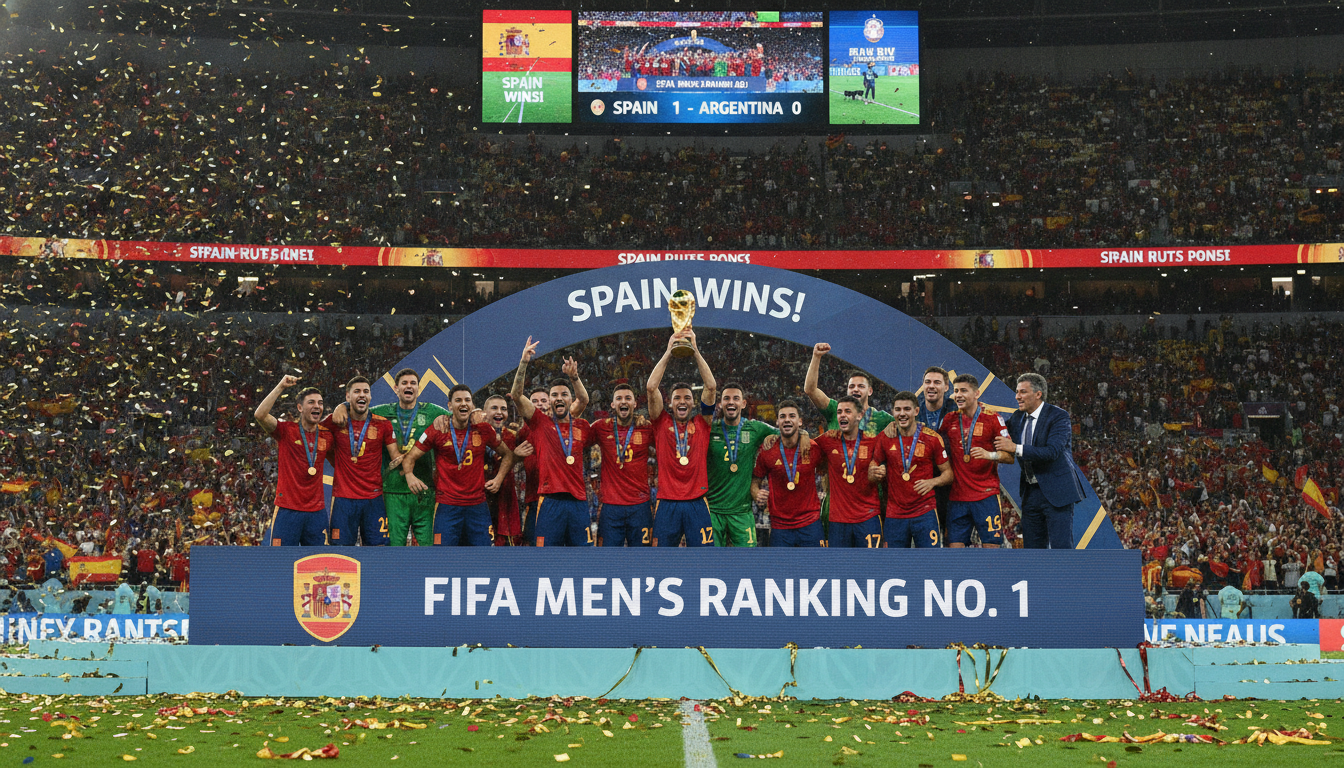
Spain Replaces Argentina as No. 1 in FIFA World Rankings After World Cup Triumph
Spain leapfrogs Argentina to top the FIFA world rankings on July 21, 2026 after beating Argentina in the World Cup final, now reshaping the men’s top 10.

Spain has climbed to the top of the latest FIFA world rankings released on July 21, 2026 following its 1-0 victory over Argentina in the World Cup final on July 20, 2026. The change ends Argentina’s run at No. 1, which had stood since the rankings published on June 11, 2026 at the start of the 48-team tournament. The update reflects the impact of a 104-match World Cup staged across Canada, Mexico and the United States.
Spain’s ascent to the summit
Spain entered the World Cup ranked second and converted that seeding into the top ranking by taking the tournament title in a tightly contested final. That 1-0 win over Argentina was decisive in the points calculations used by FIFA’s ranking methodology. The triumph rewarded La Roja with a haul of ranking points that was sufficient to overtake the defending champions in the aggregate standings.
The move to No. 1 signals the completion of a campaign that combined tactical discipline and defensive solidity with moments of attacking precision. Spain’s World Cup run demonstrated consistency across multiple knockout rounds, and the final victory furnished the greatest single-point swing available in the ranking system.
How the World Cup shifted ranking points
FIFA’s ranking model weighs match results, the importance of matches and the relative strength of opponents, meaning World Cup outcomes have an outsized effect. Tournament matches carry higher coefficients than friendlies or qualifiers, so deep runs or tournament victories tend to produce notable jumps. Spain’s World Cup title therefore produced a larger points transfer than typical international windows.
Argentina’s status as No. 1 on June 11, 2026 reflected its own recent form prior to the tournament, but the loss in the final limited the points it could add and left the door open for Spain. Other nations that advanced to later stages also benefited, creating a ripple effect through the top 20 as points were redistributed based on match-by-match outcomes.
Top 10 movements after the update
France and England retained third and fourth spots respectively despite England’s 6-4 victory over France in the third-place play-off, a result that was not enough to overhaul France’s accumulated edge in points. Brazil and Morocco moved up the table, taking fifth and sixth positions and displacing Portugal, which fell behind after an earlier exit.
Mexico enjoyed a significant rise, jumping four places into the top 10 after a strong showing on home soil in Mexico City and across the tournament. The host nation won all three group games, followed by a 2-0 victory over Ecuador in the round of 32, before bowing out to England in the round of 16.
Portugal’s setback and other notable drops
Portugal’s elimination in the round of 16, a 1-0 defeat to Spain, cost it valuable ranking points and saw it slip out of the top five. The result underlines how knockout-stage exits against high-ranked opponents can still be costly when the winner advances to lift the tournament trophy. Other European sides that underperformed at the World Cup saw smaller declines, while nations that outperformed their seeding made commensurate gains.
The reshuffle illustrates the volatility that accompanies major tournaments and highlights how single matches at critical stages can re-order the global pecking order. For Portugal, the loss punctuated a tournament that fell short of expectations and had immediate consequences for its standing in the global rankings.
Mexico’s rise and host-nation momentum
Mexico’s ascent into the top 10 will be viewed as the clearest beneficiary story from the tournament for CONCACAF. Hosting matches in Mexico City gave El Tri moments of home advantage, and three group-stage wins plus the round-of-32 victory over Ecuador furnished a points boost. The narrow 3-2 defeat to England in the round of 16 in front of a large home crowd nonetheless capped a campaign that improved Mexico’s international profile.
The rise into the top 10 positions Mexico among the most improved teams in this cycle and gives the federation momentum heading into future qualifiers and regional tournaments. The result will also be significant for player recruitment, seeding in future tournaments, and commercial opportunities that accompany higher rankings.
Implications for upcoming fixtures and seedings
The new FIFA world rankings will influence tournament seedings, draw pots and the perception of teams ahead of upcoming competitions, including continental qualifiers and the next Nations League cycles. Spain’s elevation to No. 1 affects how opponents prepare and how future draws are constructed, with the top seed often receiving strategic advantage in pot placements. Federations will assess the new order as they plan friendlies and qualification campaigns designed to protect or improve their positions.
National teams seeking to climb the chart will prioritize competitive fixtures that offer higher points coefficients, while managers and federations balance the demands of development and results. The World Cup-driven shake-up acts as a reminder that international football’s landscape can shift sharply in the space of a single tournament.
Spain’s title, Argentina’s drop, and the broader top-10 changes will be parsed by analysts and federations alike as preparations begin for the next international windows. The rankings provide a snapshot of relative strength but also set the stage for new rivalries and narratives in the months ahead.
The World Cup’s 48-team format and the 104 matches played across three host countries produced many of the ranking shifts, underscoring the tournament’s influence on global standings. National teams will now use the updated FIFA world rankings as a baseline for selections, match planning and long-term strategic decisions in an international calendar that remains crowded and consequential.