Spain beat France 2-0 in World Cup semi-final as Rodri and Oyarzabal deliver clinical display
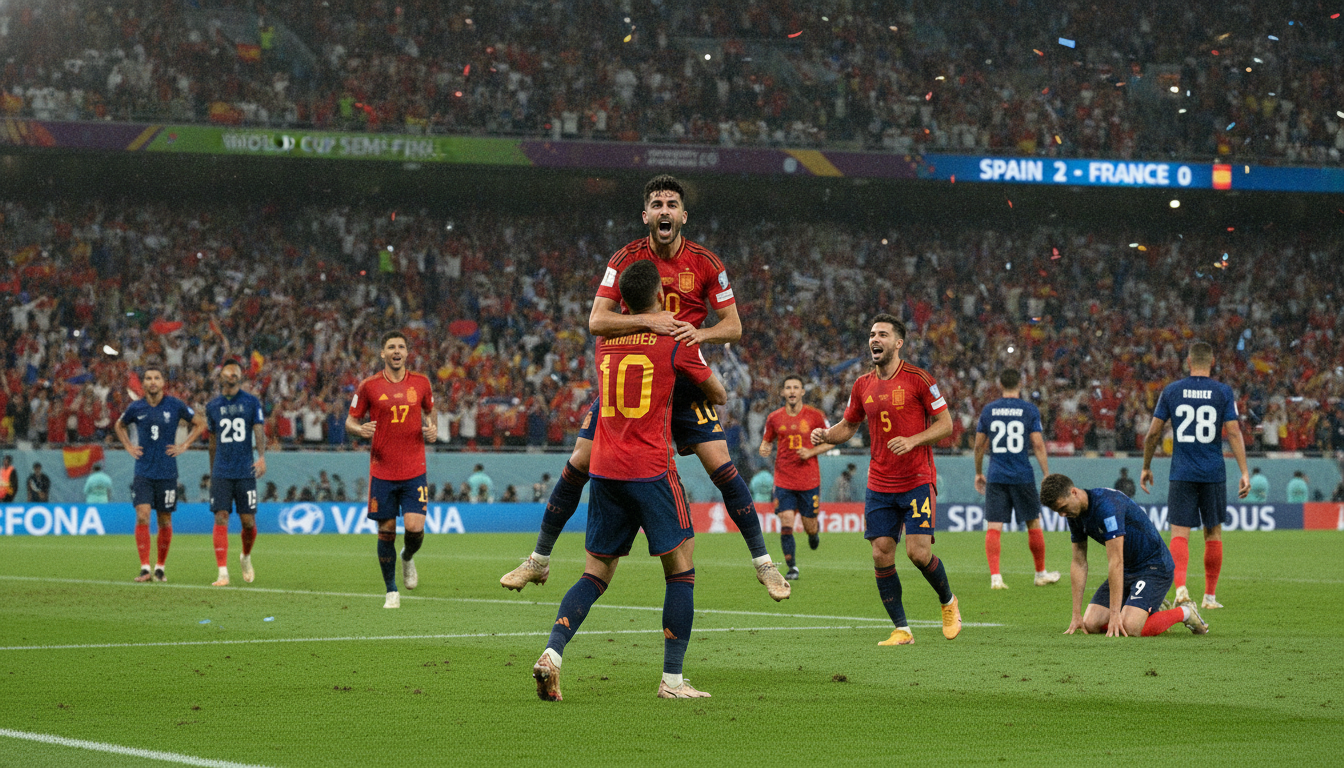
Spain 2-0 France: Spain controlled the midfield and punished France’s frailties as Mikel Oyarzabal’s penalty and a composed team performance sealed a place in the final.
Spain 2-0 France in Arlington as a composed Spanish side produced a functional, defensive masterclass to frustrate France and silence pre-game favourites. The result left Kylian Mbappé largely peripheral while Rodri’s midfield authority set the tempo and allowed Spain to pick their moments. Mikel Oyarzabal converted the decisive penalty and the Spanish backline cut out any sustained threat from France’s attackers. With the win, Spain move on to a final that will test the claim that they are “the best team in the world.”
Match-defining moments in Arlington
Spain’s opening phase was measured, surrendering possession at times but prioritising structure and defensive balance. France probed early but rarely found a rhythm, their attempts to string meaningful passages together repeatedly broken up by Spanish midfield discipline. The penalty that gave Spain their lead followed sustained pressure and a clinical finish from Mikel Oyarzabal, whose composure underlined the fine margins of the contest. From that point Spain consolidated, leaning on organisation and discipline to protect their advantage until the final whistle.
Set-pieces and transitions created the clearest threats for both teams, yet it was Spain who executed those situations with greater poise. France’s best spells tended to come from individual moments rather than coordinated team play, making their attacks easier to defend collectively. Spain’s second goal arrived as the visitors stretched to chase an equaliser, and the space left behind allowed Spain to counter with intent. Those decisive swings — the penalty and the counter — underlined the tactical planning that prevailed.
Rodri’s midfield control and influence
Rodri anchored Spain’s midfield with a blend of interceptive reading and progressive passing that neutralised France’s usual fluency. His ability to shield the defence and pick simple, effective forward passes allowed Spain to move from stifling defence into sudden, threatening attack. Rodri’s positioning forced France into longer, less-dangerous possessions and cut off supply lines to their key forwards. By controlling tempo and field position he turned the contest into a battle on Spain’s terms.
Beyond tackles and interceptions, Rodri’s spatial intelligence drew opposition attention and created room for teammates to exploit. His presence altered France’s approach, reducing their capacity for quick interchanges and high-speed combinations. When Spain needed to slow the game or shift momentum, Rodri provided the calm and structure required. That composure in a semifinal setting underpinned Spain’s broader tactical success.
France’s attacking issues and Mbappé’s quiet night
France arrived with star power and expectation but failed to construct sustained attacking sequences that troubled Spain’s disciplined block. Key forwards were frequently isolated or crowded out at moments of consequence, leaving France reliant on flashes of individual ingenuity rather than coherent build-up. Kylian Mbappé, so often a game-changer, was unusually subdued; opportunities were limited and he rarely found the space to exert his customary influence. Without consistent service into dangerous areas, France’s threats became intermittent and easier to contain.
The back half of the pitch reflected a recurring problem: France struggled to link midfield creativity to forward incisiveness. Attempts to play through Spain’s press often ended in turnovers or forced clearances, eroding both territory and momentum. As the match progressed and France pushed for an equaliser, their increasingly direct approach presented fewer high-quality chances. Spain, by contrast, managed the game’s rhythm and capitalised when the visitors left gaps.
Defensive structure and game management from Spain
Spain’s defensive performance combined zonal discipline with aggressive ball recovery, denying France the consistent time on the ball needed to build pressure. Central defenders stayed compact while full-backs were judicious in their forward excursions, preserving the defensive numbers behind the ball. The collective commitment to shape and structure frustrated France’s attempts to exploit wide or central channels. That organisation made the game into one of attrition, favouring the team with the best transitional responses.
Game management was also a feature of Spain’s approach after taking the lead. Substitutions and tactical tweaks emphasised control and possession retention rather than flashy heroics. Spain rarely allowed panicked moments to develop, instead using short passes and positional rotations to bleed the clock and maintain control. Such maturity in a semi-final set-piece underpins why Spain remain difficult opponents in knockout football.
Implications for the final and broader tournament narrative
The result sets up a final that will again place Spain’s technical cohesion against the reigning world champions, who will offer a different profile and test. Spain arrive with a clear blueprint: deny opponents sustained possession, control midfield, and strike decisively on the chances that arise. That model has carried them deep in major tournaments and now produces a shot at the title. Questions will linger about France’s ability to recalibrate in time for future fixtures, particularly around creating clearer pathways for their attackers.
For Spain, this victory will bolster confidence but also raise expectations. Managerial praise flowed after the match, and defenders of the team’s style will point to the balance between defence and attack on display in Arlington. The final will demand variation and possibly more offensive invention, yet Spain can take comfort from a performance that combined tactical discipline with clinical execution. The broader narrative of European teams contesting major finals continues, with Spain’s win adding another chapter.
Coaching decisions and tactical adjustments examined
Luis de la Fuente’s game plan prioritised midfield compactness and quick, efficient transitions, a strategy that paid off as France failed to find consistent passing lanes. Player selection and timing of substitutions indicated a focus on maintaining structure rather than chasing flair. Defensive midfield roles were clearly defined and executed, allowing more advanced players to pick their moments to move forward. Those coaching choices limited France’s usual permutations and amplified Spain’s strengths.
From France’s perspective, questions about adjustments and in-game responses will dominate analysis. Attempts to vary rhythm or overload specific zones were met with tactical counters from Spain, who showed preparedness and adaptability. Whether France’s management can adapt in shorter windows between matches will influence how their campaign is assessed. Tactical nuance in tight knockout matches frequently decides outcomes, and on this occasion Spain’s choices carried the day.
Spain leave Arlington with a measured, methodical win that emphasises collective discipline and midfield control, while France are left to ponder missed opportunities and a lack of sustained attacking cohesion. The semi-final showcased how structure and patience can outweigh individual brilliance in a high-stakes match. Spain now turn their attention to the final, carrying the momentum of a 2-0 victory and the confidence that comes from overcoming one of the tournament’s most formidable opponents.
The match demonstrated again that, at this level, tactical clarity and defensive resilience often write the headline, and Spain delivered both when it mattered most.