Hong Kong Eyes Promotion in FIFA ASEAN Cup After Reported Division 2 Draw
Hong Kong set to host Division 2 matches in the inaugural FIFA ASEAN Cup, drawn with Cambodia and Brunei while preparing friendlies as it seeks promotion.

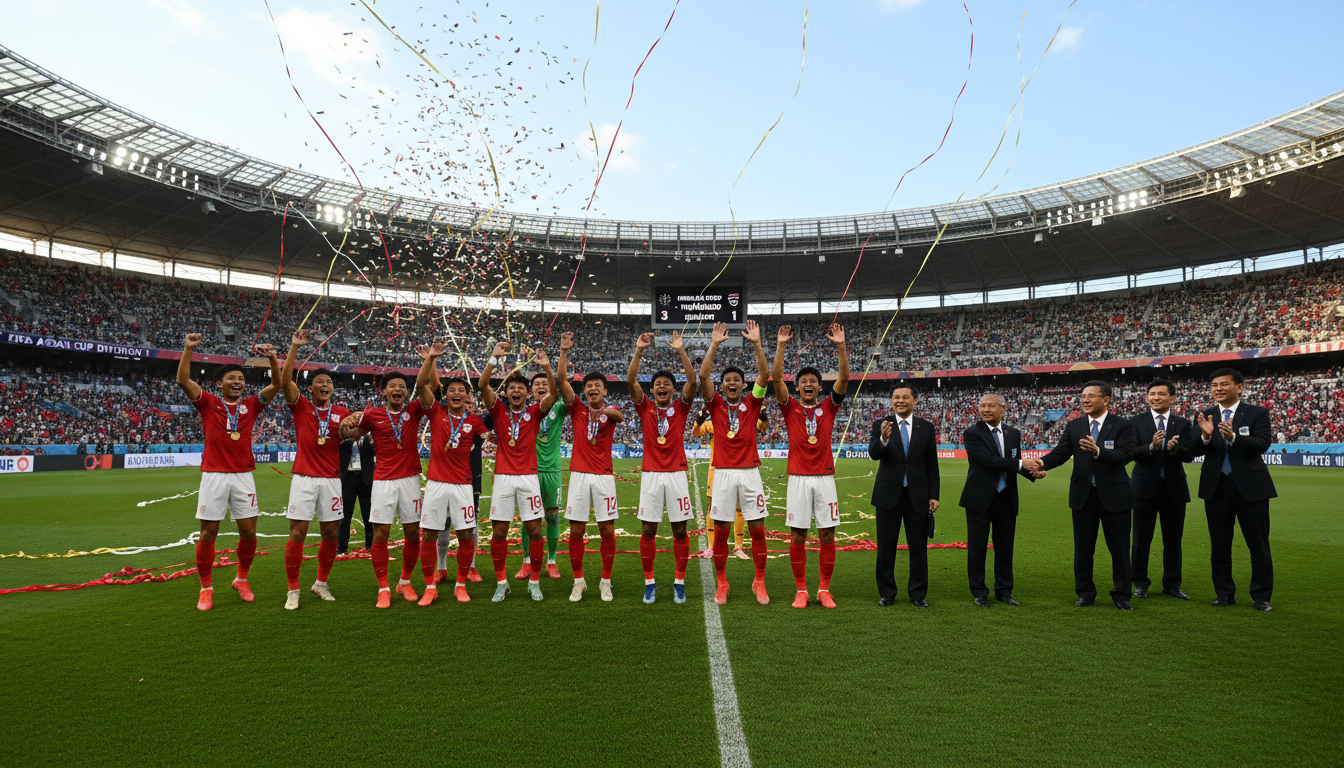
Hong Kong’s national team has reportedly been placed in Division 2 of the inaugural FIFA ASEAN Cup and drawn into a group with Cambodia and Brunei, offering an immediate pathway to promotion. The report circulated in Southeast Asian media last week and suggested the winners of Hong Kong’s group would advance to a play-off for a spot in Division 1 of the next edition. The prospect has generated fresh attention on the territory’s international schedule and its broader ambitions in regional competition.
Reported draw places Hong Kong with Cambodia and Brunei
The Vietnamese report named Cambodia and Brunei as Hong Kong’s Division 2 opponents, positioning the city’s side as the highest-ranked team in the group. According to that account, the group winner would then face the top finisher from a separate pool containing Myanmar, Laos and East Timor for promotion. If confirmed, the structure would create a direct, short-term route for Hong Kong to reach the top tier in the following tournament cycle.
Local media coverage has framed the reported draw as an opportunity for Hong Kong to capitalise quickly on regional ranking differentials. At present, the city sits ahead of the other teams named, which could make it the pre-tournament favourite in that particular group. The reported format also reflects FIFA’s growing use of tiered regional competitions to create promotion and relegation pathways.
Promotion pathway and tournament mechanics described in report
The tournament’s reported mechanics would see the two group winners contest a single promotion play-off to determine who moves up to Division 1 for the next edition. That head-to-head would effectively mirror promotion matches used in other regional competitions, with a single tie deciding which association earns elevation. Such a format compresses the stakes into a few fixtures and increases the significance of each result for smaller associations.
For competing teams like Cambodia and Brunei, the Division 2 grouping would provide an achievable route to higher-level games and stronger opposition. The format also gives associations a clear, tangible target: win the group and secure a shot at promotion. This model can accelerate competitive development for emerging nations while ensuring Division 1 places are contested on the pitch.
HKFA has not officially confirmed tournament details
Despite the media reports, the Football Association of Hong Kong, China (HKFA) has not issued confirmation about the city’s participation or the tournament schedule. An HKFA spokesman told reporters that the association was not yet in a position to confirm details of the mooted FIFA ASEAN Cup, leaving the report unverified by governing bodies. There has also been no public confirmation from the ASEAN Football Federation or FIFA regarding the draw or the competition calendar.
The lack of official confirmation has prompted a cautious response from fans and stakeholders who are eager for clarity but mindful of the number of moving parts involved. Organisers must still finalise logistics, venues and match dates before such fixtures can be formally announced. Until governing bodies publish an official schedule, the reported grouping should be treated as provisional.
Coaching situation and interim management under Roberto Losada
Hong Kong are operating under interim charge of Roberto Losada while the HKFA searches for a permanent head coach, a transition that will shape preparations for any upcoming FIFA ASEAN Cup commitments. Losada’s temporary stewardship will involve assembling squads, overseeing training camps and managing friendlies that are intended to sharpen player readiness. His influence over selection and tactical approach will be scrutinised if Hong Kong takes part in Division 2, given the immediate promotion stakes described in reports.
The coaching vacancy adds a layer of uncertainty ahead of the potential competition, but it also offers a chance for interim staff to assess depth and experiment with personnel. For a squad aiming to win a short, decisive group and a promotion play-off, swift consensus on selection and strategy will be critical. How the HKFA balances the search for a long-term coach with immediate competitive demands will be a key organizational test.
Planned friendlies and fixtures as part of preparation
Hong Kong are scheduled to play two friendly matches next month as part of their build-up, with Mongolia thought to be the likely opponents for a home game at Kai Tak Stadium. The city team is also in line for a first visit to Cambodia since a 1-1 draw in September 2023, fixtures that would provide match practice against regional and similarly ranked opponents. Those friendlies are viewed as opportunities to establish cohesion, test tactical plans and evaluate players under match conditions ahead of any FIFA ASEAN Cup fixtures.
The selection of opponents such as Mongolia and Cambodia reflects a targeted preparation strategy that balances competitive challenge with realistic development goals. Playing at Kai Tak Stadium offers home advantage and logistical convenience for assembling the squad, while an away fixture in Cambodia will help evaluate the team in different conditions. Both matches, if confirmed, will be closely watched as indicators of Hong Kong’s readiness for the regional tournament.
Potential sporting and strategic implications for Hong Kong football
A successful Division 2 campaign in the FIFA ASEAN Cup would have immediate and symbolic value for Hong Kong, providing a pathway back to higher-tier regional competition and stronger opposition. Promotion would increase the frequency and profile of competitive fixtures against top regional sides, potentially aiding player development and raising the national team’s competitive ceiling. For the HKFA, advancement would also bolster claims of progress under new coaching leadership and justify investment in international scheduling.
Conversely, failure to capitalise on a favourable grouping could prompt scrutiny of selection, preparation and the interim coaching regime. Given the condensed nature of the reported format, margin for error would be small and single-match outcomes could determine long-term placement. The association will need to weigh short-term tactics aimed at promotion against longer-term planning for sustainable development.
Hong Kong’s reported inclusion in Division 2 of the FIFA ASEAN Cup has generated discussion about the territory’s competitive ambitions, player selection and administrative readiness. The association’s forthcoming decisions on coach appointment, fixture confirmation and squad assembly will shape whether the opportunity becomes a platform for progress or a missed chance. Until the HKFA, AFC or FIFA provide official statements, the reported draw should be regarded as provisional and subject to confirmation.
The coming weeks are therefore likely to be decisive, with friendly fixtures, organizational announcements and potential tournament logistics all influencing Hong Kong’s path. Players, coaches and officials will be monitoring developments closely as they prepare for a condensed and consequential regional event. The reported FIFA ASEAN Cup grouping, if validated, offers Hong Kong an immediate route to test its standing in Southeast Asian competition and to pursue promotion to the top tier.