Super Falcons open WAFCON 2026 camp in Casablanca with Oshoala, Nnadozie and Ajibade among early arrivals
Super Falcons open WAFCON 2026 camp in Casablanca as coach Justine Madugu assembles a squad led by Rasheedat Ajibade, Asisat Oshoala and Chiamaka Nnadozie.

Super Falcons launch WAFCON 2026 camp in Casablanca
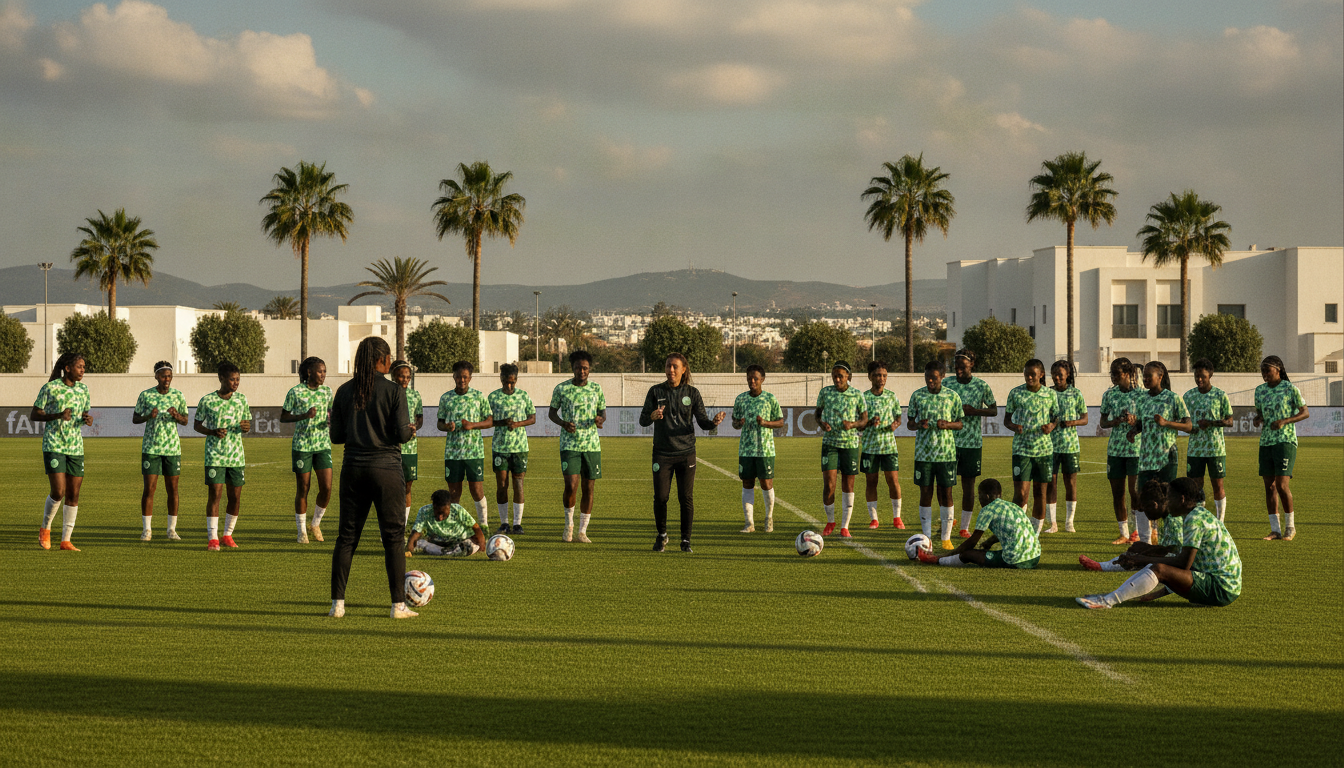
The Super Falcons officially opened their training camp in Casablanca as preparations ramp up for WAFCON 2026, scheduled from 26 July to 16 August 2026. Head coach Justine Madugu began assembling his group on Monday, with a core of established internationals among the first to report. The early training sessions focused on fitness assessments, tactical drills and establishing the tempo Madugu expects ahead of the continental title defence. Nigeria aim to use the Casablanca base to sharpen match readiness before relocating to Rabat for the group-stage fixtures.
Veteran leaders and first-wave arrivals
Captain Rasheedat Ajibade led the list of early arrivals, joined by veteran forward Asisat Oshoala and goalkeeper Chiamaka Nnadozie. The technical team also welcomed defenders Glory Ogbonna, Oluwatosin Demehin and Rofiat Imuran, plus midfielder Christy Ucheibe and goalkeeper Fatima Oloko. Madugu’s decision to call in experienced campaigners early is aimed at embedding leadership and match rhythm across the group. Those first arrivals will set the professional standard for the second wave of players due to join the camp.
Defensive structure and attacking balance examined
Coaching staff spent the initial days evaluating defensive pairings and goalkeeper arrangements, with particular attention on communication and set-piece organisation. The presence of both Nnadozie and Oloko gives Madugu options between the sticks as he considers different tactical scenarios. In attack, Oshoala’s experience and Ajibade’s leadership were used to test combinations and transitional play in small-sided exercises. The early work prioritized cohesion and clarity of roles rather than heavy tactical overhauls.
Madugu’s timeline to a full squad
Madugu and his backroom staff expect to have sixteen more players join the camp in the coming days, moving steadily toward a full complement ahead of the tournament. The coach has structured the schedule so that fitness targets, tactical modules and match simulations can be completed well before the team departs for Rabat. Training windows include recovery sessions, technical work and staged scrimmages to build match sharpness without overloading players. Officials indicated that final squad adjustments will be considered only after all invited players have trained under the coaching staff’s observation.
Group C draw sets immediate challenges
Nigeria are in Group C alongside Zambia, Malawi and Egypt, a section widely viewed as one of the toughest in the tournament. The Super Falcons will begin their campaign against Malawi’s Scorchers at the Al Madina Stadium on Tuesday, 28 July, with little margin for slow starts. Zambia’s Copper Queens and Egypt offer contrasting challenges — Zambia with a physical, progressive style and Egypt with disciplined defensive organisation. Madugu has stressed the importance of early points and maintaining composure through a dense group schedule.
Zambia finalises preparations in Algeria ahead of WAFCON
One of Nigeria’s principal rivals, Zambia, intensified preparations by moving to Algeria for their final build-up phase and to play a pair of friendlies against the hosts. The Copper Queens have spent two weeks in a domestic camp in Lusaka, overseen by assistant coach Charles Haalubono, before heading to North Africa. Head coach Nora Elizabeth Häuptle was due to join the squad in Algeria to complete the coaching unit for the final training block. Observers will watch those friendlies closely as Zambia aim to arrive in Morocco with match practice and tactical clarity.
Tournament logistics and the move to Rabat
Following the Casablanca camp, the Super Falcons will shift base to Rabat ahead of their opening match at Al Madina Stadium on 28 July. The federation has confirmed travel and accommodation plans are in place, allowing the team to acclimatise and finalise match preparations at the competition venue. Organisers typically require teams to arrive with sufficient time to adapt to stadium conditions and local climate, and Nigeria’s itinerary reflects that operational necessity. Madugu has emphasised that logistics are being handled to minimise distractions for the players.
Tactical priorities and rotation strategy
Madugu’s early work in camp suggests a pragmatic approach: solid defensive shape, controlled possession and targeted attacking thrusts through the flanks. The coach has tools to rotate across key positions, particularly in goal and defence, which could be crucial in navigating a compact schedule. Squad depth will be tested by the intensity of two or three games in short succession, and fitness management is expected to shape selection decisions. Officials will monitor player loads closely to preserve freshness for knockout stages.
Domestic and international player balance
The initial selection reflects a mix of domestic-based and Europe-based players, a balance Madugu has historically used to blend home-grown energy with overseas experience. Those who train regularly in competitive European leagues bring different tempo and tactical awareness, while domestic players contribute a familiarity with national style and cohesion. Integrating both groups quickly is a recurring challenge for national teams, and the early arrivals model aims to accelerate that process. Coaches have scheduled joint sessions and mixed-team scrimmages to create constructive competition for starting roles.
Medical, fitness and sports science focus
The medical and sports science teams opened the camp with comprehensive fitness testing and injury screenings to establish baselines for each player. Nutrition plans, recovery protocols and individualized conditioning programmes were outlined to address the rigours of tournament play. Given the proximity to the opening match, prevention and load management are as important as tactical work in the coming days. The federation confirmed that specialists will continue monitoring markers such as fatigue and recovery to guide training intensity.
Opposition scouting and match preparation
Scouting reports on Malawi, Zambia and Egypt have been circulated, with the coaching staff focusing on set-piece tendencies, pressing triggers and transitional vulnerabilities. Video sessions have been used to brief players on opponent patterns and possible match scenarios, while training will simulate the specific challenges expected in each game. The staff plan to refine game plans as the squad nears its final selection, retaining flexibility to adjust to opponents’ late changes. Emphasis remains on being well-prepared without overcomplicating the players’ tasks on match day.
Support, expectations and the title defence
As defending champions, the Super Falcons carry heightened expectations from supporters and federation officials who view another deep run as the minimum standard. Madugu and his players have acknowledged the pressure but stress a step-by-step focus on performance rather than outcomes. The early assembly of a senior core is intended to reinforce a winning culture and provide experience in high-pressure moments. Fans will be watching how the squad responds in the group’s opening fixtures, which could set the tone for Nigeria’s title defence.
Broadcast, travel and final preparations before kick-off
With the tournament days away, broadcasting arrangements and fan travel logistics are being finalised to ensure supporters can follow Nigeria’s matches live. The Super Falcons will continue controlled media availability, balancing publicity with concentrated preparation. Final training sessions in Rabat are likely to include dress rehearsals and set-piece routines tailored to the team’s immediate opponents. Officials reiterated that the priority remains full preparation and mental readiness for the first whistle on 28 July.
The Super Falcons enter WAFCON 2026 with a familiar nucleus and a clear preparation plan as they seek to retain their continental crown, and their early camp work in Casablanca will be crucial in building momentum for the challenges of Group C.