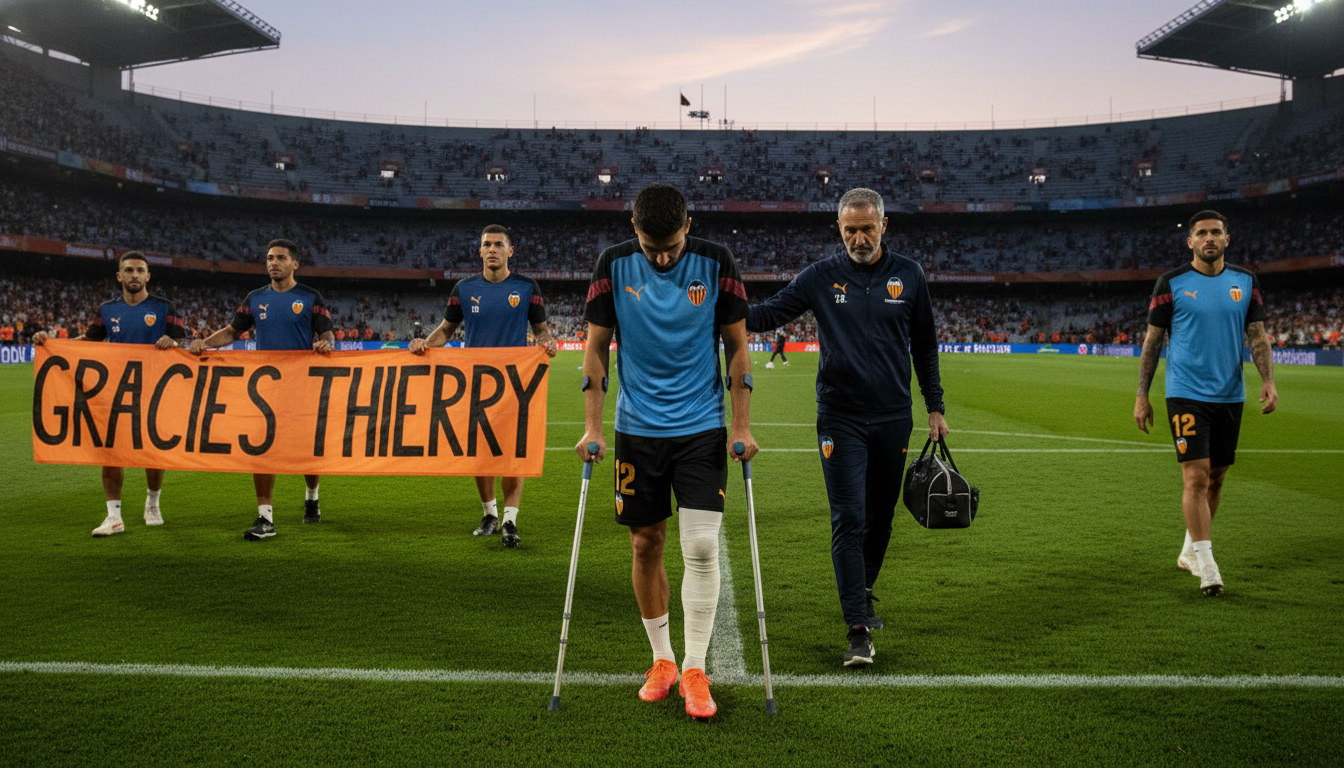
Thierry Correia Valencia exit appears imminent after injury-hit spell at Mestalla
Thierry Correia Valencia: The Portuguese full-back signals the end of his time at Mestalla after a season disrupted by a serious knee injury, ongoing muscle problems and no renewal talks.

Thierry Correia Valencia departure summarized
Thierry Correia has confirmed he expects to leave Valencia after a spell at Mestalla marked by injuries, inconsistent form and what he describes as a fractious club environment. The 2019 signing from Sporting CP said in an interview with Flashscore that the phrase "this cycle should end" best describes his present situation and that neither he nor the club have opened renewal discussions. Correia’s comments underline a campaign in which he struggled to rediscover rhythm after a long recovery from a cruciate ligament injury and faced fresh muscular setbacks when he tried to return to full fitness.
Early promise and arrival from Sporting
Thierry Correia joined Valencia in 2019 as a young prospect from Sporting CP without prior top-flight experience. The club and the player envisioned a period of adaptation and growth, with Correia prepared to develop his defensive and attacking game on Spanish soil. Early errors in high-profile matches, however, shaped public perception of him as a defender and created an initial narrative he has spent years attempting to overturn.
Correia says those opening mistakes left a stigma that stuck, and he believes that perception influenced both fan reaction and his own confidence. He also points out that the transition from Portuguese youth football to La Liga was substantial, requiring tactical and physical adjustments that took time to settle.
Injuries reshaped his Valencia tenure
Injuries emerged as the defining feature of Correia’s time at Mestalla, culminating in a significant anterior cruciate ligament problem that sidelined him for an extended period. He described the last season as particularly difficult because he returned from a long-term injury without the benefit of a full preseason and was forced into competitive minutes sooner than ideal. Fresh muscular complaints followed as he attempted to regain form, and he admits he "never felt comfortable physically" during the campaign.
Correia also confessed the psychological toll of repeated setbacks, explaining that being labelled a "glass player" after his first major injury affected him deeply. That tag, he said, contributed to a cycle in which he sometimes pushed his body when rest would have been wiser, complicating rehabilitation and performance.
Form, identity and the evolution of his game
Despite the interruptions, Correia insists he evolved at Valencia, particularly in defensive areas of his game. He characterizes himself as a fast, robust full-back who can contribute in attack and has grown in his positional understanding and tackling. Correia acknowledges early defensive lapses but wants that phase to be seen as part of a broader development arc rather than his defining legacy at the club.
The player emphasized he consistently demanded a lot from his body and sought treatments both inside and outside Valencia to return to play. That determination, he says, was motivated by a desire to finish his spell at the club on the field rather than on the sidelines.
Best years under Bordalás and Gattuso
Correia identified his time working under José Bordalás, and later under Gennaro Gattuso, as the high points of his Valencia career. He said the Bordalás season in particular brought him confidence and clarity, and that he felt "very well and appreciated by the supporters" during that period. Those campaigns, he added, reinforced the idea that consistent leadership and a coherent game plan were conducive to his best performances.
His praise for those coaches was framed against a wider backdrop of instability at the club, which he described as having frequent changes in staff and personnel that made continuity difficult to achieve. Correia linked his better form to stable tactical demands and clearer coaching expectations.
No renewal talks and the decision to move on
On his contractual future, Correia was unequivocal that talks have not taken place and that the club has not approached him about an extension. He said, plainly, that he has not discussed renewal with Valencia and that the likely outcome is separation. The player also revealed he had wanted to leave two years earlier but circumstances, including injury, prevented that move from materializing.
Looking ahead, Correia said he will meet with his agent to evaluate options and that he prefers to remain in Spain but will keep his choices open. While he stopped short of confirming any specific destination, he made clear his expectation that his career will continue away from Mestalla.
Mestalla context and player perspective
Correia framed his departure in the context of the broader challenges facing Valencia, describing the club as historically large and demanding but presently affected by a period of instability. He suggested that the succession of faces and coaches at the club made it difficult for any player to build regularity and consistent form. His assessment was personal and measured, reflecting both frustration and gratitude.
Despite the difficulties, Correia said he is "content" with his time at Valencia on a personal level and underlined moments of connection with supporters and staff. That ambivalence — pride in certain chapters coupled with disappointment at how others unfolded — shaped his decision to seek a fresh start.
Career implications and market outlook
Correia leaves Valencia with a mixed résumé: clear potential and periods of strong form offset by injuries and public scrutiny. For potential suitors, his experience in La Liga and ability to contribute going forward and backward make him an intriguing option, provided medical questions are settled. Clubs seeking a full-back with top-level Spanish experience will weigh his injury history against his demonstrated qualities and age profile.
From the player’s side, a move within Spain would preserve his familiarity with the league’s demands and tactical rhythms. Correia’s stated preference to remain in La Liga signals both comfort with the competition and a desire to rebuild his reputation in a familiar environment.
Final paragraph
Correia’s remarks mark a decisive moment in a career that began with promise and was complicated by injury and perception, and as he prepares to leave Valencia he will aim to convert hard-won experience into a new chapter that restores continuity, fitness and form.