US visa restrictions World Cup 2026: African fans and officials shut out amid inclusion row
US visa restrictions at World Cup 2026 blocked African fans and officials, exposing flaws in FIFA’s inclusion pledge and drawing global criticism and protest.


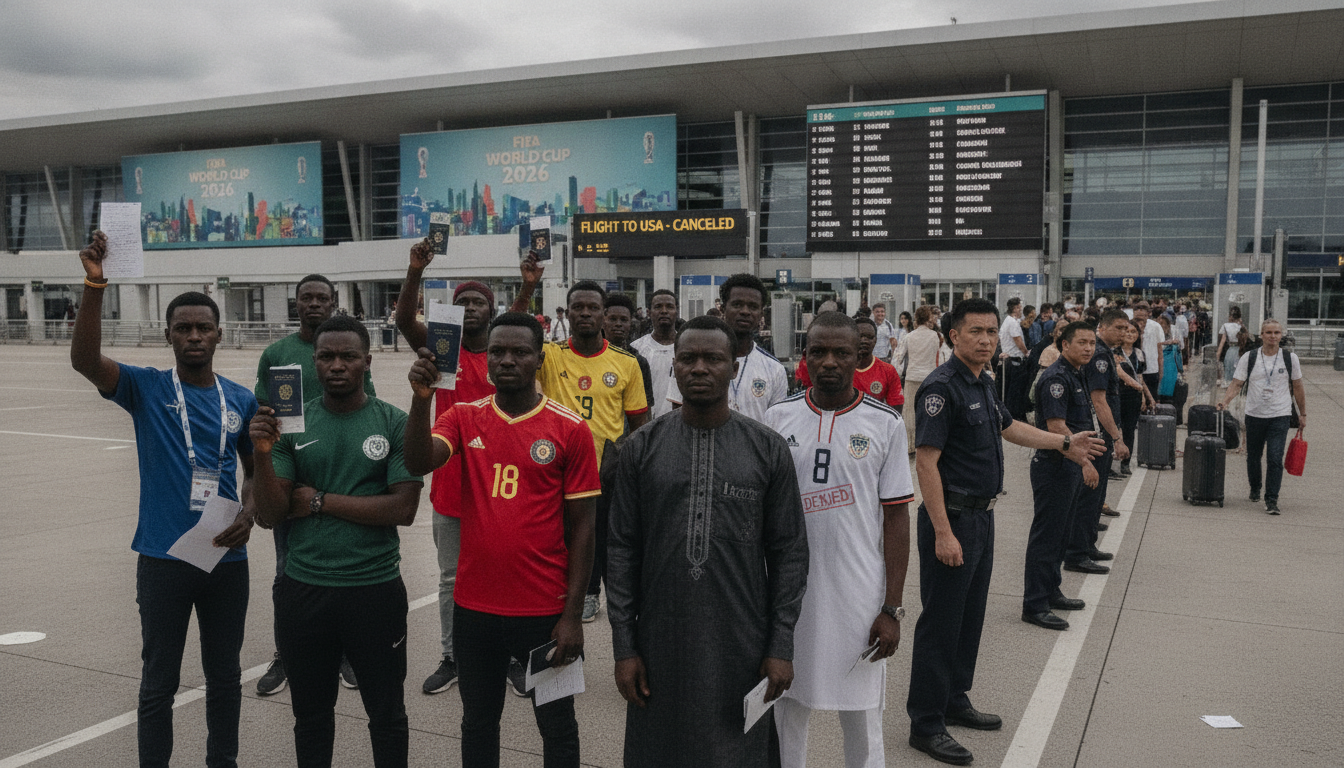
The World Cup finale between Spain and Argentina arrives against a backdrop of controversy as US visa restrictions for World Cup 2026 have kept numerous African supporters, officials and match delegates from participating on American soil. FIFA’s expansion to 48 teams and the three-nation hosting model were billed as a step toward broader access, yet many key participants encountered entry barriers that undermined those promises. The concentration of matches in the United States made unobstructed access to US venues essential for genuine global inclusion, a guarantee that critics say was not met.
Expanded format promised inclusion but relied on US access
Forty-eight nations competed across Mexico, Canada and the United States, an unprecedented field that was supposed to widen representation at the world’s biggest football tournament. Tournament scheduling placed the majority of fixtures in US cities, meaning players, officials and fans from qualifying nations needed reliable entry to the United States. The scale of US-hosted matches created a dependency between FIFA’s inclusion aims and US immigration decisions that event organisers had not fully resolved.
Hosts and organisers designed the expansion to let smaller footballing nations taste World Cup competition at scale, yet entry denials interrupted that plan. Where previous tournaments had established streamlined entry arrangements to facilitate attendance, the US approach to visa adjudication and security checks for the 2026 event proved more restrictive for many visitors. The resulting mismatch between ambition and access turned what should have been a showcase of diversity into a debate about who is allowed to participate.
African teams and supporters disproportionately affected
Ten African countries qualified for the tournament, nearly doubling the continent’s representation compared with earlier editions staged in Africa. Those teams arrived to play on pitches across the co-hosts, but their ability to bring supporters and match officials to US venues was frequently curtailed. Reports emerged of dedicated fans and accredited personnel being refused entry or facing protracted immigration scrutiny that prevented them from reaching fixtures.
High-profile examples underscored the scale of the problem: a referee widely recognised in African football was prevented from officiating after being held for extensive questioning in Miami despite holding valid travel documentation. Supporters known across the tournament circuit also saw US-based matches out of reach because of rejected visa applications. Captains and players spoke publicly about the anguish of seeing family members and national supporters unable to attend crucial games, amplifying the sense that an institutional barrier—rather than simple bad luck—was at work.
Visa rejections hit beyond individual heartbreak, affecting group delegations and organised supporter associations. One national fan club reported dozens of applications denied despite applicants presenting tickets, accommodation and travel histories that would normally satisfy consular checks. The cumulative effect was a visible absence in stadia and fan zones that many argued diluted the World Cup’s claim to be a truly global celebration.
Political interventions and incidents raised neutrality concerns
The tournament was also marked by incidents that tested the neutrality FIFA seeks to preserve. Questions circulated after the US president reportedly intervened in a disciplinary matter involving a US player, a move that critics said blurred lines between politics and sport. Separately, allegations of racist abuse directed at prominent players prompted legal inquiries and public outcry, bringing further attention to the relationship between political actors and football governance.
National coaches and team officials voiced concerns over officiating and alleged discriminatory treatment in specific matches, adding to the sense that off-field dynamics affected experiences on the pitch. Such controversies compounded the visa-access debate by suggesting that political considerations were influencing how different actors were treated during the tournament. Observers argued that when host-nation policies and political pressure intersect with match logistics, the idea of a neutral global event becomes harder to sustain.
US policy decisions and their impact on tournament participation
Policy shifts originating in Washington played a central role in shaping who could attend the US-hosted matches. A directive issued earlier in the year paused certain visa processing for a substantial list of countries, many of which are in Africa and the Middle East, and that pause extended to nationals whose teams or fan groups sought to travel for World Cup fixtures. While the US government reportedly made special arrangements to expedite travel for some players and accredited staff, those exceptions did not cover the full range of fans, journalists and officials who needed access.
Practical procedures increasingly tied entry to broader security assessments, including social media screening and public-profile reviews for applicants from designated areas of concern. For many travelers, these additions meant longer waits, deeper interrogation and a higher likelihood of refusal. Critics said the reliance on such screening mechanisms disproportionately affected applicants from less affluent countries, where a single visa rejection could extinguish the chance for an entire supporter contingent to attend.
Historically, host countries have implemented temporary measures to ease entry during major tournaments, such as personalised fan IDs or simplified visa arrangements. Organisers of past World Cups temporarily relaxed border controls or introduced tournament-specific credentials to accelerate access. In 2026, however, the United States retained broader border-control prerogatives that limited the scope of such facilitation, leaving many would-be visitors unable to join the celebration.
FIFA’s stance and reactions from football authorities
FIFA maintained that visa and border control matters are the responsibility of host governments, a position that drew criticism from football confederations and human rights groups. Concerns came not only from advocacy organisations but also from other governing bodies, which publicly defended affected individuals and questioned whether tournament organisers had done enough to safeguard participation rights. An influential European football body singled out the treatment of a denied official as unjust, announcing alternative appointments to ensure the referee could work matches elsewhere.
The governing body’s human rights commitments for the tournament, framed as a promise to prevent discrimination and promote inclusion, stood in tension with the practical reality of national immigration decisions. Observers argued that FIFA’s non-interference policy in sovereign affairs needed recalibration when it directly undermined access to competitions staged predominantly within a single country. Calls for FIFA to adopt clearer host-country obligations—ensuring special entry pathways for accredited participants and fans—grew louder as the tournament progressed.
Mobility inequality beyond the stadiums
The episode at the 2026 World Cup highlighted wider disparities in global mobility that extend well beyond sport. Researchers and civil-society groups point to visa regimes as a contemporary axis of inequality, affecting students, professionals, entrepreneurs and cultural participants from lower-income regions. For many Africans, complex and costly visa processes are routine barriers to international engagement and professional opportunity.
The tournament illuminated how those structural obstacles manifest during high-profile moments when inclusion should be easiest. Beyond ticket sales and match tickets, travel access requires institutional permissions that often correlate with geopolitical relationships rather than individual merit. The result is a public display where nationality, not sporting achievement, can determine who is present to share a historic event.
Potential reforms and the future of global tournaments
As stakeholders assess the fallout from the World Cup, options for change are becoming clearer. Tournament hosts could be required by contract to guarantee streamlined entry for accredited participants and a defined percentage of fans, with dispute-resolution mechanisms overseen by the sport’s governing bodies. FIFA could build host accountability into future bidding processes, making facilitation of access a threshold criterion rather than a best-practice recommendation.
Practical steps might include tournament-wide fan credentials accepted as valid travel documents, temporary visa-waiver systems tied to match accreditation, or binding agreements on expedited processing for applicants associated with participating teams. Transparency and measurable commitments would reduce the discretionary gaps that allowed large-scale exclusions in 2026. Advocates also urge that human-rights provisions be operationalised with specific remedies when host policies interfere with the right to participate.
The broader lesson for sport organisers is that global events cannot fully divorce themselves from the policies and politics of hosting states. If football’s governing institutions wish to claim moral authority on inclusion, they will need to exercise that authority to ensure access is meaningful and not merely aspirational.
The World Cup’s expanded format brought more nations into the competition than ever before, but the promise of universal access was compromised by visa restrictions that kept devoted fans, officials and match delegates off the field and out of the stands. Addressing that gap will require concrete, enforceable changes to how hosts and organisers manage border controls during major sporting events. Only by aligning tournament ambition with practical facilitation can future editions deliver the genuinely global celebration the sport intends.