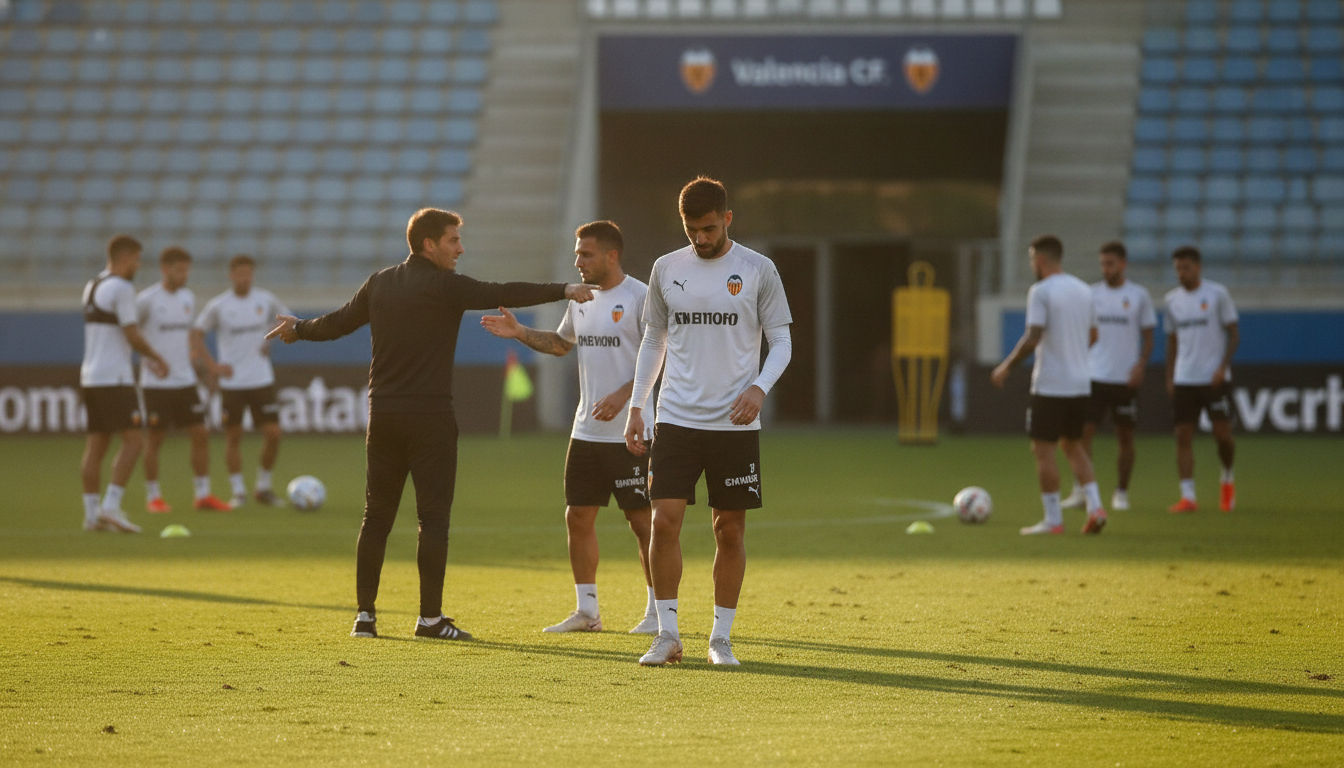
Valencia preseason dilemma deepens as surplus squad and Cenk Ozkacar saga leave club racing the clock
Valencia preseason uncertainty grows as a sizeable group of players told to find new clubs remains without moves, with the Cenk Ozkacar situation emblematic of the wider problem.


Opening summary
Valencia preseason preparations are entering a critical phase with less than two weeks to go before first-team training begins, and the club still carries a long list of surplus players who have been instructed to seek exits. The issue has drawn particular attention to centre-back Cenk Ozkacar, whose stalled transfers and contractual amortization underline the scale of Valencia CF’s summer puzzle. With the start of pre-season approaching and limited transfer activity to date, the club faces both sporting and financial pressure to resolve departures quickly.
Surplus squad faces summer deadline
A significant number of players in the Valencian squad have been informed they do not figure in the coaching staff’s plans and must find new clubs ahead of the new campaign. Those players remain contracted to the club and occupy roster spots and wage budget that Valencia needs to clear before additions are feasible. The compressed timeline between now and the first training sessions increases the urgency for mutual agreements, sales or loan moves to be concluded.
Many of these cases are already in advanced discussions with agents, but market realities and valuation gaps have slowed progress. The accumulation of unresolved contracts has created an operational bottleneck that affects recruitment, pre-season planning and the coach’s ability to assess a settled group of players.
Cenk Ozkacar transfer timeline and failed exits
Cenk Ozkacar provides a clear example of the complications the club faces this summer. Valencia initially signed the Turkish defender on loan from Olympique Lyonnais in August 2022 with an option to buy. After one season on loan, the club exercised that option and completed a permanent transfer in the summer of 2023 for a reported fee of around five million euros on a five‑year deal.
Ozkacar’s spell after the permanent move did not consolidate his position, and he spent the 2023–24 season on loan at Real Valladolid, where his performances coincided with a difficult campaign that ended in relegation for the Pucelanos. In the summer of 2025 Valencia arranged another loan, this time to 1. FC Köln, which included a non‑obligatory purchase option set at approximately two million euros for the summer of 2026.
Köln ultimately decided not to activate that option, leaving Valencia with a remaining book value on Ozkacar’s contract that closely matches the figure stipulated in the clause. Attempts to place the player elsewhere over the ensuing months have not produced an agreement acceptable to all parties, illustrating how sporting form, market appetite and contract accounting can interact to stall exits.
Financial weight of unplaced contracts
Unplaced players present more than a sporting headache; they carry clear financial consequences for Valencia CF. Remaining amortization costs, wage obligations and the inability to recoup transfer fees restrict the club’s flexibility in the market. In Ozkacar’s case, the clause that remained unpaid corresponded to the residual amortization expected to be registered by July 2026, which narrowed potential buyers’ interest because the club could not realistically reduce the asking price further.
Those contractual realities influence internal budgeting and the calculation of how many reinforcements are realistic before the window closes. For a club needing to balance competitiveness with financial prudence, every unmovable contract reduces the margin for new signings and complicates long‑term planning.
Players and agents push to avoid presenting for training camp
Sources close to Valencia say that both players and their representatives are accelerating efforts to resolve situations ahead of the first day at the training ground in Paterna, which is scheduled to begin in early July. In several cases, including Ozkacar’s, agents have sought to prevent their clients from being required to report for pre‑season because the players are unlikely to be part of the squad during the competitive season.
That tactic serves multiple purposes: it spares the player the embarrassment of training knowing they will not be selected, it reduces injury risk while the player searches for a new club, and it applies pressure on the parent club to find a resolution. From the club’s perspective, however, absent players complicate planned sessions and limit the coaching staff’s ability to evaluate options in a full squad environment.
Why potential buyers are holding back
There are several reasons clubs that might once have been interested in surplus players are pausing this summer. Individual form and recent performances weigh heavily; clubs are cautious about investing in players who struggled in previous campaigns or whose recent loans coincided with relegation battles. Wages are another sticking point, as many of the players Valencia wants off the books command salaries that prospective buyers find difficult to match.
Market timing also matters. The later in the transfer window other clubs wait to finalize their squads, the more leverage buyers have to negotiate lower fees or loan deals. In addition, clubs across Europe are balancing their own financial constraints, meaning fewer teams are prepared to pay transfer fees for players with ambiguous recent records.
Those dynamics create a sellers’ market for Valencia only if the club is willing to accept lower returns, agree to wage sharing, or negotiate mutual terminations—options that carry their own costs and consequences.
Coach’s stance and squad planning
Valencia’s head coach has reportedly drawn a firm line about which players will be integrated into tactical plans and who will not, a position that has informed the club’s public and private messaging to affected individuals. The coaching staff’s clarity on personnel is intended to establish a definitive path for pre‑season preparation and competitive objectives, but it also forces the club’s sporting directors into a race against time to reshape the roster.
Preparations for the season need a stable group for building fitness, implementing tactical work and staging friendly matches. Without resolution on key surplus cases, the initial weeks of pre‑season could be fractured, forcing coaching staff to split attention between fringe players and the core squad they intend to develop.
Possible solutions and realistic scenarios
Valencia has several options to alleviate the logjam, each with trade‑offs. The club can lower transfer fees to prioritize moves this month, accept loan deals with wage contributions, or negotiate mutual contract terminations where the economics make sense. Alternatively, the club could keep the players for pre‑season and look to sell later in the window, albeit at the cost of delaying reinforcements and risking player morale.
For Cenk Ozkacar specifically, likely outcomes include a late loan to a market willing to cover wages, an agreed termination if both sides see no future together, or integration into the squad if no acceptable offers emerge. Any of these paths will require compromises from the player, agent and club.
Implications for the start of the campaign
How Valencia resolves these cases will shape the early season in tangible ways. A cleansed squad would permit targeted reinforcements and clearer tactical planning, while a failure to move players could force the club to enter the campaign with an unwieldy roster. Financially, unsold contracts will impact amortization schedules and wage bills, which in turn influence transfer strategy across the coming windows.
The club’s handling of this summer will also send a signal about the effectiveness of its sporting management and the coherence between coaching demands and executive actions. Quick, pragmatic decisions would suggest decisive leadership; protracted stalemates would underline the difficulties clubs face when valuation expectations and market reality diverge.
Valencia preseason preparations must now confront both short‑term logistics and longer‑term consequences as the transfer window progresses.
The coming days will test Valencia’s ability to synchronize sporting requirements with financial constraints as the clock ticks down to the first training session.