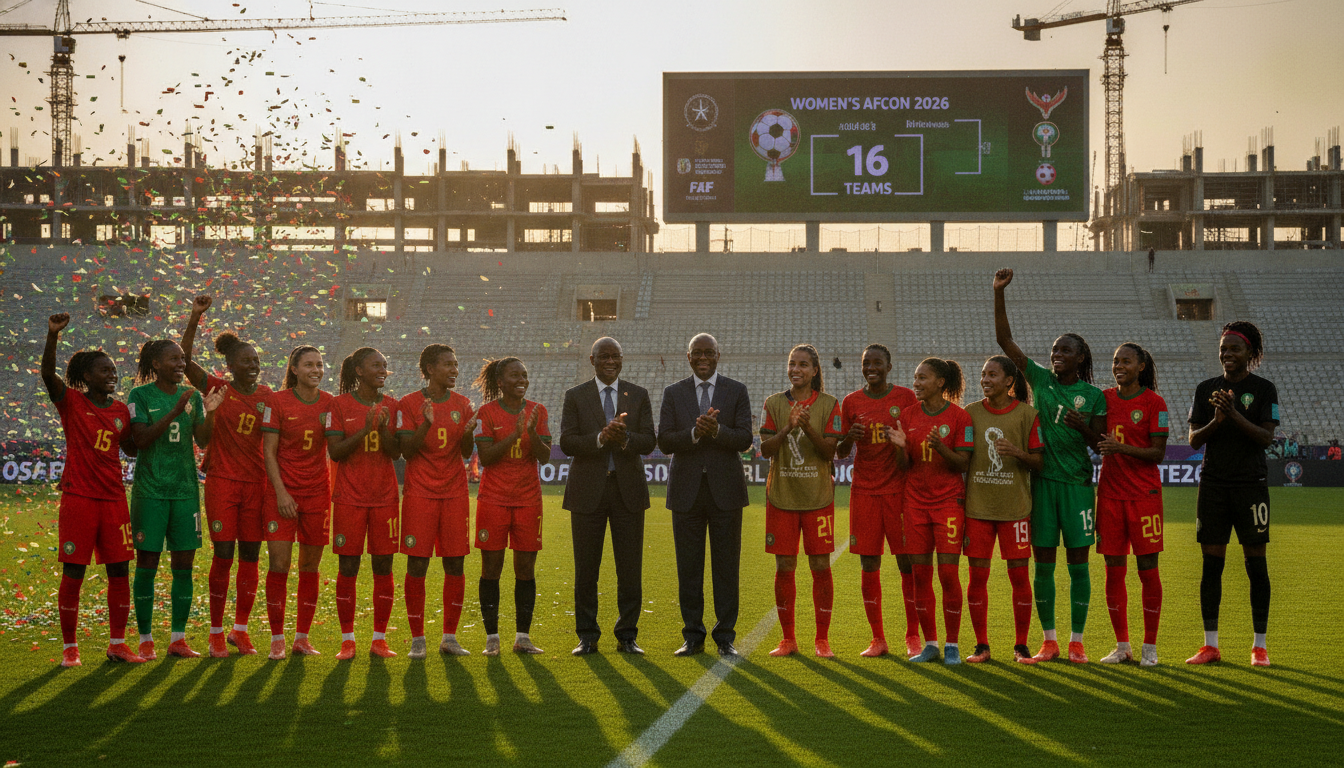
CAF Women’s Africa Cup of Nations Morocco 2026: Expansion to 16 Teams and Milestones Ahead of July 26 Kickoff
Kickoff July 26: CAF Women’s Africa Cup of Nations Morocco 2026 expands to 16 teams. Milestones, records and debutants like Cape Verde shape the tournament.


With just weeks remaining, the CAF Women’s Africa Cup of Nations Morocco 2026 arrives on July 26 with a landmark expansion to 16 nations and heightened attention across the continent. The tournament, scheduled to run until August 16, will be the 14th edition since the competition adopted its modern format in 1998 and the first to feature a 16-team field. Expectations are high after the last edition’s wide broadcast reach and Nigeria’s dramatic comeback in the final, and organizers say the enlarged format aims to deepen competition and increase representation.
Tournament Countdown and Expansion
The 2026 edition opens on July 26 and runs through August 16, marking a compact but intense three-week window for Africa’s top women’s national teams. Organizers have confirmed the move to a 16-team structure, a step up from the 12-team setup introduced for the 2019 cycle, which is expected to create more group-stage drama and new knockout dynamics.
That expansion is the most significant format change since the competition officially adopted a group stage in 1998 and broadened to eight participants. By increasing the field to 16 teams for the first time, the tournament will provide more qualifying opportunities and broaden the geographic footprint of the finals across regions that have historically had limited representation.
Nigeria’s Record and Continental Dominance
Nigeria enters the tournament as the continent’s most decorated side, holding a record 10 titles and an unblemished finals record in matches they have contested. The Super Falcons have been fixtures since the competition’s modern inception and remain the team with the most wins, most matches played and the most consistent podium finishes.
That dominance includes a string of early triumphs—winning the competition’s first five editions—and recent drama, notably the comeback victory over hosts Morocco in the last final where Nigeria overturned a 2-0 deficit to win 3-2. Such results underscore the nation’s depth of talent and strategic resilience, qualities that make them perennial favourites in any edition.
Host Nation Morocco and Recent Finals History
Morocco will host its third consecutive finals in 2026, a rare hat-trick of hosting that reflects the country’s growing investment in women’s football infrastructure. Despite strong home support, Morocco suffered successive final defeats in recent editions, falling to South Africa in 2022 and to Nigeria in the most recent final.
Those losses have nonetheless coincided with rising domestic interest and improved competitive standards in North Africa, where Morocco’s performances, media visibility and hosting role have helped draw broader international broadcast partnerships. Local development and fan engagement will be key storylines as Morocco aims to convert home advantage into a long-sought title.
New Entrants and Regional Breakthroughs
Cape Verde will make its tournament debut in 2026, becoming the 28th nation to reach the finals and only the second island nation to feature after Réunion’s appearance in 2000. Cape Verde’s qualification is a milestone for the West African Football Union (WAFU), with the island now the 10th WAFU association to reach the final tournament.
Malawi’s qualification also adds to regional diversity, giving COSAFA representation its eighth member at the finals and reflecting the broader progress across southern and eastern Africa. Those debutants and returning mid-tier nations are expected to introduce tactical variety and create potential upset scenarios in the expanded group stage.
Goalscoring Records and Individual Landmarks
Perpetua Nkwocha remains the competition’s most prolific scorer with 24 career goals and record single-edition tallies that include 11 goals in 2010. Nkwocha’s consistency—she scored across 20 different matches—has set a high benchmark for successive generations, and several current Nigerian forwards follow in her prolific tradition.
The competition’s Golden Boot has often been claimed by Nigerian players, who top the list of top scorers on nine separate occasions. Other notable moments include Asisat Oshoala’s four-goal match in 2016 and historical hat-tricks such as Veronica Phewa’s in 2001, underscoring the tournament’s capacity for individual attacking brilliance.
Statistical Trends and What to Expect in 2026
Recent editions show fluctuating goals-per-match averages, with the 2018 tournament reaching 3.19 goals per match and the 2022 edition averaging 2.25. The most recent tournament produced 55 goals across 26 matches, returning to a mid-range goals-per-game figure and demonstrating both tighter defenses and potent attacking options in equal measure.
Past editions have produced hallmark results that remain part of the tournament’s lore, including Nigeria’s 5-0 final win over Cameroon in 2004—the largest winning margin in a Women’s AFCON final—and the only goalless final in 2018 that was decided on penalties. Those historical benchmarks provide context for what teams will chase in Morocco 2026: efficiency in attack, defensive resilience and clutch performances in knockout moments.
Nigeria’s extensive unbeaten runs and the repeat appearances of South Africa highlight competitive continuity, but the expanded format and a growing pool of capable nations mean surprises are increasingly likely. Analysts point to squad depth, preparation time, and the experience of players who compete in overseas leagues as decisive factors in this edition.
The tournament will also be a media moment. The previous finals saw unprecedented global distribution, with broadcasters in more than 120 territories, and the 2026 edition is expected to build on that footprint as federations and commercial partners seek to grow the women’s game across Africa and beyond.
Cape Verde’s arrival and Malawi’s breakthrough exemplify the tournament’s shifting geography, while perennial powers like Nigeria and South Africa continue to set performance standards. For host Morocco, a third consecutive hosting duty brings both pressure and opportunity to catalyse the next phase of regional development.
As teams complete final preparations, attention will turn to key fixtures in the group stage that could determine knockout paths, with head-to-head matchups between established heavyweights and ambitious newcomers the most anticipated matchups. Tactical nuance, squad rotation and set-piece effectiveness are likely to determine which sides navigate the expanded field most successfully.
Players to watch include established top scorers and emerging talents who have impressed in continental qualifying and domestic leagues. Coaches will be judged not only on immediate results but on their ability to integrate new talent while managing the physical demands of a compressed schedule.
The CAF Women’s Africa Cup of Nations Morocco 2026 arrives as both a celebration and a barometer of progress in African women’s football. Expansion to 16 teams means more nations will taste finals football, and the tournament’s rich history of records, comebacks and individual feats provides a compelling backdrop for what promises to be a fiercely contested championship.
Organizers, federations and broadcasters alike will be watching closely to see whether the expanded format accelerates competitive balance or reinforces established hierarchies. Fans can expect a blend of tactical caution and attacking ambition, with group-stage surprises likely to set up dramatic knockout clashes.