World Cup penalty shootouts send Netherlands and Germany crashing out as Morocco and Paraguay advance
Morocco and Paraguay stunned favorites in shock World Cup penalty shootouts as Brazil advanced, with the Netherlands and Germany eliminated in the last 32.

The round-of-32 produced dramatic late goals and tense spot-kick deciders as the tournament saw two of its pre-tournament favourites exit after shootout losses on Monday night. World Cup penalty shootouts determined the fate of the Netherlands and Germany, while Morocco, Paraguay and Brazil moved into the last 16.
Morocco stuns Netherlands in penalty shootout
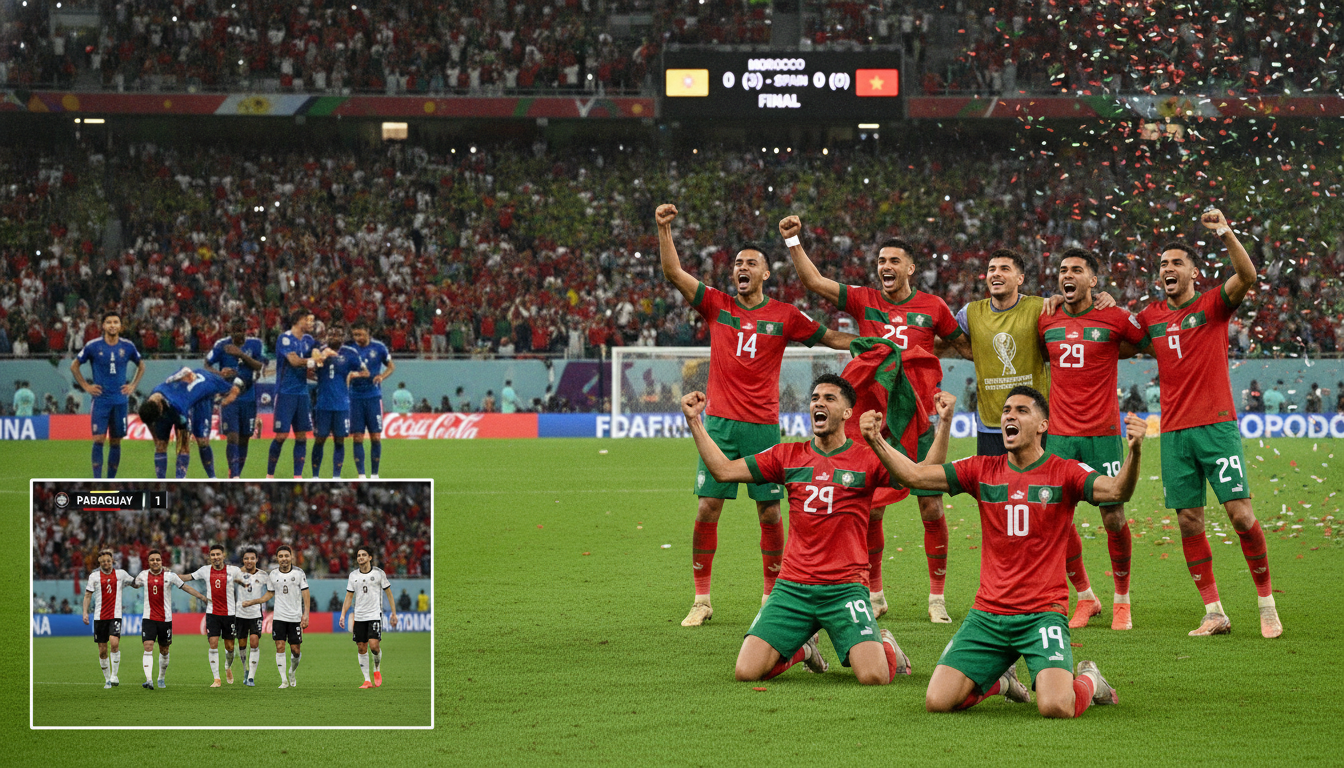
Morocco advanced to the round of 16 after a 3-2 victory in a penalty shootout against the Netherlands following a 1-1 draw in normal and extra time. Cody Gakpo had given the Dutch the lead with 20 minutes remaining in regulation, but a last-minute equaliser from Issa Diop forced extra time and ultimately left the tie to penalties.
The Atlas Lions converted three of their spot-kicks while the Netherlands missed or were denied on two attempts, a sequence that compounded the disappointment for one of the tournament favourites. Morocco’s goalkeeper and composure from the penalty spot proved decisive in an emotionally charged match that showcased both teams’ contrasting approaches.
Morocco will now travel to Houston to meet Canada in the round of 16 on Saturday, setting up a match that carries continental significance as the first African team to progress from the last 32. The victory marks another strong performance for the Atlas Lions and underscores their resilience under pressure.
Paraguay’s defensive resilience downs Germany
In Boston, Paraguay upset Germany by holding the Germans to a 1-1 draw and prevailing in the penalty shootout despite limited possession. Paraguay managed only 24 percent of the ball during the match, but their disciplined defensive structure and counterattacking threat kept Germany off balance and ultimately delivered the result.
Germany squandered opportunities in the shootout, with Kai Havertz, Nick Woltemade and Jonathan Tah failing to convert from the spot, a sequence that ensured an early exit for the four-time champions. The outcome marks a second consecutive World Cup in which Germany have departed earlier than expected, intensifying scrutiny of the team’s ideas and execution.
Paraguay’s progression will see them face the winners of France versus Sweden in the next round, a draw that gives the South American side a challenging but opportunity-rich path. Their success emphasises how compact defending, tactical discipline and efficient transitions can overturn possession-dominant opponents at this World Cup.
Brazil’s late winner keeps favorites alive
Brazil escaped a scare against Japan with a stoppage-time winner from Gabriel Martinelli to claim a 2-1 victory and a place in the last 16. Japan had taken the lead through Kaishu Sano just before the half hour, and Brazil needed a second-half response, which arrived when Casemiro levelled shortly after the interval.
The match featured a sustained contest of tactics and moments of individual brilliance, but it was Martinelli’s intervention deep into added time that settled a match full of tension. The win ensures Brazil remain among the contenders and avoids the kind of exit that befell other heavyweights on the same night.
Brazil now await the winner of the Ivory Coast versus Norway tie, and their path through the tournament will test whether they can convert late arousal into consistent control. For Brazil, the result offered both relief and a reminder of the precarious margins at the World Cup.
Round of 16 matchups take shape
Monday’s results solidified several round-of-16 pairings and reshaped the bracket in ways that will affect favourites and underdogs alike. Morocco’s victory set up a meeting with Canada in Houston, while Paraguay will be matched with either France or Sweden, depending on the outcome of that tie.
Brazil’s progression means they will meet either Ivory Coast or Norway, a pairing that could influence the balance of power among South American and European contenders. The elimination of the Netherlands and Germany opens the bracket for teams that might have been considered outsiders before the tournament began.
These developments will force planning shifts for coaches and analysts who must now assess different potential opponents and tactical matchups. The last 16 promises to deliver a mix of established stars and determined underdogs, with paths to the latter stages more open than many anticipated.
Penalty shootouts underline tournament unpredictability
The prominence of penalty shootouts in deciding knockout-stage matches has cast a spotlight on the fine margins that separate progress from elimination. Shootouts are inherently unpredictable, and Monday’s results reinforced how psychological composure and preparation can overshadow statistical dominance during 90 minutes.
Teams that manage to regulate adrenaline and execute routine techniques under immense pressure gain outsized advantages in this format. For Morocco and Paraguay, the combination of defensive resolve and penalty proficiency provided a route past technically superior opponents on paper.
The reliance on spot-kicks also reignites questions about strategic approaches late in games, including substitutions, goalkeeper preparation and the sequencing of takers. Coaches will be scrutinised for their choices as nations prepare for the tactical chess of the round of 16.
Implications for favourites and tournament narrative
The elimination of the Netherlands and Germany will resonate across international football, altering perceptions of which sides carry momentum into the tournament’s later stages. Both teams entered with strong reputations and expectations, and their exits will prompt fresh evaluation of squad depth, tactical variation and leadership under pressure.
For the Netherlands, losing to an African opponent in a shootout will be felt as a missed opportunity to assert continental dominance, while Germany’s second successor early exit raises questions about long-term rebuilding and adaptability. Conversely, Morocco and Paraguay will draw praise for their structure and belief, validating investment in disciplined systems and player development.
Meanwhile, Brazil’s dramatic finish keeps one of the pre-tournament favourites on course and offers a narrative of survival that could galvanise the squad. The last 16 now looks set to test whether underdog momentum can outlast the pedigree and resources of historically dominant nations.
Looking ahead, teams that navigate the psychological landscape of knockouts and execute in decisive moments stand to benefit as the tournament tightens. Monday’s results are a reminder that the World Cup remains a stage where preparation, nerve and a single moment can redefine expectations and create new contenders.