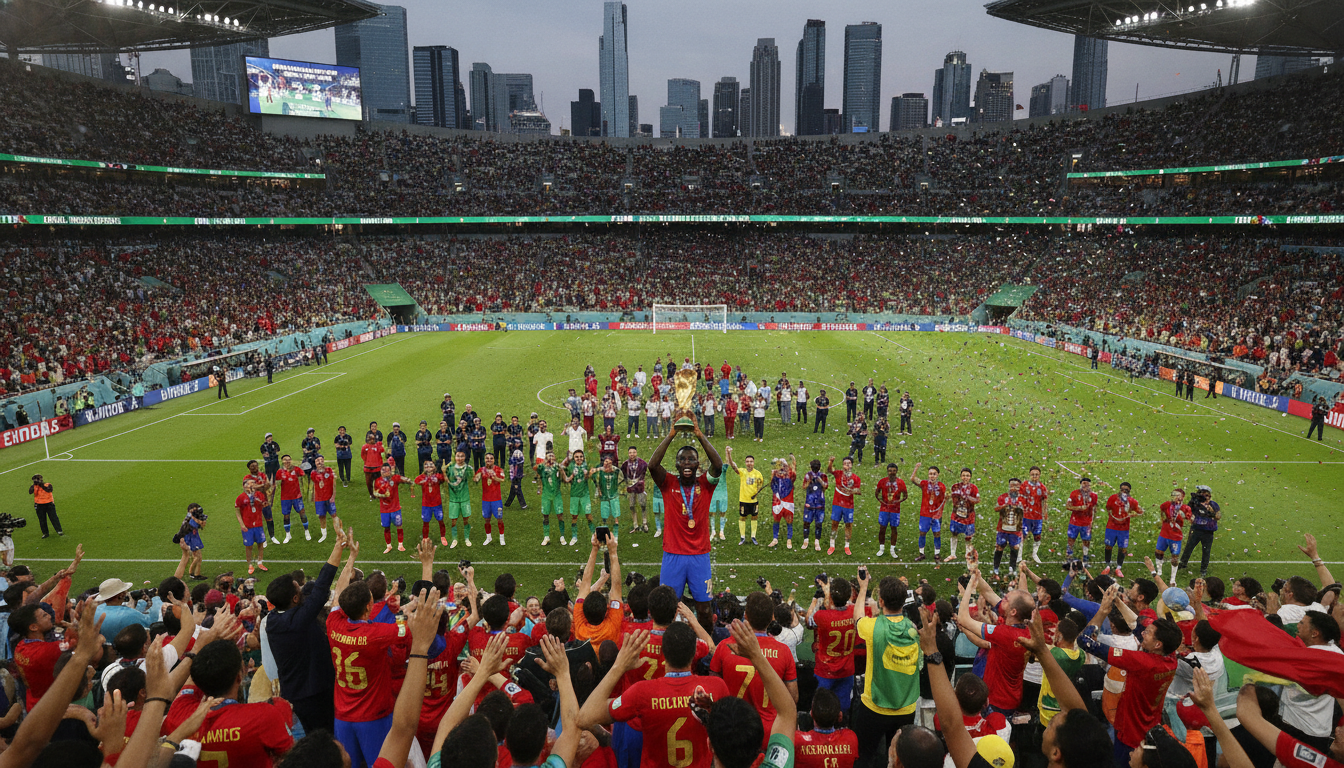
Spain crowned 2026 FIFA World Cup champions after extra time win over Argentina
Spain beat Argentina after extra time to win the 2026 FIFA World Cup. The expanded 48-team event thrilled fans but exposed visa, governance and access faults.


Spain lifted the 2026 FIFA World Cup trophy at MetLife Stadium
Spain completed a dramatic tournament run with a late extra-time victory over Argentina to claim the 2026 FIFA World Cup title at MetLife Stadium. The final provided a fitting capstone to a tournament that combined classical technique, tactical adaptability and moments of individual brilliance. Spain’s win reinforced a long-held belief that technical football and possession-based strategies remain viable paths to the game’s highest prize. The match’s narrative — a champion reclaiming global glory in a tightly contested final — will be replayed in highlight reels for years.
The final whistle and the ensuing celebrations also masked wider debates about what the 2026 World Cup revealed about modern football’s strengths and shortcomings. While the expanded format produced memorable underdog stories and broadened representation, it also magnified logistical and governance challenges that organizers must address. Across three host countries, packed stadiums and record viewing figures coexisted with visa delays, travel complications and administrative friction. Those contradictions left players, fans and officials reflecting on whether the tournament’s structural gains were matched by equitable access.
Expanded 48‑team format produced fresh narratives and tougher questions
The decision to increase the field to 48 teams changed tournament dynamics from the first kick to the final. More national teams reached the world stage than ever before, creating new storylines and giving smaller federations a platform to showcase their progress. Instead of predictable group-stage processionals, the 2026 World Cup delivered a mixture of surprise results and competitive fixtures that kept global audiences engaged.
Yet expansion also raised legitimate concerns about competitive balance and fixture congestion. Some group matches featured lopsided scorelines, while the longer schedule tested squad depth and recovery protocols. Organizers argued that broader representation would accelerate global development of the game, and in many respects that case was borne out. Still, tournament administrators must now reconcile the commercial and sporting promises of a larger World Cup with the practical burdens placed on players, host cities and smaller federations.
African teams demonstrated tactical growth but stopped short of the semifinals
African nations emerged from the tournament with renewed credibility and evidence of deeper talent pools than in past cycles. Several countries delivered disciplined, tactically aware performances and progressed to later stages, underscoring structural improvements in coaching and youth development across the continent. This depth suggested African football is no longer dependent on a single golden generation but rather on systemic advancements that produce multiple competitive squads.
Nonetheless, progress on the pitch did not translate into a continental breakthrough in the form of a semifinal or final berth. Persisting issues off the field — inconsistent domestic leagues, governance weaknesses, and underinvestment in infrastructure — remain longstanding obstacles. Administrators, federations and governments will face mounting pressure to convert on-field promise into tangible, tournament-winning frameworks if Africa is to make the next leap toward football’s ultimate prize.
Visa and immigration failures undermined claims of global inclusion
One of the most visible shortcomings of the 2026 World Cup was the inconsistency of visa and entry processes for supporters, officials and media. Thousands of passionate fans from Africa, Asia and parts of Latin America faced prolonged delays, onerous documentation requirements or outright refusals that prevented them from attending matches. In a tournament that repeatedly celebrated diversity inside stadiums, those same values were often contradicted at international borders.
The mismatch between FIFA’s rhetoric about football as a universal celebration and the practical realities of international travel exposed a bitter irony. Some journalists, volunteers and smaller federation officials reported bureaucratic obstacles that limited coverage and participation. For a global event marketed as inclusive, host nations must deliver entry systems that treat supporters as guests rather than risks. Failure to do so risks alienating the very communities the expansion aimed to embrace.
Player welfare and calendar pressures sharpened long-standing debates
Beyond travel and access, the 2026 World Cup reignited discussions about player welfare amid an increasingly crowded international calendar. Clubs and national teams negotiated around longer tournaments, additional qualifying windows and compressed domestic seasons. The physical demands on elite players intensified as the global football ecosystem sought to reconcile commercial imperatives with humane recovery and workload practices.
Medical teams and sports scientists highlighted the need for clearer scheduling that prioritizes recovery, mental health and long-term fitness. Observers noted instances where fixture congestion appeared to affect performance levels and injury risk. Going forward, federations and competition organizers will need to adopt concrete calendar reforms and enforced rest periods to protect players whose peak performance underpins the sport’s global appeal.
Host selection and legacy planning will determine whether the World Cup serves communities
The logistical challenges of staging the 2026 FIFA World Cup across three countries showcased both organizational capability and persistent blind spots in legacy planning. Host cities produced world-class stadia and entertainment packages that attracted record crowds and substantial broadcast audiences. Those achievements, however, must be weighed against questions about who benefits from hosting and whether investments reach communities beyond stadium precincts.
Future bids should be evaluated not only for infrastructure and event delivery but also for commitments to visa accessibility, local economic inclusion and long-term development programs. Successful tournaments will be those that embed community investment into planning from the outset, ensuring that the economic and social dividends extend beyond short-term construction cycles and matchday hospitality. Host nations must convince federations and supporters alike that the World Cup generates broad-based legacies rather than concentrated returns.
Spain’s victory and the tournament’s on-field drama will dominate headlines, but the broader legacy debate will shape future editions of the World Cup. The expansion to 48 teams has clearly widened opportunity and introduced new footballing narratives, yet opportunity without accessibility or fairness risks becoming symbolic rather than substantive. If FIFA and national federations truly intend the World Cup to be a shared human celebration, they must pair sporting innovation with policy changes that guarantee entry, fairness and meaningful community benefit.
The 2026 FIFA World Cup will be remembered for thrilling matches, unexpected heroes and the reaffirmation that technical, possession-based football can still win the game’s grandest prize. At the same time, it has left organizers with an unambiguous mandate: deliver a tournament structure that matches the sport’s global ambitions with equal access, sensible schedules and transparent governance so that future World Cups unite more people in person as well as on screen.