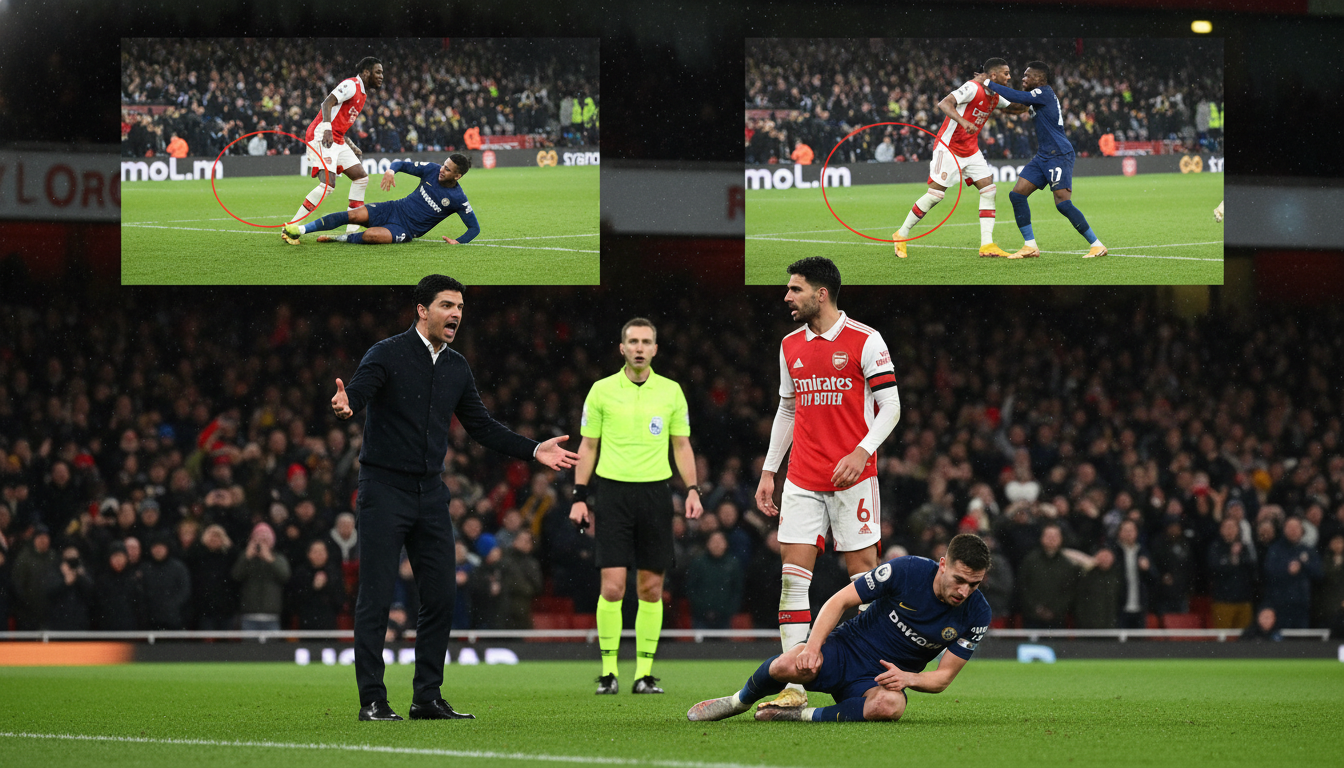
Mikel Arteta criticises referees after Arsenal hold Newcastle as red-card calls reignite debate
Arsenal boss Mikel Arteta has accused Premier League referees of altering the course of two pivotal matches, claiming incidents involving Manchester City and Newcastle should have produced red cards. The Gunners climbed back to the top of the table after Eberechi Eze’s early strike secured a 1-0 win at the Emirates, but Arteta insisted that key decisions in both games left the title race hanging in the balance. His assessment centres on Nick Pope’s foul on Viktor Gyökeres and a challenge on Kai Havertz in the City fixture, which the manager says merited dismissals. Opta’s model still lists Arsenal as favourites to win the title at 72.4%, a slim margin that underscores the stakes of each decision.


Eze’s early brilliance restored Arsenal to the summit
Eberechi Eze produced a moment of individual quality to break the deadlock inside the opening quarter-hour, his strike ultimately deciding a tight contest at the Emirates. The goal marked a rare occasion when Arsenal’s first goal in a top-flight home match arrived within the opening ten minutes, an occurrence not seen at the ground since October 2019. That early strike allowed Mikel Arteta’s side to weather sustained pressure from Newcastle and manage the match tempo around a slender lead. Despite securing three points, the result provoked more conversation about officiating than tactical nuance.
Eze’s contribution was decisive, but the game’s narrative quickly shifted to two controversial challenges that dominated the post-match analysis. Newcastle’s goalkeeper Nick Pope committed the foul on Viktor Gyökeres well away from goal, an incident that drew a yellow card and prompted immediate protest from Arsenal’s bench. Arteta insisted he saw a clear red when he reviewed the footage repeatedly, arguing the moment should have removed Newcastle’s ability to field a full XI at a critical juncture.
Arteta pinpoints two match-changing incidents
Mikel Arteta left little doubt about his view of the two incidents, telling reporters he had studied both moments multiple times and considered them sending-off offences. He reiterated his belief that the foul on Gyökeres deserved a red and referenced a similar decision he expects should have been made in Arsenal’s game against Manchester City when Abdukodir Khusanov impeded an advancing Kai Havertz. Arteta suggested that had either opponent been reduced to ten men the complexion of each match — and potentially the title race — would have been very different.
The manager framed his remarks as an assessment of pivotal moments rather than an attempt to excuse his players’ performances. He said the margins in such fixtures are razor thin and that crucial refereeing calls in both recent matches had tilted the balance away from Arsenal. His comments underlined the sense of frustration inside the dressing room and the wider debate about how decisions at game-defining moments are made.
Refereeing interpretations and the DOGSO debate
Much of the controversy rests on the interpretation of laws covering denial of an obvious goal-scoring opportunity and reckless or excessive force. When a goalkeeper leaves his area and fouls an attacker, referees must determine whether the action was a genuine attempt to play the ball, a last-man denial, or reckless conduct — distinctions that can mean the difference between a yellow and a straight red. Those fine margins are increasingly scrutinised in big matches where one decision can swing both results and momentum.
Video Assistant Referee (VAR) interventions were introduced to reduce clear errors, but their involvement has not eliminated debate about subjective calls. Opposing camps often point to consistency issues — whether similar incidents receive identical sanctions across different matches — while officials defend split-second judgments made under unique circumstances. That tension is now central to the Premier League conversation as managers, players and supporters assess how such decisions will shape the closing stages of a closely fought title race.
Immediate reactions from players and officials
Inside the Arsenal dressing room, players were quick to deflect from the controversy and focus on the outcome, emphasising the value of three points in a congested run-in. Newcastle’s camp expressed satisfaction at having kept the scoreline down and demonstrated defensive resilience despite conceding an early goal. Outside the clubs, pundits and former referees dissected each moment, offering differing views on intent, the position of the ball and the goalkeeper’s proximity to the attacker when the fouls occurred.
As of the latest post-match exchanges, neither club reported an official sanction or formal complaint that would trigger retrospective action from the league’s disciplinary body. That situation leaves the incidents in a grey area: widely debated in public and analysed in broadcast studios, yet still subject to the thresholds and timelines that govern review and appeal. The lack of a definitive external ruling maintains uncertainty over whether the contentious moments will have further consequences.
Title race consequences and Opta’s outlook
Arsenal’s victory restored them to first place and kept the title contest open as the campaign approaches its decisive phase. Small episodes such as the fouls highlighted by Arteta gain outsized importance when league standings are tight and psychological edges matter. Opta’s statistical projection continues to favour Arsenal to clinch the title at 72.4%, a figure that reflects probabilities rather than inevitabilities and that changes with every result in the run-in.
For clubs chasing or defending honours, the reality is that single incidents can alter the narrative even when models lean one way. Managers and sporting directors will be evaluating everything from refereeing consistency and VAR application to squad rotation and tactical flexibility in response to those marginal moments. The interplay between on-field decisions and off-field perception has amplified in recent seasons, turning refereeing controversies into a recurrent subplot of the title fight.
What the run-in looks like for Arsenal and opponents
Arsenal now face a sequence of fixtures that will test squad depth and mental resilience; handling pressure in matches where marginal calls may again be decisive is part of the challenge. Mikel Arteta has signalled his intent to keep focus on performance and preparation, while also making clear his expectations about how important decisions should be adjudicated. The manager’s public stance is likely aimed at reinforcing standards within his dressing room and at shaping the broader discourse around officiating in critical matches.
Opponents will be equally motivated to capitalise on any slip-ups and to press for consistency from referees and VAR panels. The competition’s governing bodies face mounting calls to provide clarity on contentious interpretations to preserve the perception of a level playing field. As the campaign edges toward its conclusion, both on-field results and off-field processes will be scrutinised by clubs, media and supporters seeking fair competition.
Arteta’s comments have reignited an argument that will follow the Premier League through its most consequential weeks, and while the manager accepts the unpredictability of sport, he has made his view on those two incidents abundantly clear.