Arsenal expected XI vs Atletico Madrid: Raya to start as Gunners chase first-leg edge
Arsenal expected XI vs Atletico Madrid sees David Raya return between the posts as the Gunners aim to claim a crucial first-leg advantage at the Civitas Metropolitano. The match is the first leg of the UEFA Champions League semi-final and follows Arsenal’s 1-0 Premier League victory over Newcastle United at the weekend. Mikel Arteta must balance squad fitness and tactical discipline while managing several selection questions ahead of the return fixture next week. This preview examines the probable starting XI, tactical implications and the areas Arsenal will target to unsettle Atletico Madrid.


Raya to start as Arsenal chase Champions League edge
David Raya is widely expected to keep the goalkeeper slot for the continental tie, providing continuity behind a defence that has been solid in recent weeks. Raya’s distribution and command of the penalty area will be central to Arsenal’s plan to build from the back and maintain possession under pressure. His presence gives Arteta the confidence to play a higher defensive line at times, trusting Raya to sweep and read long balls.
Keeping Raya between the sticks also signals a preference for ball-playing from the goalkeeper in what will be a high-stakes, high-intensity fixture. The Champions League semi-final demands both shot-stopping and the ability to initiate counters, qualities Raya has shown in key moments this season. Expect him to play a pivotal role in launching Arsenal transitions when Atletico commit numbers forward.
Back four likely to remain unchanged with Saliba and Gabriel central
Defensive selection looks set to be conventional, with William Saliba and Gabriel forming the centre-back pairing that has become Arsenal’s defensive spine. Their aerial presence and physicality are vital against Atletico’s direct moments and set-piece threats. Ben White is expected to cover the right-back berth, offering pace and security on the flank.
Piero Hincapié is in contention to occupy the left-back slot, balancing defensive cover with forward thrust down the left. Jurrien Timber’s ongoing absence leaves Arteta with fewer rotation options, reinforcing the likelihood of a settled back four selected to provide stability in the first leg. The pairing of Saliba and Gabriel will be asked to limit Atletico’s ability to play through the middle and to manage crosses into the penalty area.
Midfield pivot to prioritize control with Rice and Zubimendi
Arsenal’s midfield double pivot is anticipated to be Declan Rice alongside Martín Zubimendi, a pairing designed to combine defensive shielding with progressive passing. Rice’s role will focus on breaking up Atletico transitions and offering a structured outlet when possession is regained. Zubimendi brings positional intelligence and ball-carrying that suits Arsenal’s desire to dominate the middle third.
Together they should aim to control the tempo, reduce turnover risk and allow Martin Ødegaard to operate higher as the number 10. That control will be crucial against Atletico’s compact defensive block, where patience and precise passing are required to create openings. Expect Arsenal to use the double pivot to recycle possession, draw Atletico out and create pockets for the attacking line to exploit.
Flank adjustments as Bukayo Saka returns and Martinelli features
Bukayo Saka is fit to return and looks likely to slot into the right-wing role, bringing directness and a goal threat from wide areas. His return gives Arsenal an attacking balance and pace on the right that can stretch Atletico’s full-backs. Gabriel Martinelli is expected to feature on the left, offering inverted runs and sharp movement to disturb Atletico’s organised shape.
These flank choices indicate Arteta’s intention to pair creativity with width, using Saka’s ability to cut inside and Martinelli’s propensity to attack the channels. Eberechi Eze remains a squad option after recent involvement, while Kai Havertz’s absence through injury narrows the attacking permutations. Arsenal will rely on their wide attackers to create mismatches and provide service for the centre-forward.
Viktor Gyökeres to lead the line in a 4-2-3-1
Viktor Gyökeres is expected to spearhead the attack in a 4-2-3-1 formation, starting after a bench appearance in the previous outing. Gyökeres offers a focal point for Arsenal’s forward play with the ability to hold up the ball and link with the attacking midfielders. His movement can disrupt Atletico’s central defenders and create space for Ødegaard and the wingers to exploit.
As the central striker, Gyökeres will also be tasked with pressing from the front and contesting Atletico on second balls. His presence allows Arsenal to play through him when channels are congested and to attack set-piece situations where his physicality can be an asset. The decision to start Gyökeres suggests Arteta prioritises a blend of resilience and forward projection in the first leg.
Tactical outlook: breaking a compact Atletico and managing counters
Arteta’s Arsenal will face a team built on defensive organisation and efficient counter-attacking, so the tactical plan must emphasize controlled possession and quick transitions. Arsenal will seek to draw Atletico out, exploit the spaces between defence and midfield, and use midfield rotation to displace the Spanish side’s compact lines. Risk management will be essential; losing possession in dangerous areas would play into Atletico’s strengths.
Set pieces and second-phase transitions could decide moments in a closely matched tie, so Arsenal must be precise in their defensive duties and clinical in attack. The ability of Rice and Zubimendi to screen and recover will determine how often Arsenal get punished on the break. Meanwhile, Ødegaard’s link play and the wingers’ movement will be crucial in unlocking a notoriously stubborn Atletico defence.
Selection questions and injuries shaping Arteta’s choices
Injuries have narrowed Arteta’s options, affecting rotation and tactical flexibility for a two-legged semi-final. Jurrien Timber’s absence restricts changes at full-back and forces a reliance on the healthiest available defenders to cover the minutes. Kai Havertz and Eberechi Eze’s recent fitness concerns influence forward options and place additional emphasis on Saka and Martinelli’s availability.
Arteta must also weigh the need for fresh legs next week in the return match, which could influence substitution patterns and game management tonight. Managing yellow cards, fatigue and potential knocks will be part of a broader strategy designed to keep the squad competitive across both legs. The manager’s selection will reflect a balance between securing a favourable first-leg result and preserving squad capacity for the decisive return.
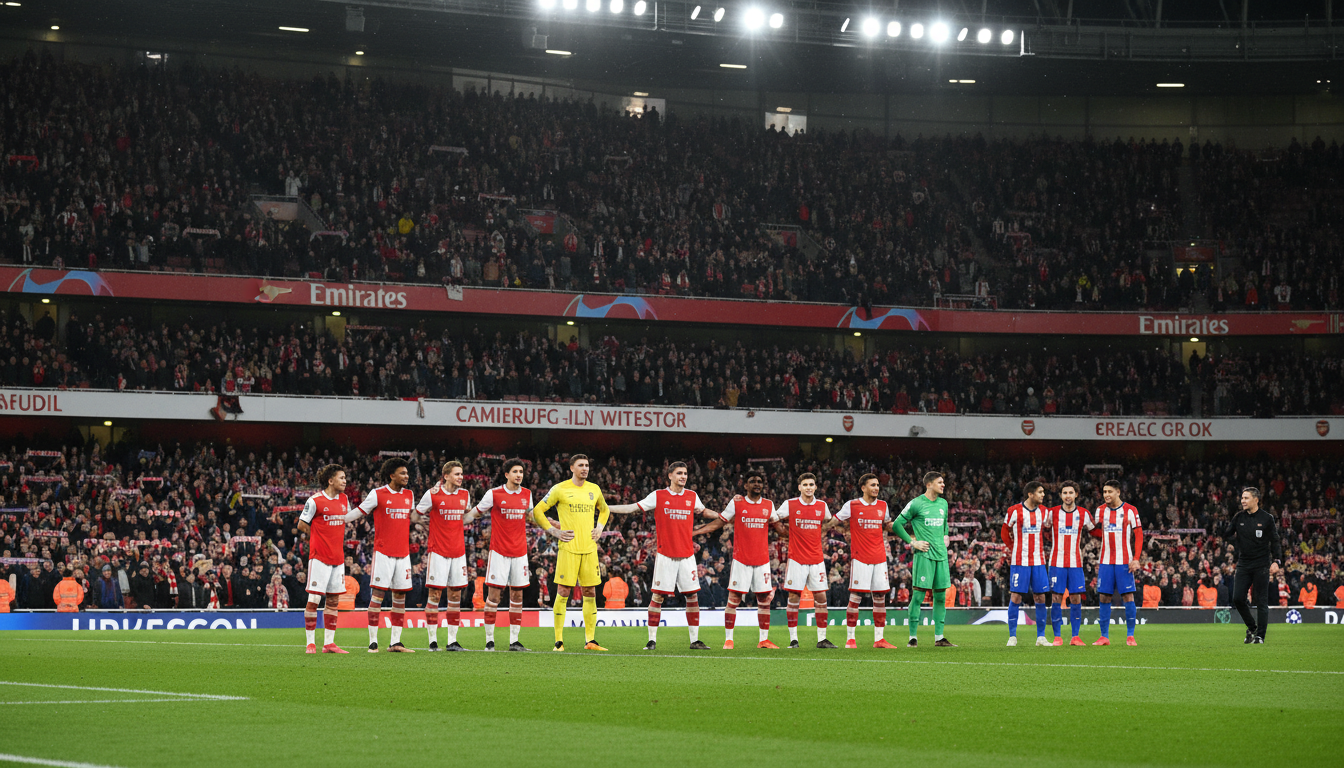
Arsenal’s projected starting XI is likely to line up in a 4-2-3-1 with Raya; Ben White, William Saliba, Gabriel, Piero Hincapié; Declan Rice, Martín Zubimendi; Bukayo Saka, Martin Ødegaard, Gabriel Martinelli; Viktor Gyökeres. That configuration emphasizes midfield control, wing pace and a single striker capable of holding the line.
Arsenal will go into the Civitas Metropolitano with the objective of taking a positive result back to London and keeping the tie open ahead of the return leg. Securing a clean sheet would be particularly valuable given Atletico’s strengths on the counter. How effectively Arsenal implement their tactical blueprint and cope with Atletico’s physical and organised defence will determine whether they leave Madrid with the advantage they seek.
Tonight’s fixture represents both a tactical test and a measuring stick for Arsenal’s Champions League credentials this season. The starting XI and in-game adjustments will offer clues about Arteta’s approach to two-legged knockout football at the highest level. Whatever the outcome, the first leg will set the tone for an intriguing remainder of the semi-final.