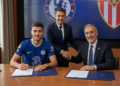
Armando Gonzalez emerges as Barcelona’s budget striker option as Lewandowski exit looms
Barcelona eye Armando Gonzalez as a budget striker option this summer while Robert Lewandowski’s exit looms and Julian Alvarez remains the club’s priority.


Barcelona steps up its summer striker search
Barcelona are preparing for a summer overhaul of their attacking ranks as uncertainty grows over Robert Lewandowski’s future and the club evaluates more affordable alternatives. Armando Gonzalez is being discussed in Catalonia as a cost-conscious option as the club balances sporting ambition with financial limits. Julian Álvarez remains the club’s leading target, but Barca’s recruitment plan now looks wider, blending ambition with pragmatism.
The Catalan club has reportedly explored multiple avenues to replace or supplement Lewandowski should he leave on the expiry of his contract. That uncertainty has forced sporting directors to sketch contingency plans, with younger or less expensive forwards entering the frame. Gonzalez’s name has surfaced in recent weeks after reported talks between Barcelona representatives and his camp, signaling that the club is actively surveying the market.
Barcelona’s planning comes amid a changing managerial and tactical environment that affects recruitment priorities. The current coaching setup, which emphasizes mobility, technical ability and pressing from the front, has specific requirements for any incoming striker. That tactical profile partly explains why the club has persisted in targeting high-profile names while simultaneously assessing players like Gonzalez who could slot into a different development pathway.
Gonzalez responds to Barca interest and maintains focus
Armando Gonzalez, the Mexican forward linked with Barcelona, has responded to transfer speculation with measured optimism and a focus on his present responsibilities. In an interview with Sport, he acknowledged the prestige of Barcelona and said he would be grateful for the opportunity while insisting he remains concentrated on his day-to-day work. He also noted that family and representatives prefer to manage expectations carefully to avoid distractions.
Gonzalez described Barcelona as one of football’s historic clubs and praised their modern identity under current coaching staff, signalling his admiration without committing to any move. He made clear that while the prospect is appealing, he tows a cautious line because his advisors are trying to protect his routine and development. That pragmatic stance will inform any potential negotiations and could shape both timing and conditions of a transfer.
The forward’s comments underline a common dynamic in modern transfers: a player’s desire must be weighed against club finances, agent positioning and the player’s own development plans. Gonzalez’s public reaction is consistent with many young players who welcome the idea of moving to an elite club while prioritizing steady progression and avoiding premature upheaval.
Financial constraints push Barcelona toward alternative targets
Barcelona’s financial constraints remain a central factor in their summer transfer strategy and are likely to determine whether the club secures a marquee signing or opts for a more economical profile. The board’s stewardship of wages and transfer spending has introduced a realism that narrows the effective options for new signings. In that environment, a lower-cost target like Gonzalez becomes a plausible and attractive solution.
Pursuing Julian Álvarez would satisfy the club’s sporting demands but could prove expensive given market dynamics and the competition for his signature. That cost profile makes alternatives necessary, particularly if Barcelona must honor other financial commitments or prioritize rebuilding other parts of the squad. A move for a less established forward could free funds to reinforce multiple positions while still addressing the immediate need for a striker.
Clubs in Barcelona’s position commonly blend an ambitious primary target with secondary options who offer value and potential resale upside. For Barca, the calculus will include transfer fee, wages, player age, and how quickly a recruit can adapt to LaLiga and the club’s playing philosophy. Gonzalez’s appeal rests on the possibility that he could arrive at lower cost while providing an adjustable, long-term asset.
How Gonzalez’s profile might fit Barca’s forward line
Gonzalez’s publicly stated interest in joining Barcelona is paired with comments about wanting to play alongside elite young talent, suggesting he views the club as a place to grow within an attack-oriented environment. He singled out Lamine Yamal as a player he admires and as someone he would like to team up with, highlighting Gonzalez’s inclination toward technical, interlinked attacking football. That aspiration aligns with Barcelona’s emphasis on fluid forward play and positional interchange.
From a tactical perspective, Barcelona often prioritizes forwards who can contribute to build-up play, press effectively and combine well in tight spaces. While specific details of Gonzalez’s attributes were not detailed in his interview, Barca’s recruitment team would evaluate his ability to link play, run in behind, and fulfill pressing responsibilities. Compatibility with young playmakers and wide attackers would be a key metric in any scouting assessment.
Beyond on-field fit, Barcelona will consider how quickly a prospective signing adapts to the club’s culture and training demands. Players arriving from different leagues or systems often require an adjustment period; the club’s coaching and support staff play a major role in accelerating integration. Gonzalez’s comments about staying focused and letting his representatives manage the wider noise signal a temperament that Barca could view positively during a potential transition.
Agent contact and the transfer timeline ahead
Reports earlier in the year indicated Barcelona had held exploratory conversations with Gonzalez’s representatives, a standard step in transfer negotiations designed to gauge interest and potential deal structure. Those initial contacts rarely amount to immediate offers but are intended to map feasibility, financial expectations and timing. Any formal proposal would likely be negotiated during the summer window once Barca clarifies Lewandowski’s contractual status and finalizes budget allocations.
The coming months will be decisive for both parties. Barcelona will need to balance its sporting priorities against regulatory and financial constraints, while Gonzalez and his camp will decide whether to pursue a move or continue the player’s development elsewhere. The timing of Lewandowski’s possible departure — should the club confirm it — will accelerate Barca’s decision-making and potentially prompt swift action in the market.
Negotiations of this sort involve multiple stakeholders and contingencies, from transfer fees and wage structure to potential sell-on clauses and performance incentives. Barcelona’s directors and legal team will also scrutinize any proposal for compliance with long-term financial plans and LaLiga regulations. For Gonzalez, a move to Barca would represent a significant career step, but it would also require careful planning to ensure playing time and development pathways are preserved.
Implications for Barca’s summer planning and squad balance
If Barcelona progresses with a move for Gonzalez, the decision will reflect a broader squad-building philosophy that blends short-term needs with long-term sustainability. Adding a younger or less costly striker could allow Barca to maintain depth while pursuing a marquee signing if one becomes attainable. Conversely, failing to secure Alvarez or another high-profile forward would increase the strategic importance of developing promising alternatives internally or through more modest transfers.
Squad balance and minutes allocation will come under scrutiny if a player like Gonzalez joins a team with established senior forwards. Coaching staff must manage expectations and provide a clear pathway for a newcomer to contribute without undermining team harmony. The club’s approach to rotation, cup competitions, and phased integration will determine whether such a signing proves a shrewd investment.
Barcelona’s supporters and analysts will watch recruitment decisions closely, interpreting them as signals of the club’s ambition and fiscal discipline. A pragmatic signing that yields on-field returns and preserves financial stability could be framed as smart planning, while a high-profile miss could invite criticism. Ultimately, the club’s performance next season will be the most persuasive argument for or against the choices made in the transfer market.
Looking ahead, Barcelona’s pursuit of a striker this summer is likely to remain fluid, with the club weighing high-end targets against budget-friendly prospects such as Armando Gonzalez. The balance between immediate impact and long-term sustainability will guide decisions, and the player’s own willingness to join a major European club while managing career progression will be pivotal. Either way, the transfer window promises to be a defining moment for both Barca’s attack and Gonzalez’s ambitions.