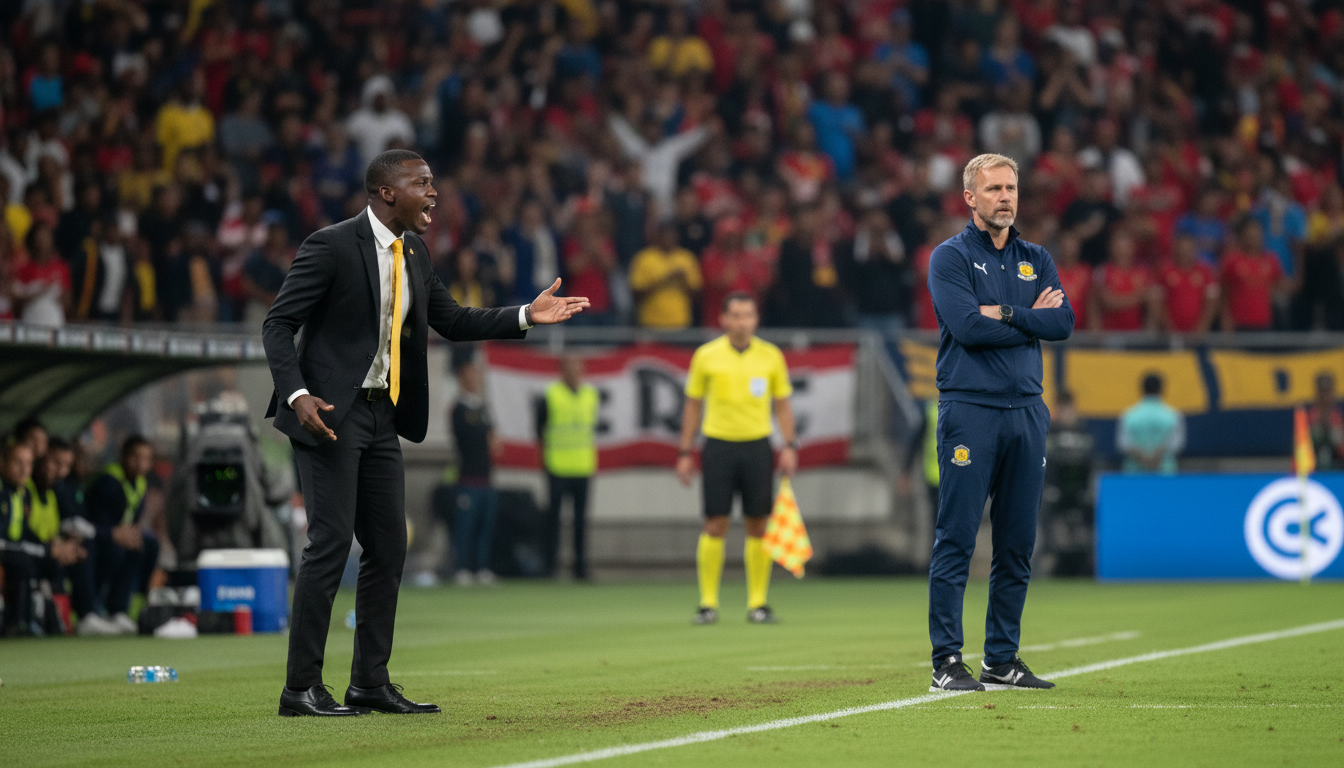
CAF Champions League final: Mamelodi Sundowns and FAR Rabat set for Portuguese coaching duel
Portuguese coaches Miguel Cardoso and Alexandre Santos prepare for the CAF Champions League final as Mamelodi Sundowns host FAR Rabat in Pretoria next week.

Mamelodi Sundowns and FAR Rabat will meet in the first leg of the CAF Champions League final in Pretoria next week in a matchup that carries as much intrigue in the technical areas as on the pitch. The meeting pits two Portuguese coaches, Miguel Cardoso and Alexandre Santos, against one another on African football’s biggest club stage. Cardoso arrives aiming for a third consecutive continental final, while Santos has guided FAR to its first Champions League decider since 1985. The duel underlines the growing footprint of Portuguese coaching methods across the continent and sets up a tactical chess match over two legs.
Cardoso and Santos set to clash in CAF Champions League final
Miguel Cardoso, 52, and Alexandre Santos, 49, represent two contrasting managerial arcs that have converged at the summit of African club competition. Cardoso has established a reputation for a possession-oriented approach and persistent high intensity since arriving in Pretoria in December 2024. Santos, appointed by FAR Rabat in February 2025, has built his side around organisation, resilience and pragmatic game plans. Their meeting in the CAF Champions League final is notable for showcasing both the continuity and the adaptability of contemporary Portuguese coaching.
Both coaches have recent continental pedigree, but their paths to the final highlight different strengths. Cardoso has navigated Sundowns through domestic and continental fixtures with an emphasis on control and wide play. Santos reached the final by tightening FAR Rabat’s defensive structure and winning key knockout ties. The narrative will be shaped as much by managerial preparation and adjustments over two legs as by the players who take to the field.
Sundowns’ evolution under Miguel Cardoso
Since his appointment, Cardoso has refined an already talented Sundowns squad into a team with clearer tactical identity and greater intensity. The Portuguese coach favours a structured 4-3-3 that prioritises possession, high tempo transitions and width to stretch opponents. Under his stewardship the club has sought to blend aesthetic attacking football with a more disciplined defensive framework, producing a side capable of controlling matches without sacrificing chance creation.
Sundowns’ route to the final reflected that balance, including a composed elimination of Espérance Sportive de Tunis. The aggregate win over Espérance showcased the team’s defensive organisation alongside clinical finishing, particularly from key attackers. Cardoso’s focus on match control and phase-based training appears to have reinforced Sundowns’ ability to dominate long periods while remaining alert to counter threats.
Cardoso’s experience in continental finals gives him a tactical edge in managing two-legged affairs. His familiarity with the pressures and fine margins of Champions League deciders will be critical in match management and in-game substitutions. For Sundowns, the objective in Pretoria will be to secure a meaningful first-leg advantage while avoiding complacency against a side built to frustrate.
FAR Rabat’s rise and Alexandre Santos’ pragmatic blueprint
FAR Rabat’s run to the final has been defined by defensive discipline, physical conditioning and tight game management rather than flamboyance. Santos has prioritised organisation and adaptability, often switching between a compact 4-4-2 and a 4-2-3-1 depending on the opponent and match context. These systems have allowed FAR to absorb pressure, defend narrow spaces and strike on the break or from set-pieces where margins are slim.
The club’s semi-final victory over RS Berkane underlined Santos’ game plan in knockout football: secure a strong home result and grind out results on the road. FAR won 2-0 at home and advanced after a tense away leg to progress 2-1 on aggregate. That approach has made FAR a difficult proposition in two-legged ties, particularly when playing with a disciplined defensive block and clinical counters.
Santos’ prior success in Angola with Petro de Luanda is reflected in his emphasis on structure and collective work rate. His appointment in February 2025 injected belief into a side that had not reached the competition’s final in decades. In a matchup against a possession-dominant Sundowns, Santos will rely on concentration, tactical fouls in strategic areas, and set-piece routines to manufacture opportunities.
Portuguese coaching influence across African football
The Sundowns–FAR Rabat final is part of a broader pattern in which Portuguese coaches have been influential in African club and national football. Historically, figures such as Manuel José brought sustained success to North African clubs, while other Portuguese managers have left their mark through tactical discipline and professional training methods. That lineage of coaching has encouraged African clubs to look to Portugal as a source of managerial talent that blends technical insight with structural rigour.
Recent decades have seen a new wave of Portuguese tacticians export methodologies emphasizing game intelligence, positional discipline and flexibility. These elements translate well across diverse leagues and have been adapted to local playing styles and player profiles. The result is a wider acceptance of Portuguese coaching philosophies in Africa, visible in club choices, tactical trends and player development initiatives.
Beyond the two men in charge at the final, Portuguese influence has affected tactical setups, youth development programmes and scouting networks across the continent. Clubs seeking continental success often prioritise coaching hires that promise organizational clarity and the capacity to manage two-legged, high-stakes encounters. The final in Pretoria will be another high-profile example of that exchange of ideas and techniques.
Tactical match-up and decisive factors ahead of first leg
On paper the contrast between Sundowns’ expansive 4-3-3 and FAR Rabat’s compact designs is stark, but the decisive factors will be subtle and situational. Sundowns will aim to control possession, use wide players to stretch FAR and create overloads in attacking thirds. Their success will depend on midfield depth, full-back involvement and the ability of forwards to convert possessions into clear chances.
FAR will concentrate on limiting space between the lines, forcing Sundowns into predictable channels and exploiting turnovers with direct counters or set-pieces. Defensive transitions, discipline in marking and efficient use of the ball in transition moments will be crucial for Santos’ side. Physical conditioning and concentration over 90 minutes will determine whether FAR can neutralize Sundowns’ superior technical resources.
Match management will be a critical arena for both coaches. Cardoso’s substitutions could be aimed at regaining tempo or protecting a lead, while Santos may prioritize changes that bolster defensive stability or sharpen the counter-attack. The first leg in Pretoria is likely to be decisive if Sundowns secure a comfortable margin; conversely, a narrow or scoreless result would hand FAR belief going into the return in Rabat.
Stake, legacy and what to watch across both legs
The stakes extend beyond a single trophy for both clubs and their coaches. For Cardoso, a title would cap a run of successive finals with a major honours breakthrough at Sundowns and would cement his reputation in African club football. For Santos, leading FAR Rabat to continental glory would rewrite the club’s recent history and underline the effectiveness of pragmatic coaching in knockout formats.
Key individual matchups to watch include Sundowns’ creative midfielders versus FAR’s disciplined double pivot, and the full-back duels where Sundowns look to create width. Set-pieces and defensive errors will likely play oversized roles in both legs, elevating the importance of concentration and precise execution. Coaching plans in the technical area — tactical tweaks, press triggers and substitution timing — will be as consequential as any on-field action.
The outcome will also feed into broader discussions about managerial pathways and the export of coaching philosophies. A win for either side will provide a case study for how Portuguese methods can be implemented in different club environments and how managers adapt their principles to local resources and competition formats.
Both teams have clear objectives for the first encounter in Pretoria: Sundowns will seek to build a platform at home, while FAR Rabat will aim to preserve the tie and take advantage of opportunities on the break. Expect a disciplined Sundowns display that tests FAR’s compactness, and a FAR side that will punish lapses and look to unsettle the hosts.
This two-legged final promises a tight tactical contest that will be decided by execution, in-game decisions and marginal moments rather than a wholesale superiority in style. Portuguese coaching influence will be an observable thread throughout the tie, but ultimately the trophy will be won by the team that best translates preparation into performance across both legs.