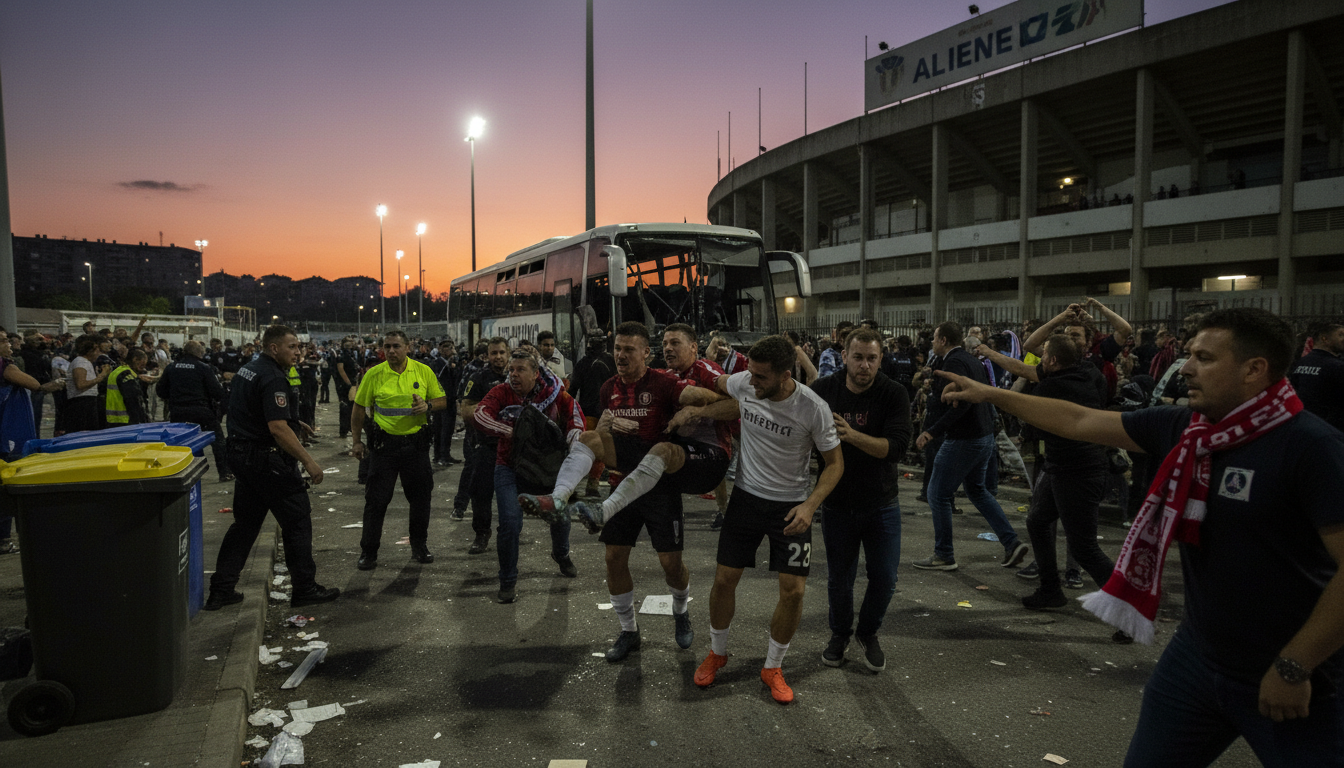
Ghana football safety under scrutiny after bus attacks and stadium violence
Attacks on team buses and stadium violence have put Ghana football safety at risk, prompting calls for mandatory police escorts, stronger penalties and reforms.


Ghana’s domestic game has been thrust into a security crisis after a string of violent incidents that have targeted players, officials and supporters. The latest reports, including armed attacks on team buses and the stabbing of Asante Kotoko supporter Francis Yaw Frimpong, have intensified concern about the safety of those who travel for and attend league matches. With stakeholders warning that the problem is systemic, the debate has shifted from isolated criminality to whether the Ghana Football Association and clubs are doing enough to protect lives. Immediate reforms are being urged to restore confidence in matchday security and safeguard the future of the league.
Armed attacks on team buses spark alarm
Teams traveling between fixtures have reported increasing exposure to ambushes and robberies, often on poorly policed highways. Several incidents in recent months involved assailants targeting buses carrying players and staff, leaving crews shaken and matches disrupted. The threat has led some clubs to alter travel schedules and avoid night journeys, but logistical constraints and fixture congestion make these stopgap measures unsustainable. Officials now face pressure to introduce consistent protective measures rather than reactive, ad-hoc responses.
Roadside attacks threaten not only team equipment and property but also the physical safety of players and staff. In one widely reported case a club bus was forced to stop after occupants fired shots into the vehicle, prompting a convoy to reroute and seek police assistance. These episodes have prompted questions about intelligence sharing between law enforcement and football authorities, and whether higher-risk fixtures receive adequate pre-emptive planning. Club managers say the unpredictability of such attacks is a primary concern for squad welfare and morale.
Travel vulnerabilities exposed across regions
Many Ghana Premier League clubs travel long distances across regions with varying levels of security capacity and infrastructure. Unlike international competitions, where coordinated state security and federations provide escorts, domestic clubs often depend on minimal or last-minute police assistance. This inconsistent protection leaves teams vulnerable during transfers, particularly late-night movements after matches. Players and staff have described journeys that feel exposed, amplifying anxiety ahead of fixtures.
Resource constraints and competing policing priorities mean that providing full security coverage for every fixture is unrealistic without new policies. Smaller clubs operating on tight budgets cannot afford private convoys, and national agencies are stretched thin. The geographic spread of Ghana’s league calendar compounds the problem, forcing teams to traverse isolated stretches of road where emergency response is slow. These factors underline the need for a league-wide approach that balances cost with practical safety outcomes.
Matchday crowd control and stadium infrastructure failings
Violence inside stadiums and at venue perimeters is another front in the safety crisis, with inadequate crowd management frequently cited as an underlying cause. Many stadia lack modern turnstiles, segregated seating, and surveillance coverage, which hampers officials’ ability to de-escalate tensions. Confrontations between rival supporters and clashes with match officials have resulted in injuries and the abandonment or postponement of matches. The absence of robust incident-reporting systems also complicates efforts to hold perpetrators accountable.
Poorly trained stewards and inconsistent policing at venues have compounded risks for spectators and participants alike. Match officials have reported being harassed and threatened, and referees’ decisions have sparked violent reactions when there is no clear crowd-control protocol. Investment in stadium upgrades, better-trained security personnel, and real-time communication systems are repeatedly recommended by safety analysts. Without infrastructural and operational upgrades, matchdays will continue to be flashpoints for disorder.
GFA response and policy gaps under scrutiny
The Ghana Football Association has announced measures intended to improve matchday safety, but critics say those steps are fragmented and lack enforcement. Public statements from the GFA have emphasized guidelines for clubs and calls for cooperation with security agencies, yet observers point to inconsistency in application across the league. Stakeholders argue that without mandatory, enforceable standards and transparent accountability mechanisms, advisories will have limited effect. Calls for a formal, written protocol that covers travel, venue security and sanctions are growing louder.
Enforcement remains a key sticking point in the debate. Clubs that fail to comply with recommended measures often face only symbolic fines or short suspensions, which do not deter repeat behavior. Some association members have acknowledged the need for a tiered system of penalties tied to severity and recurrence of breaches. Meanwhile, the lack of centralized data on incidents prevents the GFA and law enforcement from developing targeted interventions based on evidence. Comprehensive incident tracking could better inform policy and resource allocation.
Experts advocate mandatory escorts and intelligence-led planning
Security consultants and former officials propose a layered strategy that combines mandatory police escorts, improved intelligence gathering and fixture risk assessments. Under this model, fixtures flagged as high risk would receive coordinated state protection, while lower-risk matches would follow a standardized private security baseline. Intelligence-led planning would involve pre-match threat assessments, route risk mapping and liaison officers embedded with traveling parties. Proponents argue that such a framework would reduce ad-hoc decision-making and ensure resources are applied where they are most needed.
The suggestion for mandatory police escorts is politically sensitive but viewed as a practical baseline by many clubs and commentators. Implementation would require collaboration between the GFA, the Ministry of Interior and regional police commands to create clear criteria for escort deployment. Trials during peak-risk fixtures have been suggested as a way to measure effectiveness and refine protocols. If adopted, intelligence-led operations could dramatically reduce opportunistic attacks and provide teams with the confidence to travel without fear.
Club responsibility, funding shortfalls and practical steps
Club executives acknowledge that financial constraints limit their ability to invest in private security or extensive travel protections. Many teams operate on narrow budgets that prioritize player wages and facility maintenance over transport safety. Yet administrators and player unions emphasize that investing in safety is non-negotiable if the league is to remain credible and attract sponsors. Clubs are being urged to budget for basic security measures and to collaborate on pooled services that could offer economies of scale.
Practical steps clubs can take immediately include staggered departure schedules, use of larger convoys for high-risk trips, pre-arranged emergency contacts and minimum security standards for away travel. Jointly contracting licensed private security firms for multiple clubs has been proposed to lower per-club costs while improving overall protection. Investment in fan education campaigns and transparent sanctions for hooliganism would also address the supply side of matchday violence, discouraging behavior that undermines safety.
Penalties, fan education and the international reputation of Ghana football
Strict enforcement of penalties for violent conduct is seen as essential to changing behavior among supporters and club officials. Heavier sanctions for clubs whose fans engage in violence, including point deductions and stadium closures, have proved effective in other leagues when applied consistently. Equally important is a sustained campaign of fan education highlighting the consequences of hooliganism on community safety and the clubs themselves. If Ghanaese football fails to curb these trends, its international reputation and commercial prospects could suffer.
The long-term risk is material: sponsors, broadcasters and international partners may reconsider engagement with a league perceived as unsafe. This would have ripple effects on player development, club finances and the national game’s ability to nurture talent. Preventing that outcome requires both immediate policy changes and sustained cultural work aimed at rebuilding trust between clubs, fans and authorities. The stakes extend beyond individual matches to the wider health of Ghanaian football.
Ghana’s football community now faces a critical choice between incremental fixes and a comprehensive, enforced safety overhaul. Without coordinated action from the Ghana Football Association, security agencies, club owners and supporters, the dangers that have surfaced will remain. Implementing standardized travel protocols, upgrading stadium security and imposing meaningful penalties for violence can arrest the decline in safety and restore public confidence. The urgency is clear: the preservation of players’ and fans’ lives, and the future vibrancy of Ghana football, depend on reforms that are both immediate and enduring.