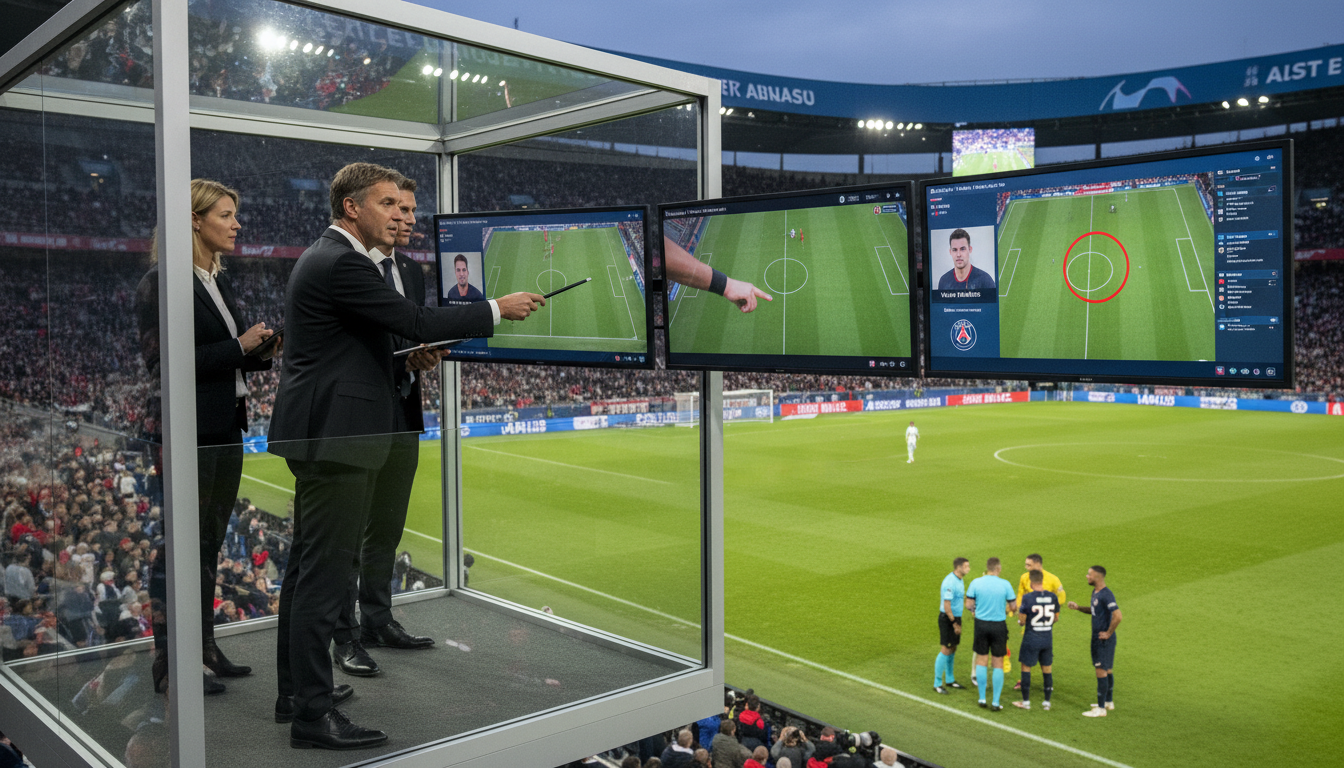
PSG handball decisions in Champions League draw fresh scrutiny after two non-calls
Analysts question two PSG handball decisions in Champions League as a potential red card for Nuno Mendes and a denied Bayern penalty prompt renewed debate over VAR and refereeing consistency.


Champions League analysts Nedum Onuoha, Guillem Balague and Stephen Warnock reviewed two separate handball incidents involving Paris Saint-Germain that were not punished during the match. The discussion centered on a challenge that raised the possibility of a red card for Nuno Mendes and a separate situation in which Bayern Munich were denied what some saw as a possible penalty. The exchanges have reignited debate about how handball is interpreted and when VAR intervention is appropriate.
Analysts identify two unpunished incidents
Champions League pundits flagged the Mendes incident and the Bayern appeal as clear examples of decisions that merited closer scrutiny. Each analyst brought a different emphasis, with some focusing on the letter of the law and others on the spirit and impact of the incidents. The joint assessment underlined how marginal calls can shape a high-stakes knockout contest, amplifying scrutiny on match officials and VAR teams.
The trio’s review was broadcast as part of routine post-match analysis, and their conversation was driven by replays and slow-motion angles. While none of the analysts claimed definitive proof that a foul had occurred, they argued that both incidents were within the range of reviewable events under current interpretations of handball and foul play. Their consensus was that the lack of on-field or VAR action left reasonable questions about consistency.
Nuno Mendes challenge and red card debate
One scene that attracted most attention involved PSG left-back Nuno Mendes, whose intervention was described by analysts as contentious and potentially deserving of a red card in certain interpretations. Critics of the non-call pointed to the proximity to goal and the timing of Mendes’s hand-to-ball contact as factors that could meet the threshold for denying an obvious goal-scoring opportunity. Supporters of the referee’s decision suggested the contact was inadvertent and occurred in a split-second situation, complicating a clear sanction.
Analysts emphasized that whether a dismissal should follow often hinges on intent, arm position and the defender’s ability to control the ball. They noted the difference between a deliberate block with the hand and a natural reaction in a crowded penalty area, and argued those nuances are exactly why VAR exists. The commentary reflected broader unease among observers about how subjective interpretations can produce divergent outcomes in similar scenarios.
Bayern penalty claim examined in detail
The second incident under scrutiny involved Bayern Munich pressing for a penalty that went unawarded after contact with a PSG player. Analysts dissected the footage to assess arm placement, proximity and whether the hand movement materially affected the ball’s trajectory. Some analysts suggested the contact looked sufficient for a penalty on first viewing, while others cautioned that replays can exaggerate perceived culpability compared with the referees’ on-field perspective.
Discussion also addressed the standard applied by VAR: clear and obvious error. Panelists questioned whether the available angles delivered the required certainty to overturn the on-field decision. The exchange highlighted how tight margins and differing camera perspectives often leave room for reasonable disagreement, even among experienced professionals.
Handball law and VAR interpretation in focus
The debate returned repeatedly to the application of the handball law and VAR protocols, with analysts calling for clearer standards that can be consistently applied. They noted that IFAB’s guidance and recent interpretations emphasize whether the hand or arm is in an unnatural position and whether the player deliberately handled the ball. However, the panel stressed that practical application hinges on split-second contexts, spatial relationships and the referee’s original view.
Analysts also discussed how VAR intervention is governed not only by the law but by procedural thresholds intended to prevent constant stoppages. That procedural filter—intended to reserve overturns for unmistakable errors—can produce outcomes that fans and pundits perceive as inconsistent. Several commentators urged UEFA to publish more transparent guidance and to explain key decisions publicly when they shape match outcomes.
Observers on the panel warned that perceptions of inconsistency can erode trust in officiating, particularly when high-profile matches are decided by a small number of interventions. They argued for enhanced referee training and a commitment to clearer public communication from governing bodies about how specific decisions are reached. The analysts suggested that improved transparency would help reconcile differing viewpoints among pundits, clubs and supporters.
Match impact and competition implications
Both unawarded incidents, analysts said, had the potential to influence the match’s flow and result by changing player behaviour and tactical decisions. A red card would have forced PSG into a defensive reshuffle and handed Bayern a numerical advantage, while a penalty decision could have shifted momentum and scoring balance. The panel described how refereeing outcomes ripple through game plans and alter the psychological state of teams during key phases.
Beyond the single match, commentators noted that disputed decisions can carry into subsequent rounds through disciplinary reviews, player suspensions or shifts in referee assignment philosophies. For clubs, the immediate concern is competitive fairness; for the competition’s governing body, the challenge is preserving credibility. The analysts urged both teams and officials to treat contentious episodes as opportunities to refine processes rather than to entrench positions.
Calls for transparency and consistent standards from UEFA
Following the analysis, there was a clear call from the panel for UEFA to provide clearer post-match explanations when contentious handball decisions affect high-profile ties. Analysts recommended publishing more detailed VAR reports or referee statements that explain why particular incidents met—or did not meet—the threshold for intervention. They argued that such disclosures would reduce speculation and help educate fans about the nuance behind complex calls.
The panel also urged ongoing referee education and scenario-based training to align on tight interpretations, particularly in the penalty area where stakes are greatest. Several contributors suggested that independent audits of high-impact VAR interventions could build public confidence. Overall, the consensus was that improved transparency and training are pragmatic steps toward reducing controversy without undermining referees’ authority.
The debate over these PSG handball decisions reflects broader tensions in modern football between technological support and human judgment. While VAR was introduced to correct clear mistakes, its operation still relies on subjective interpretation of rules and situational context. That combination will likely produce future disputes, and the conversation among analysts illustrates how stakeholders are seeking clearer, more consistent frameworks to govern those moments.
Fans, clubs and officials will watch closely for any formal explanations from competition authorities in the days after the match. Until then, the incidents examined by Nedum Onuoha, Guillem Balague and Stephen Warnock will remain case studies in how marginal calls and VAR thresholds continue to shape the narrative of the Champions League.