Salah Farewell at Anfield as Liverpool Draw 1–1 With Brentford and Robertson Also Exits
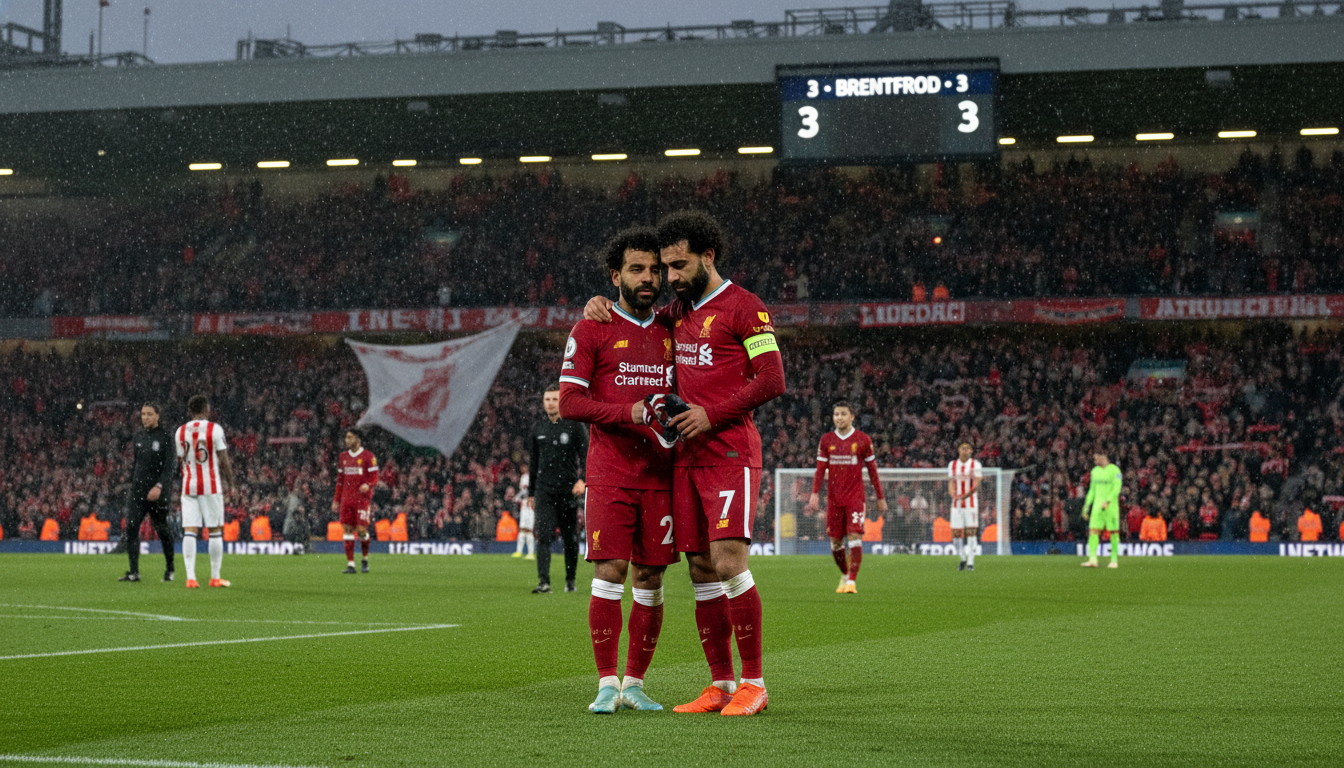
Mohamed Salah farewell at Anfield ended in a 1–1 draw with Brentford as Andy Robertson also played his final match for Liverpool, leaving the club with plaudits and unanswered questions.


Late Equaliser Denies Emotional Send-Off
Liverpool took the lead in the second half through Curtis Jones after a precise pass from Mohamed Salah, but the occasion soon lost momentum. Kevin Schade levelled for Brentford within minutes, and the final whistle confirmed a 1–1 draw that felt more like a coda than a celebration. The result extended Liverpool’s winless run in the closing fixtures of the season and denied supporters the kind of triumphant farewell they had hoped for during Salah’s farewell.
The match showcased familiar difficulties that reappeared with worrying regularity this season. Liverpool created moments of threat, including a Salah free-kick that rattled the post, yet could not convert dominance into sustained control. The game drifted in the later stages as Brentford defended with discipline and Liverpool failed to regain decisive momentum.
Fans and pundits left Anfield with mixed emotions because the evening centred on the departures rather than a dominant team display. What might have been a night of unalloyed tribute instead highlighted tactical and temperamental weaknesses that defined Liverpool’s campaign.
Salah Final Act Breaks Club Record
Mohamed Salah’s assist for Curtis Jones carried extra significance beyond the immediate goal and became a defining statistic of his Liverpool career. That final contribution was recorded as a new club landmark for Premier League assists, marking the end of an era in which Salah combined finishing with playmaking. Across nine seasons, his sustained output altered Liverpool’s attacking identity and provided a steady stream of decisive moments.
Salah leaves Anfield with a remarkable goals-and-assists ledger that underlined his importance to the club’s most successful period in recent memory. His ability to perform at a consistently high level, produce match-winning goals and create chances for teammates made him one of the most influential forwards in Liverpool history. The ovation at full time reflected recognition of both his statistical achievements and cultural impact at the club.
Even as his final season produced fewer headlines for goals, Salah’s last acts at Anfield encapsulated the dual threat he posed throughout his tenure. The assist was both a statistical milestone and a symbolic farewell, reminding supporters of how often he supplied the decisive touch.
Robertson Exit Underscores Defensive Continuity Loss
Andy Robertson’s final appearance for Liverpool closed another long chapter of consistency and durability at left-back. Over nine seasons he developed into a template for the modern full-back, offering attacking impetus, defensive stability and relentless work-rate. His partnership across the pitch helped shape Liverpool’s tactics and offered a continuity that will be hard to replicate in a single signing.
Robertson’s career totals tell part of the story, but his contribution extended into leadership and identity on the field. He was as much a cultural figure within the squad as a statistical contributor, setting standards in training and matches that influenced younger players. The farewell at Anfield acknowledged a player whose presence had become synonymous with the club’s recent peak years.
As Liverpool move into a new phase, losing Robertson alongside Salah trims two pillars from the spine of the team. The club faces the task of replacing not only minutes and assists, but also the tactical understanding and experience those players supplied season after season.
Tactical Shortcomings and Season Patterns
Sunday’s draw reiterated recurring tactical concerns that surfaced under Arne Slot during the campaign. Liverpool produced moments of high-quality possession and attacking threat but frequently struggled to impose a consistent tempo and control matches from start to finish. The inability to protect leads and to find a cutting edge against organized defenses became a defining pattern.
Slot’s side showed flashes of incisiveness, yet their cohesion often faltered at crucial moments, especially in the final third and during transitions. Defensive lapses and a drop in intensity during decisive phases allowed opponents to regroup and exploit gaps. Those problems were visible at Anfield and echoed through other fixtures that marred Liverpool’s season.
The tactical questions extend beyond a single match to the club’s broader approach to recruitment, rotation and game management. If Liverpool are to return to competing regularly for top honours, the current blueprint will need refinement to address both structural and psychological weaknesses.
Champions League Qualification and Its Context
Securing Champions League football offered a measure of relief for Liverpool, but the achievement felt more like a survival than a triumph. The fifth-place finish and points total will permit a return to Europe’s elite competition, yet it owed as much to the failings of rivals and the league’s changing allocation as to Liverpool’s own consistency. The mood in the dressing room and among supporters reflected pragmatic satisfaction rather than celebration.
Qualification buys the club breathing space in financial and sporting terms, allowing the squad to plan for the upcoming transfer window with European fixtures in mind. At the same time, the context in which that qualification was achieved places pressure on those responsible for squad construction to prioritize targeted upgrades. Reliance on past reputation will not suffice if Liverpool are to re-establish themselves at the summit of English football.
For the coaching staff, the result functions as both a safety net and a warning. Champions League status secures prestige and revenue, but it also raises expectations about how the club uses that platform to rebuild and reset in the months ahead.
Managerial Review and Recruitment Imperatives
Arne Slot will walk into a summer where scrutiny of his first season intensifies, as will the club’s recruitment and sporting directors. The draw at Anfield and the wider season’s inconsistency raise pressing questions about tactical clarity, squad depth and the balance between experience and renewal. Addressing those areas will be central to restoring competitive momentum.
Liverpool must decide whether to pursue immediate replacements who mirror the departed stars or to pivot towards a longer-term rebuild that emphasizes new profiles and flexibility. The summer window will likely prioritise forward options capable of varying the attacking approach and defensive reinforcements to restore authority in both wide and central areas. Equally, adding players with leadership attributes could help mitigate the loss of two long-serving figures.
Stakeholders will watch how the club allocates resources, structures coaching responsibilities and defines objectives for the coming seasons. The decisions made in the next transfer market and in the training ground will shape whether this campaign is viewed as a blip or the start of a longer-term transition.
Salah farewell at Anfield and Robertson’s exit crystallised a season of contrasts, with individual legacies outshining collective performance. The immediate task for Liverpool is to convert Champions League qualification into a platform for decisive change that restores consistency and ambition.
The final whistle on a 1–1 draw felt like the closing line of an era and the opening paragraph of a new chapter for Liverpool.