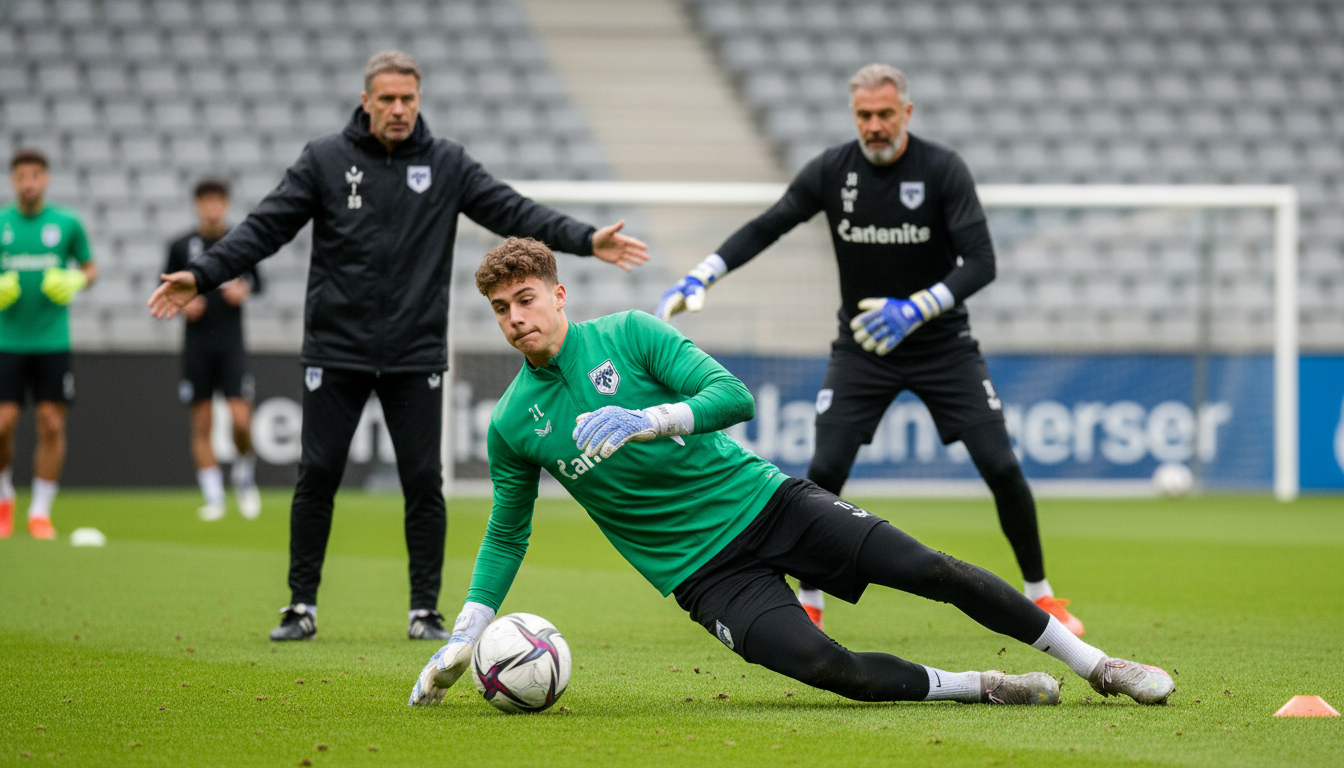
Stuttgart weigh goalkeeper options as doubts rise over Dennis Seimen’s readiness
VfB Stuttgart goalkeeper plans face fresh uncertainty as staff question Dennis Seimen’s readiness for a No.1 role in a Champions League campaign.


Dennis Seimen, long positioned as VfB Stuttgart’s likely first-choice goalkeeper for the 2026/27 campaign, is facing renewed scrutiny over his age and experience as club leaders reassess their summer plans. The 20-year-old, who has yet to feature in the Bundesliga, was earmarked to step into the starting role following Alexander Nübel’s scheduled return to his parent club. With Champions League qualification raising the stakes, Stuttgart’s coaching and sporting staff are reported to consider a more experienced short-term solution while preserving Seimen’s longer-term prospects.
Coaches and management express reservations
Members of the coaching staff and sporting leadership have flagged concerns that naming Seimen as the immediate No.1 would carry significant risk for a club preparing for European competition. Their assessment centers on Seimen’s lack of top-flight minutes and the heightened pressure of goalkeeping duties at a club playing in the Champions League.
Those doubts have prompted internal discussions about balancing competitive stability with talent development, with both the head coach and sporting directors reportedly involved in the debate. The central question for decision-makers is whether the club can afford an inexperience-related setback in a season where defensive reliability will be tested regularly.
Seimen’s development pathway and loan considerations
Seimen’s recent season on loan with Paderborn, where he played a key role in the club’s promotion via the play-off, is seen as a vital step in his development rather than a finished apprenticeship. Club officials appear to be weighing the option of allowing him to remain at Paderborn for another season to accumulate Bundesliga minutes and build experience under pressure.
A further loan would preserve Seimen’s upward trajectory while avoiding the immediate exposure of thrusting a young keeper into a high-intensity Champions League schedule. Sporting directors are therefore balancing the short-term need for experience against the long-term plan that views Seimen as Stuttgart’s eventual goalkeeper for years to come.
Immediate replacement options on Stuttgart’s radar
With Alexander Nübel set to return to Bayern Munich and the club reluctant to hand full responsibility to an untested 20-year-old, Stuttgart have identified multiple candidates who could be signed or loaned in as a bridge option. The club’s list reportedly includes domestic keepers with varying profiles — from experienced internationals to promising younger shot-stoppers already accustomed to Bundesliga football.
Two domestic options under active consideration are goalkeepers currently with other Bundesliga sides who would bring top-flight experience without blocking Seimen’s future role. The shortlist prioritizes players who can provide immediate stability, command the area, and offer leadership at the back while the club pursues its European objectives.
Bernd Leno as a pragmatic experienced fallback
Among the names mentioned as a short-term solution, Bernd Leno stands out because of his experience at club and international level and his previous affiliation with Stuttgart. At 34, Leno would represent a low-risk option: he brings years of top-tier matches and a commanding presence that could steady the defence during a demanding season.
A veteran signing such as Leno would also preserve Seimen’s development timeline by avoiding a competitive logjam for minutes. Sporting staff appear to view a short-term, experience-driven signing as an acceptable trade-off to protect the team’s immediate competitiveness and Seimen’s long-term prospects.
Young alternatives and squad succession planning
Stuttgart’s recruitment list also contains younger keepers who combine Bundesliga exposure with room to develop, providing a middle path between an experienced stopgap and promoting Seimen immediately. Names linked to the club include goalkeepers who have already featured in Germany’s top division and could adapt quickly to Stuttgart’s structures.
Selecting a younger, yet proven, goalkeeper would allow the club to remain competitive while maintaining a clear succession plan. Such a signing would likely be framed as both an immediate reinforcement and a developmental partner for Seimen to learn from in training and match preparation.
Market dynamics and transfer timing ahead of the season
The club’s final decision will be influenced by the broader summer market, player availability, and the timing of transfers at other clubs that affect goalkeeper supply. Moves elsewhere — including rival clubs signing keepers or promoting their own prospects — will shape Stuttgart’s bargaining position and urgency in the market.
Time is a significant factor: Stuttgart need clarity well before the pre-season programme begins to ensure coaching, tactical work, and goalkeeper-specific preparation are coherent. Sporting directors are therefore under pressure to conclude a plan that aligns with medical checks, registration deadlines, and the club’s European schedule.
Projected cost, contract length and the balance between a loan versus permanent deal are also central to negotiations. The club’s preference appears to be for a solution that limits long-term financial exposure while delivering immediate competence between the posts.
Stuttgart’s recruitment team will also consider how any new arrival fits socially and tactically into a defensive unit that will see increased scrutiny next season. Goalkeepers must communicate effectively with the backline and adapt quickly to the manager’s preferred style, making personality and leadership traits nearly as important as shot-stopping ability in the club’s evaluation process.
Final decisions are expected to weigh heavily on whether the club believes competition for the position will benefit Seimen’s growth or undermine his confidence. Ultimately, officials aim to field a goalkeeper who reduces error risk and helps the team compete consistently across domestic and European fixtures.
Despite the internal debate, the club’s long-term plan appears unchanged: keeping Seimen within the pathway toward becoming the eventual No.1 while minimizing short-term risk to Stuttgart’s performance. The coming weeks will be critical for resolving whether that plan proceeds via further loan experience for Seimen or the recruitment of an interim keeper to bridge the gap.