


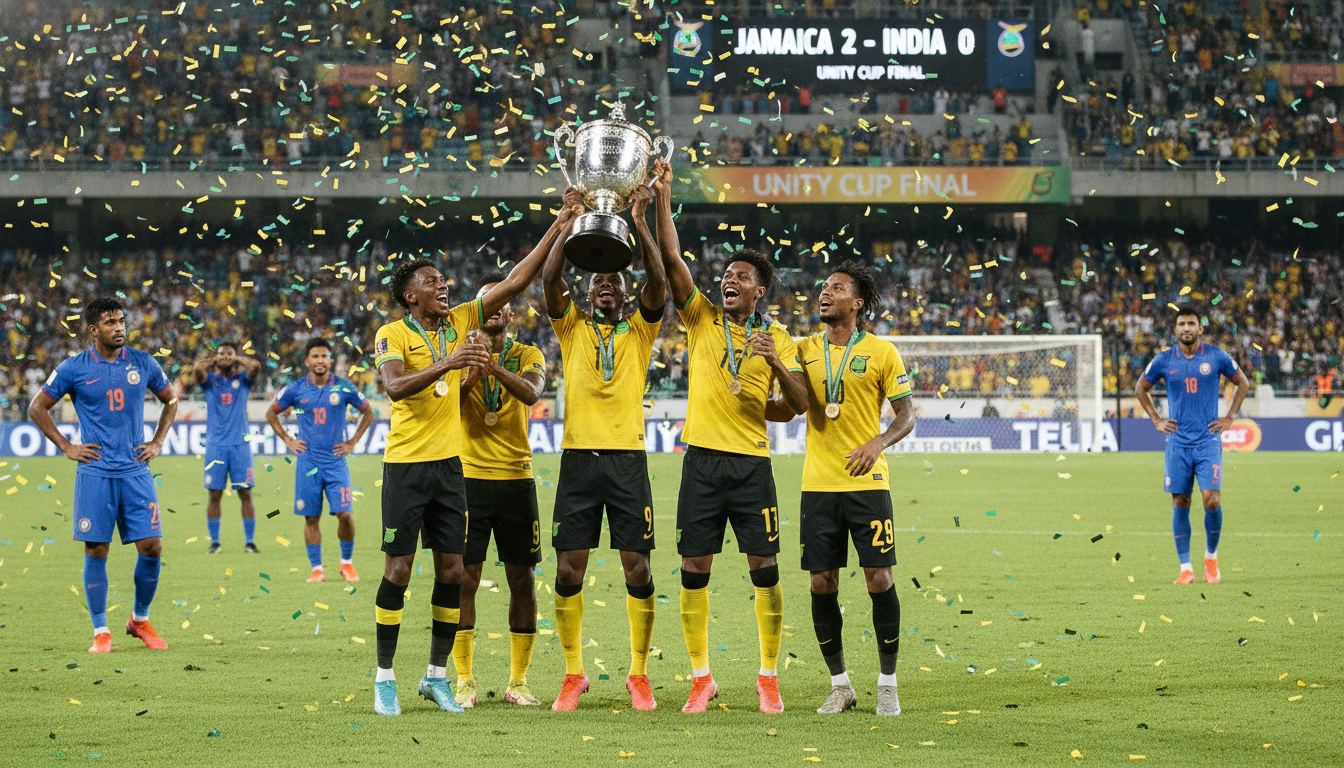
Jamaica reach Unity Cup final with composed 2-0 win over India at The Valley
Jamaica booked their place in the Unity Cup final with a composed 2-0 victory over India at The Valley, setting up a repeat of last year’s showpiece against the Super Eagles of Nigeria. The Reggae Boyz dominated large spells, converting key openings through Kaheim Dixon and Courtney Clarke as they closed out a confident performance ahead of the Unity Cup final. Jamaica’s physical approach and sharp transitions were on full display, while Nigeria’s earlier progress after a win over Zimbabwe has set up a compelling regional rematch.


Reggae Boyz secure 2-0 semifinal win at The Valley
Jamaica entered the semifinal widely regarded as favourites and produced a largely controlled performance to justify that billing. The visiting side managed the tempo, created the clearer chances and maintained composure in possession throughout the contest. Defensive organisation and quick outlets from midfield limited India’s opportunities, allowing Jamaica to press and transition effectively from defence into attack.
The final scoreline reflected more than just goals; it underlined Jamaica’s game management in pressure moments and their ability to exploit space behind the Indian backline. The Valley crowd witnessed a side that combined physicality with direct intent, rarely surrendering momentum once they asserted control in the middle third. That balance of structure and speed will be central to Jamaica’s preparation for the Unity Cup final.
Dixon and Clarke turn chances into goals
Kaheim Dixon opened the scoring after persistent Jamaican pressure created a clear opportunity inside the penalty area. Dixon’s finish provided an early foothold and forced India to open up in search of an equaliser, which in turn created more room for Jamaica to operate on the counter. The Reggae Boyz capitalised on those transitions, turning territorial advantage into decisive forward moments.
Courtney Clarke’s finish later in the game settled the contest and underscored Jamaica’s clinical edge on the night. Clarke’s strike removed any doubt about the outcome and rewarded a team that had controlled both passage and rhythm for long spells. Those two goals were the tangible rewards of an evening in which Jamaica created the better high-quality chances.
Jamaica control with pace and transition play
A defining feature of Jamaica’s performance was the level and frequency of their transitions from defence to attack. They repeatedly targeted open spaces between India’s lines, using pace in wide areas and direct passing to reach the final third. That approach tested India’s defensive organisation and created mismatches that Jamaica exploited with ruthless efficiency.
The Reggae Boyz also pressed intelligently when out of possession, forcing turnovers in midfield that quickly became counterattacking opportunities. Their collective athleticism allowed them to sustain a tempo that India struggled to match for extended periods. Those attributes make Jamaica a persistent threat in transition-heavy encounters and a difficult opponent to contain for any team in the Unity Cup.
Leon Bailey absence and squad depth tested
Jamaica arrived at the tournament without their most high-profile attacker, Leon Bailey, and his absence inevitably shifted expectations about how they would create and finish chances. Even without Bailey’s individual explosiveness, the Reggae Boyz demonstrated an ability to distribute attacking responsibility across multiple players and to find different routes to goal. That depth of options reduces predictability and makes Jamaica harder to isolate tactically.
Coaches and opponents will note that Jamaica’s forward momentum does not rely on a single outlet when Bailey is unavailable. Other attackers stepped into roles that required both chance creation and defensive work, helping the team preserve balance across all phases. The result at The Valley is a reminder that Jamaica’s collective strengths can compensate for individual absences when their tactical identity remains clear.
Super Eagles earn final spot after Azeez brace and Chelle’s experiments
Nigeria reached the Unity Cup final earlier in the week with a hard-fought win over Zimbabwe, a match defined by debutant Femi Azeez’s clinical double. Azeez’s brace delivered the result Nigeria required, even as coach Éric Chelle acknowledged the team fell short of the tactical standards he expects. Chelle’s selection policy at the tournament has included a number of debutants and fringe players, drawing from the domestic league and overseas prospects to broaden the pool.
Those experiments have allowed Chelle to assess squad depth ahead of forthcoming competitions, but they have also revealed areas requiring improvement. While the Super Eagles showed attacking potency in spells, set-piece vulnerability and transitional lapses were exposed at times. Nigeria’s pathway to the final has therefore been useful as both a confidence boost and a reminder of the work still needed to solidify defensive cohesion.
Chelle pressing for tactical discipline before the rematch
After the Zimbabwe game, Éric Chelle was blunt about his side’s inability to execute specific tactical instructions consistently, flagging problems in transitions and defensive organisation. Those observations suggest the Super Eagles will enter the Unity Cup final with a sharper emphasis on structure and urgency in training sessions. Tactical discipline, especially in moments when possession is lost, will be crucial against a Jamaican team that lives off quick counters.
Goalkeeper Arthur Okonkwo’s relatively quiet semifinal debut may not portend a similar evening in the final, given Jamaica’s preference for rapid attacks and space exploitation. Chelle will need his backline to neutralise wide runners and close passing lanes quickly to prevent the Reggae Boyz from gaining momentum. The coach’s selection choices and potential adjustments to formation will be decisive in determining whether Nigeria can blunt Jamaica’s principal threats.
Key matchups and tactical questions for the Unity Cup final
The forthcoming Unity Cup final presents several key matchups that could determine the outcome, chief among them Jamaica’s pacy wide players versus Nigeria’s full-backs and midfield transitions. If Nigeria can plug the channels and force Jamaica into longer build-up play, the Super Eagles may reduce the number of direct counterattacks they face. Conversely, if Jamaica finds the space in behind, their speed could prove the decisive factor in a match where a single breakaway can swing momentum.
Set-pieces and defensive organisation will also be central to the tactical narrative, given that close contests at tournament finals often hinge on moments from dead-ball situations. Both teams will study each other’s weaknesses from recent matches; Jamaica’s clinical finishing will be tested against Nigeria’s attempts to tighten transitional cover. Selection dilemmas for both coaches, especially in midfield and on the wings, will influence how the tactical battle unfolds.
Saturday’s final also carries extra significance beyond silverware, serving as a barometer for both nations ahead of larger international campaigns. For Jamaica, a Unity Cup title would confirm that their collective approach can deliver under pressure even without marquee names. For Nigeria, retaining the trophy would signal successful squad rotation and tactical maturation under Chelle’s stewardship.
The Unity Cup final promises a physical, fast-paced encounter that will test both teams’ defensive discipline and attacking ingenuity. With Jamaica’s transition game against Nigeria’s blend of youth and experience, the match should provide a clear measure of where each side stands as they prepare for future regional and continental commitments.
Nigeria and Jamaica will meet again on Saturday with contrasting recent tests behind them and plenty at stake beyond a single trophy. The encounter at the centre of the Unity Cup final will be watched closely for tactical adjustments, individual auditions and the resilience each team can show under pressure.