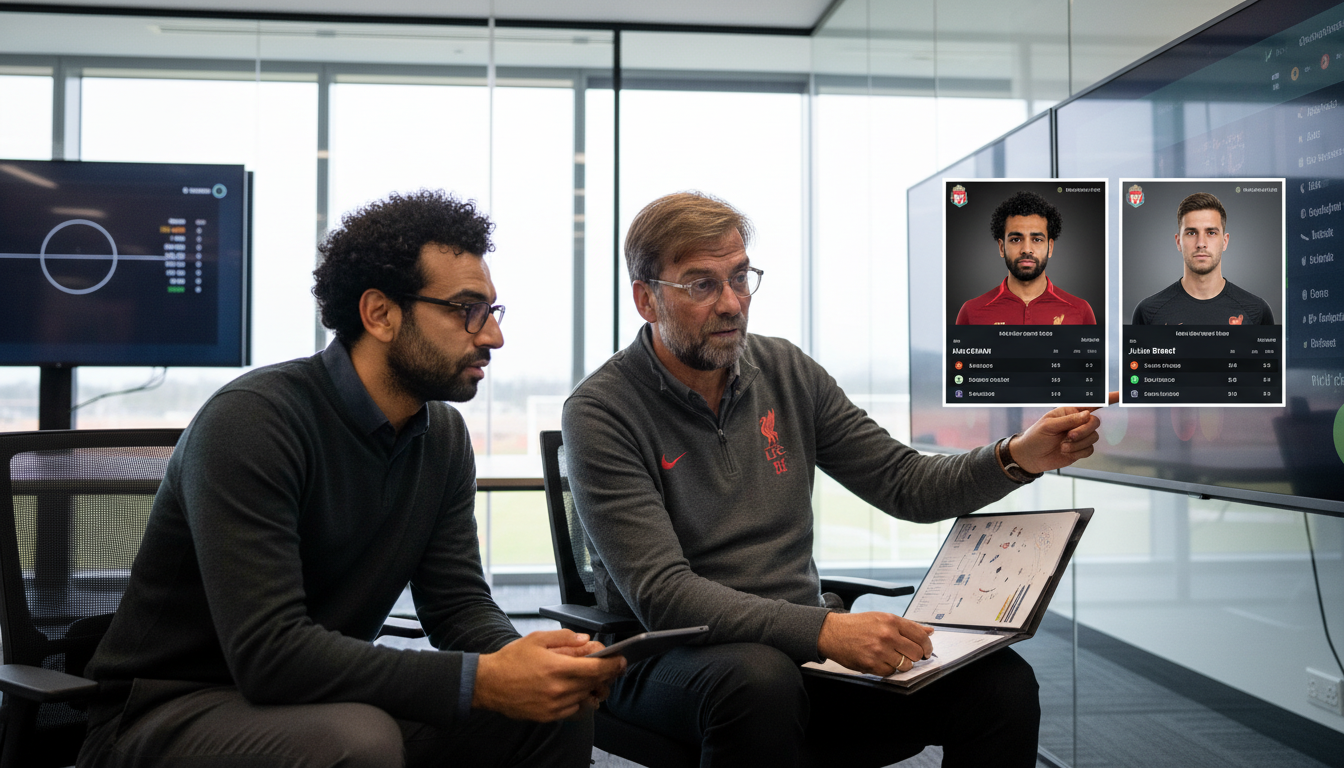
Mohamed Salah signing: How Liverpool persuaded Jurgen Klopp to pick Salah over Julian Brandt
Ian Graham reveals how Liverpool’s Mohamed Salah signing in 2017 required persuading Jurgen Klopp to pick Salah instead of Julian Brandt and proved decisive.


Liverpool’s former director of research Ian Graham has disclosed that the Mohamed Salah signing in 2017 required internal persuasion to convince Jurgen Klopp to move for the Egyptian forward rather than pursue a younger Bundesliga prospect. The revelation illuminates a pivotal recruitment debate within Liverpool’s hierarchy and offers new insight into how data, scouting and managerial preference intersected during a transfer window. The decision to back Salah has since been framed as a turning point in Liverpool’s attacking evolution under Klopp. The broader implications of that choice continue to shape how the club approaches recruitment and risk in the transfer market.
Klopp’s Initial Preference and the Scouting Debate
Jurgen Klopp, known for clear footballing instincts and a strong voice in recruitment, reportedly had early inclinations that diverged from Liverpool’s scouting department during the 2017 summer window. Sources inside the club indicate Klopp favored a different profile of attacker, one with more youth potential and longer-term resale value. That preference put the manager at gentle odds with analysts and scouts who were increasingly convinced by the short-term impact a ready-made, high-performing winger could deliver.
The tug-of-war between immediate performance and developmental upside is a familiar dynamic at elite European clubs. Liverpool’s recruitment structure at the time included a research division responsible for synthesizing statistical signals with scouting observations. Ian Graham’s account suggests that the Mohamed Salah signing emerged from a collective push by that department to present a compelling, evidence-backed case to the manager. That collaborative approach ultimately bridged the divide between data-driven recommendation and managerial conviction.
Ian Graham’s Role in Liverpool’s Recruitment Process
As director of research, Ian Graham led the unit tasked with identifying transfer targets who matched Liverpool’s tactical model and pressing style. His role combined quantitative analysis with contextual scouting to highlight players who could hit the ground running under Klopp’s system. Graham’s team prioritized players who demonstrated output in high-intensity attacking plays, transitional speed, and an ability to influence the final third consistently.
In the case of Mohamed Salah, Graham and his colleagues compiled a dossier emphasizing measurable attributes—goal involvement, chance creation, and wide-right productivity—that aligned with Liverpool’s needs. That dossier is said to have been persuasive because it presented not only raw numbers but also contextual footage and tactical fit assessments. The research unit’s influence underscores how modern recruitment blends data with human judgment to challenge and inform managerial choices.
The Choice Between Mohamed Salah and Julian Brandt
At the heart of the 2017 debate was a choice between two distinct profiles: Mohamed Salah, an established winger with proven output in Serie A, and Julian Brandt, a younger Bundesliga talent viewed as a long-term investment. Brandt’s technical qualities and versatility appealed to those seeking a player who could be developed within Klopp’s project over several seasons. Salah, by contrast, offered an immediate upgrade in goal threat and wide-play efficiency, promising instant returns on the field.
Making this choice required Liverpool to weigh short-term competitive gains against future potential and value retention. The research team’s case for Salah concentrated on immediate tactical fit and the quantifiable probability of significant goal contributions in the Premier League. That argument proved decisive: the club moved to secure Salah, concluding that his arrival would strengthen Liverpool’s attacking unit quickly and materially. The outcome reflected a calculated acceptance of immediate impact over prolonged developmental upside.
Immediate Impact Following the Mohamed Salah Signing
Mohamed Salah’s arrival in 2017 had an almost instantaneous effect on Liverpool’s attacking dynamics. He quickly adapted to the club’s high-intensity pressing and counter-attacking patterns, offering a combination of pace, directness and finishing that added a new dimension to Klopp’s front line. Salah’s goal contributions and consistency forced opposition teams to adjust their defensive structures and opened space for teammates to exploit.
The signing catalyzed a sequence of competitive improvements that extended across domestic and European campaigns. Salah’s influence on match outcomes was measurable: he became a regular marker on the scoresheet and a reliable creator in the final third. That immediate uplift validated the recruitment argument presented by Graham’s research team and demonstrated how targeted acquisitions can accelerate a club’s ambitions.
Long-term Consequences for Liverpool’s Transfer Strategy
The success of the Mohamed Salah signing reinforced a pragmatic flexibility within Liverpool’s transfer strategy, blending targeted, readiness-based signings with investments in emerging prospects. The club’s leadership appeared to take from the episode a renewed willingness to balance data-driven recommendations with managerial instincts, allowing evidence to temper preferences rather than replace them. This hybrid approach shaped later windows, where Liverpool sought players who combined tactical fit with measurable output potential.
Beyond Liverpool, the episode has wider resonance for clubs wrestling with the same trade-offs between immediate effectiveness and long-term development. The Salah decision demonstrated that a carefully argued buy—supported by research, scouting, and managerial buy-in—can deliver outsized returns. It also encouraged a culture where research teams gained greater credibility inside recruitment processes, helping to institutionalize the role of analytics in transfer decision-making.
Lessons for Clubs and Recruiters from the 2017 Decision
The internal debate that preceded Mohamed Salah’s transfer offers several practical lessons for clubs aiming to optimize recruitment outcomes. First, clarity about squad needs is essential: identifying whether a club needs instant impact or developmental potential frames the evaluation criteria. Second, integration between scouting, analytics and managerial staff minimizes friction and creates a unified assessment of a target’s fit. Third, communicating findings with tactical examples, statistical evidence and risk assessments improves the likelihood that recommendations will be adopted.
For recruiters, the episode highlights the importance of framing. Presenting a player like Salah required situating his numbers within the tactical reality of Liverpool’s system and projecting how his attributes would translate to the Premier League. That blend of evidence and narrative helped persuade stakeholders who might otherwise defer to different priorities. The process underscores that recruitment is as much about storytelling as it is about data.
Liverpool’s decision to prioritize Salah also speaks to appetite for calculated risk. Opting for a player expected to perform immediately invited scrutiny about potential resale value and longevity, but the club judged that competitive gains were worth that risk. The subsequent years offered validation for that calculus, providing a case study in how short-term ambition and long-term planning can coexist within a coherent recruitment philosophy.
Salah’s trajectory at Liverpool has since been used as a reference point in talks about transfer market efficiency and valuation. Clubs comparing potential targets now often ask whether a player can produce immediate, tangible improvements in results or whether they represent a developmental prospect whose returns are distant and uncertain. The 2017 choice therefore reshaped internal metrics of success and influenced how future targets were prioritized.
The practical outcome of that era was not merely trophies or goals but a shift in organizational confidence. Liverpool’s recruitment apparatus grew more assertive, willing to advocate for players who matched immediate tactical needs even when managerial preferences leaned elsewhere. That balance of conviction and evidence became a template for subsequent windows, with the club continuing to refine how it evaluates and presents targets.
Ultimately, Ian Graham’s account provides a window into the complex machinery behind a single transfer that had outsized consequences. It reveals how data, scouting and managerial judgment can collide and then coalesce into a decision that reshapes a team’s competitive trajectory. The Mohamed Salah signing in 2017 stands as a clear example of how careful alignment across recruitment stakeholders can deliver transformative results on the pitch.
The debate between Salah and Brandt in 2017 remains instructive for clubs, analysts and managers who must reconcile different timelines and objectives in transfer policy. It demonstrates that rigorous research can persuade even the most influential coaches when framed to address immediate tactical questions. Above all, the outcome confirms that recruitment decisions are rarely binary; they are the product of negotiation, evidence and an appetite for the risks associated with winning now.