Germany vs Finland: Nagelsmann Names Surprise Lineup as Germany Test Options in Mainz Friendly
Germany vs Finland friendly in Mainz sees Nagelsmann hand Nathaniel Brown a rare start as Musiala, Wirtz and Undav lead the hosts in a World Cup tune-up.


Confirmed lineups and formations
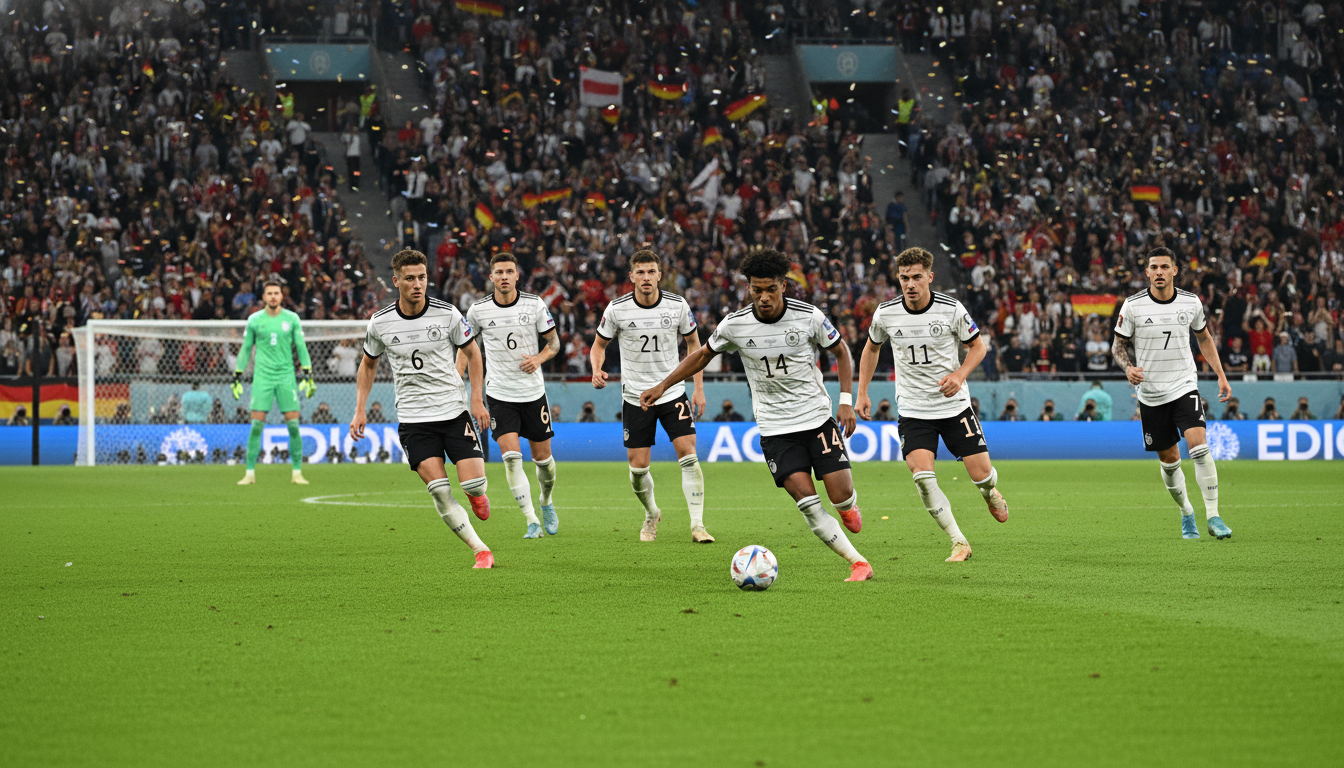
Germany are set up in a 4-2-3-1 for the friendly in Mainz, with Baumann in goal and a back four that includes Kimmich, Tah, Schlotterbeck and Nathaniel Brown.
The midfield pairing is listed with Pavlović alongside another holding role, while Lennart Karl, Jamal Musiala and Florian Wirtz occupy the attacking three ahead of Deniz Undav.
Finland line up in a 3-5-2 shape with Lukas Hradecky in goal and a back three of Alho, Koski and Miettinen, supported by a dense midfield of Mahuta, Suhonen, Marhiev, Walta and Lod.
Nagelsmann’s surprise selection: Brown handed rare start
Julian Nagelsmann’s team sheet contains one headline choice in full-back Nathaniel Brown, who earns a rare start for the hosts.
Brown’s inclusion at right-back represents a look at depth on the flank as Germany accelerate preparations for the 2026 World Cup, and it gives the coaching staff a chance to evaluate his crossing, defensive shape and composure under pressure.
The rest of the selection blends established internationals with creative youth, a pattern Nagelsmann has followed across recent friendlies to balance results with longer-term assessment.
Tactical setup: Germany’s 4-2-3-1 explained
Deploying a 4-2-3-1 allows Germany to press in two distinct phases: the front four can squeeze possession high while the double pivot provides cover for transitional moments.
Musiala, Wirtz and Karl form a flexible attacking three tasked with interchanging positions, creating overloads on the flanks and offering through-ball angles for Deniz Undav to run onto.
The configuration also offers a platform for Kimmich and Pavlović to manage tempo; the central pair must read Finnish switches, overturn second balls and recycle possession quickly to keep the German press effective.
Finland’s 3-5-2: compact defence and wing-back workrate
Finland’s 3-5-2 is designed to protect the central areas against Germany’s creative trio while relying on wing-backs to supply width on the break.
The three centre-backs will be asked to maintain a compact line and react to Undav’s movement, while Mahuta and Suhonen provide midfield steel and vertical runs to contest second balls.
Up front, Källman and Keskinen will look to exploit any gaps left by overlapping full-backs, making Finland’s transitions a key test for Germany’s midfield coordination.
Attack combinations and who must deliver for Germany
Germany will depend on the understanding between Musiala, Wirtz and Karl to unlock a packed Finnish defence and to provide the link-up play for Undav.
Musiala’s dribbling and ability to carry the ball into attacking pockets should create space, while Wirtz’s late runs and Karl’s width can stretch opponents and open central lanes.
Undav’s role as the focal forward is to hold up play, bring others into the game and finish chances created from the flanks and through central combinations.
What this friendly reveals about World Cup preparations
With the 2026 World Cup cycle approaching, this friendly operates as both a match and a large-scale rehearsal for tactical symmetry, squad rotation and player fitness.
Nagelsmann appears to be probing options across the spine of the team and on the wings, using the fixture to identify which combinations can be scaled up against higher-quality opponents.
The inclusion of fringe or less experienced players in competitive minutes will feed into selection debates heading into major tournament qualifiers and the final World Cup roster planning.
Set-piece duties and defensive responsibilities under scrutiny
Set-pieces are likely to be a decisive factor in a fixture where open-play chances can be limited by compact defensive schemes.
Germany’s aerial threat from centre-backs and runners arriving late will be tested against Finland’s organized marking, while Finland will look to capitalise on any lapses from German wide defensive positions.
How both sides assign zonal or man-marking responsibilities for corners and free-kicks will offer insights into coaching priorities and player discipline under match conditions.
Coaching decisions and in-game management to watch
Substitution patterns will be revealing: whether Nagelsmann opts for youth injections, defensive reinforcement or increased tempo in the final third will signal his short-term priorities.
Finland’s bench options and their timing may indicate how the visitors plan to handle a high-possession opponent and whether they will preserve a compact shape or chase a more expansive approach late in the match.
How both managers respond to tactical shifts during the game will be a small-scale trial of in-game management that could matter heavily in tournament scenarios.
Fitness, minutes and the management of player workloads
This friendly allows coaching staff to manage minutes carefully, especially for players carrying minor knocks or returning to full fitness after club seasons.
Balancing competitive exposure with recovery is a central theme this week, as teams aim to avoid unnecessary risks while still gleaning meaningful data from live opposition.
Individual workload monitoring during and after the match will influence selection windows in the weeks to come and inform decisions on international availability.
Broadcast, timing and local context in Mainz
The match kicks off at 20:45 CET in Mainz, providing German supporters with an evening fixture that doubles as a preparatory exercise ahead of more consequential tests.
Staging the friendly at a domestically central venue gives Nagelsmann a familiar setting in which to trial combinations while maintaining a supportive atmosphere for squad assessment.
Attendance patterns and the crowd’s response to experimental selections will offer an immediate barometer for public sentiment as the national team builds toward the World Cup.
Germany’s starting XI and Finland’s formation in Mainz deliver more than a single result; they provide a snapshot of selection thinking and tactical intent as both nations continue their competitive cycles.
The contest will highlight how Germany integrate younger attacking talent around an experienced spine, and how Finland deploy compactness and counter-structure to stifle creative opponents.
Coaches, analysts and supporters will be watching for both immediate outcomes and longer-term implications as the two teams use this international friendly to sharpen ideas ahead of the months ahead.