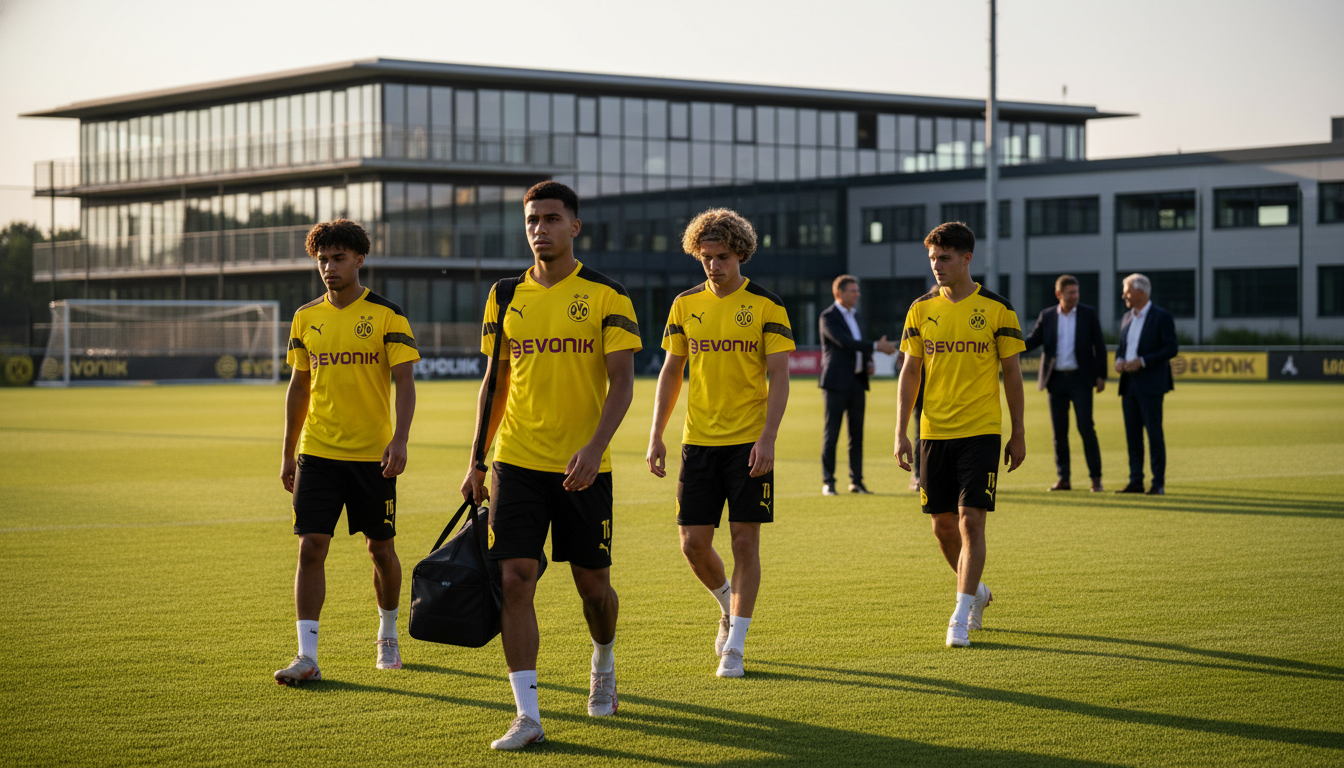
Borussia Dortmund youth departures: Four young players set to leave the club this summer
Borussia Dortmund youth departures are set to reshape the club’s academy output as the Bundesliga side prepares to move four promising youngsters this summer, according to Kicker. The list of players expected to depart includes Kjell Wätjen, Cole Campbell, Julien Duranville and Diant Ramaj, with Dortmund reportedly planning buy-back clauses on any exits.


Club confirms summer exits for four prospects
Borussia Dortmund have cleared a pathway for several academy graduates to leave the club during the upcoming transfer window. The departures reflect a targeted reshuffle under the club’s new sporting leadership and are intended to balance playing opportunities with long-term asset management.
Dortmund’s leadership has indicated that these moves are not blanket sell-offs but part of a broader strategy to manage squad depth while continuing to recruit young talent. The club also intends to retain contractual levers, including buy-back options, to protect future interests.
The decision to move multiple young players simultaneously signals a decisive pivot in roster planning rather than isolated transactions. Sources within the club point to a careful evaluation of each player’s immediate prospects at the senior level.
Player-by-player status and likely destinations
Kjell Wätjen, 20, finished the 2025/26 season on loan at Bochum in the 2. Bundesliga and is expected to seek a permanent home where he can secure regular first-team minutes. His loan spell offered valuable senior experience, but Dortmund appear ready to allow him to pursue a clearer pathway elsewhere.
Cole Campbell, also 20, spent the season on loan at Hoffenheim and there is growing belief that a permanent transfer to Sinsheim could be completed. Hoffenheim’s recent return to European competition has increased the club’s appeal, and Campbell’s loan performances reportedly impressed enough for Hoffenheim to push for a deal.
Julien Duranville, 20, has been offered to RC Strasbourg as Dortmund explore options to give the Belgian forward a stable platform to develop. His skill set attracted interest, but Dortmund see regular playing time at a different club as a preferable next step for his growth.
Diant Ramaj, 24, emerged as Heidenheim’s first-choice goalkeeper for much of the season and played in all but three Bundesliga fixtures, but he could not prevent the team’s relegation to the second tier. Dortmund view a move for Ramaj as beneficial both for the player’s development and to keep their goalkeeping options flexible.
Incoming youth signings already shaping the squad
While orchestrating departures, Dortmund have not paused their recruitment of young talent. The club has announced the signing of French defender Joane Gadou, 19, from RB Salzburg, a move intended to bolster the left side of their defensive unit in coming seasons.
Gadou will arrive alongside previously secured prospects Kauã Prates, 18, and Justin Lerma, 18, who are expected to reinforce the club’s long-term development pipeline. These incoming players underline Dortmund’s continued commitment to renewing their academy and transfer model with teenage prospects.
Dortmund are also actively pursuing 16-year-old Kennet Eichhorn from Hertha Berlin as part of their strategy to secure elite talent at the earliest stages. The potential acquisition of Eichhorn reflects a broader emphasis on recruiting players with high ceilings and integrating them gradually into the club’s framework.
The simultaneous outflow and inflow of young players indicate a recalibration rather than a retreat from Dortmund’s renowned youth-first approach. New arrivals are likely to be given time to adapt within a structure redesigned by the club’s sporting leadership.
Strategic direction under sporting director Ole Book
Since the appointment of sporting director Ole Book, Dortmund’s transfer activity has acquired a clearer, more systematic flavour. Book has prioritized precise, age-focused signings while placing a premium on strategic exits to maintain squad balance and fiscal prudence.
The approach appears to center on ensuring that each young player either has a realistic route into Dortmund’s first team or is positioned to leave with future buying options preserved. That dual track—development at the club versus outside growth with buy-back protections—signals a pragmatic evolution in policy.
Under Book, Dortmund have sought to synchronize recruitment with longer-term squad needs rather than reactive market moves. The club’s willingness to include buy-back clauses reflects a desire to retain upside while enabling players to mature competitively elsewhere.
This model also allows Dortmund to capitalize on the financial value of academy graduates while maintaining the option to re-sign them should they flourish. It is a method designed to mitigate the perennial risk that promising youngsters stagnate on the fringes of a top-level squad.
Contract mechanics and buy-back clauses explained
Dortmund plan to include buy-back clauses in any permanent transfer of their young players, a contractual mechanism increasingly common among elite clubs. These clauses permit the selling club to re-acquire a player at a pre-agreed price or under specified conditions, safeguarding future options.
Buy-back terms can vary significantly in length and financial structure, and Dortmund will likely tailor each clause to the player’s age, potential, and the receiving club’s stature. Such agreements give Dortmund both financial security and strategic control over a player’s medium-term trajectory.
From the player’s perspective, a move with a buy-back clause offers regular playing time while keeping the door open for a return if development progresses quickly. For receiving clubs, these deals require negotiating a balance between investment in the player and the acceptance of eventual uncertainty.
The inclusion of buy-back options also aligns with Dortmund’s wider commercial and sporting calculus, enabling them to monetize talent without permanently severing ties with prospects who may later reach elite status.
Competitive and developmental implications for Dortmund
The wave of proposed departures will test Dortmund’s ability to convert recruitment into consistent squad upgrades. Allowing multiple young players to leave concurrently raises questions about depth, particularly across positions where academy graduates have historically stepped into senior roles.
However, Dortmund’s incoming class and the club’s ongoing scouting network may offset short-term gaps if new signings adapt quickly. The long-term plan appears to prioritize sustainable progression over forcing fringe players into limited roles at the expense of their careers.
For the players involved, permanent moves could offer the playing time necessary to establish themselves at senior level. In many cases, regular minutes at other Bundesliga or European clubs can accelerate development more effectively than sporadic appearances at a club competing on multiple fronts.
The strategy also signals to the wider football market that Dortmund values both development and shrewd asset management. If managed successfully, the club could emerge with a refreshed squad, a healthier financial position, and the retained option to reclaim polished talents.
Reactions from clubs and marketplace context
Domestic and continental clubs are watching Dortmund’s movements closely, potentially viewing the availability of academy-trained players as attractive recruitment opportunities. Hoffenheim’s interest in Cole Campbell and Strasbourg’s reported consideration of Julien Duranville reflect the cross-border appetite for age-profiled talent.
Clubs aiming to blend youth with immediate competitiveness see Dortmund’s outgoing players as viable additions. The marketplace context—particularly the premium on young players with top-level training—likely informed Dortmund’s insistence on buy-back protections.
For the receiving clubs, securing young players from a club with Dortmund’s reputation can be both a sporting coup and a commercial prospect. Their ability to offer first-team football will be decisive in concluding deals during the summer window.
As the transfer market unfolds, Dortmund’s mix of departures and signings will be measured against both sporting outcomes and the efficacy of their development model under the new sporting director.
Dortmund will now enter a critical summer where talent management decisions carry immediate competitive consequences. The club’s handling of these exits, the terms negotiated, and the integration of incoming youth will define their squad composition for the coming seasons.
Ultimately, the Borussia Dortmund youth departures this summer represent a calculated reshaping of the club’s development pipeline rather than a retreat from its academy philosophy. The next months will reveal whether the balance of exits, buy-back safeguards, and targeted signings yields the on-field stability and long-term upside the club seeks.